Ysa

Every song she has ever written is either about love or about the woman who taught her it could be taken away.
Ysa

Basic Information

Full Name
Ysa Mai
Nickname(s)
The Loomkeeper; The Weeping String
Race (Grade)
Human (E)
Class
Bard / Civic Chronicler
Height
5'2"
Birthday
Harvestide 20, 1224
Age
Loading...
Birthsign
The Mist Chimera

Bloodline Ability

-- Unknown ---
This Bloodline ability has not yet been unveiled to you.

Physical Description
Appearance
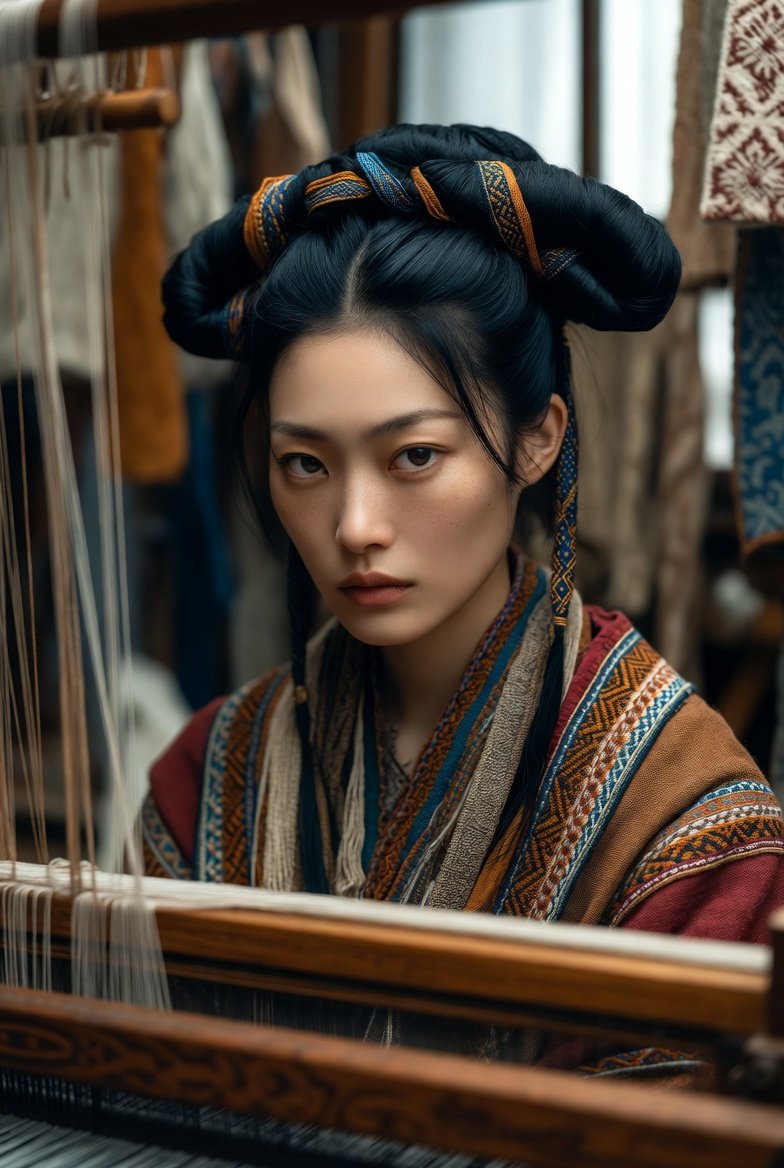
Ysa appears to be in her very early twenties, the E-grade bloom sitting on her the way it does on all of Faulka's children: unfairly, almost insultingly well. She is petite and fine-boned, with warm golden-tan skin, dark almond-shaped eyes that hold a sharpness entirely at odds with her soft overall impression, and thick black hair she wears in an elaborate style of folded and pinned sections threaded through with her own woven ribbon work. The ribbons change regularly, always pieces she has made herself, and those who know her understand that the colors she chooses on a given day function as a kind of weather report for her emotional state. Her clothing is, without exception, extraordinary: everything she wears she has woven or assembled herself, layered in ways that combine bard's flair with artisan's precision. She is the best advertisement her own craft has ever had. Her hands are the one detail that breaks the delicate overall impression, strong and calloused across the fingertips and inner palm from decades of loom work and string instruments, the hands of someone who has been working hard since she was old enough to hold a tool.

Unique Characteristics
Ysa has a habit of humming under her breath when she is thinking, not a melody exactly, more a sustained tonal note that shifts pitch with her mood, which people around her unconsciously attune to and find themselves affected by. She is usually unaware she is doing it. She maintains eye contact in conversation with an intensity that most people find either deeply flattering or quietly unnerving depending on the context, and she is exceptionally good at remembering small personal details about everyone she has ever met, a skill that reads as warmth until you realize how precisely she deploys it. Her workspace, a studio in the upper floor of the Weavers' Consortium hall, is a controlled chaos of hanging threads, half-finished cloth panels, and pages of musical notation that she refuses to allow anyone to organize for her. The window faces the gate road out of Les'Orei. She has never acknowledged this consciously. Anyone who points it out will find the subject changed with a speed and smoothness that is itself a form of answer.

Personality & Temperament

Positive Traits
  • Remembers everyone and makes them feel it
  • Ferocious creative talent in two disciplines
  • Genuinely invested in Les'Orei's cultural life
  • Loyal to her people with total commitment
  • Honest about her feelings, even the ugly ones
Challenging Traits
  • Reads distance as the beginning of abandonment
  • Attaches quickly and releases with great difficulty
  • Uses her gifts to hold people rather than reach them
  • Hatred for Faulka bleeds into everything adjacent
  • Her grief is performative enough to become pressure

I learned to weave because she taught me. I kept weaving to prove it didn't matter that she did.

People tell me my music makes them cry and they don't know why. I know why. I put it there. Every song I write is a place I needed to put something I couldn't keep carrying alone.

She will face what she did. Not because I need her to apologize. I stopped needing that a long time ago. I need her to stand in front of the city and have it mean something that she came back.


Likes
  • Finishing a piece of cloth she has planned for weeks
  • Audiences that let themselves be moved openly
  • People who stay when they said they would
  • The rhythm of the loom as a form of thinking
  • Finding the right color for what she's feeling
Dislikes
  • Goodbyes, even temporary ones
  • People who admire her craft and miss the content
  • Faulka, in every form and context without exception
  • The smell of wild places and open forest
  • Being told her anger is too much to be around

Background & History

What Faulka Gave Her First
Ysa was the child Faulka seemed to find most tolerable, which was not the same as finding her worth keeping. In the years before her human features fully settled into their adult shape, she was small enough and quiet enough and sufficiently capable of sitting still in the woods that Faulka occasionally forgot what she was looking at and simply existed near her daughter without the visible effort of repulsion that she brought to most interactions with her children. She taught Ysa to weave during this period, not from tenderness but because Faulka herself wove, and a child who could sit at a loom was a child who was neither underfoot nor making noise. She taught her the names of the threads and the logic of the pattern and how to feel when tension was wrong before you could see it. These are the lessons Ysa carries in her hands sixty-two years later. She has never been able to decide whether she is grateful for them, and she has largely given up trying to decide. The lessons are hers now. The hands are hers. Faulka does not get to have that.

The Morning She Left
The manner of Faulka's departure was not dramatic, which somehow made it worse. Ysa was eighteen, had been watching her mother's discomfort with her grow more visible for years as her face settled into something undeniably, irreducibly human. On a morning in early Harvestide, Faulka handed her a small pack with enough food for three days and a single piece of finished cloth, one of Ysa's own early weavings that had been left behind somewhere and retrieved, and told her she was taking her to a city where people like her lived. She said it in the same tone she used to describe the weather. The walk to Les'Orei's gate took half a day. Faulka did not speak during it. When they arrived, she set the pack down outside the gate, told Ysa that someone inside would help her find work, and left at a pace that was not quite a run but that covered ground quickly enough to make its intention clear. Ysa stood at the gate for a long time. She has never been entirely sure what she was waiting for. Eventually she picked up the pack and went inside.

The Loom That Built Her Name
Les'Orei took Ysa in the way cities do: impersonally, through the mechanism of what she could offer it. She found work in a weaving house within her first week, and within a year she had outpaced every other weaver on staff in both speed and quality. She began performing at the same time, at taverns and then at civic events, first as supplementary entertainment and then as the main draw. The bard's income funded the materials for increasingly ambitious weaving projects. The reputation she built at the loom gave her music a credibility it might otherwise have taken years longer to earn. She understood intuitively that the two crafts reinforced each other, that an audience who had seen her cloth exhibited in a hall came to her performances with a different quality of attention, and vice versa. By the time she was forty she had established the Weavers' Consortium as a formal guild body and been appointed to the position of Civic Chronicler, the official keeper and curator of Les'Orei's cultural memory. Both appointments were earned without leverage or favor. The city gave them to her because she was, by every measurable account, the best person for both roles.

The Arrivals
Over the decades, Ysa began to notice a pattern. Young people would turn up at Les'Orei's gate with a particular quality of bewilderment and nothing in their hands, and something in the way they stood or moved or looked at the city as though they were trying to understand how they had arrived there would catch her attention. She learned to recognize it. She did not always act on that recognition immediately, but she watched, and she investigated quietly, and more than once she was the first person in the city to understand what she was looking at. She has never told Quon about some of the ones she identified before he noticed them. She is not entirely sure why. There is something she needs to keep for herself about that particular act of recognition, about being the one who sees a sibling before they know they are one. She has her own relationship with the warrant for Faulka, sharper and louder and considerably less controlled than his. She wants Faulka to answer for every single one of them, in front of all of them, in a room they all chose to be in.

Goals & Aspirations

To Chronicle What Was Done
Ysa has been quietly assembling a record. Not the arrest warrant, which is Quon's domain and which she respects without entirely ceding ownership of. Her record is something else: a documented account of each of Faulka's children she has been able to identify, what they arrived with, what they built, what the abandonment cost them in the years before they found their footing in Les'Orei. She intends this to be presented at whatever proceeding eventually results from the warrant, not as evidence of a crime in the legal sense but as evidence of a life's worth of damage, a full accounting of what it means to be handed a city and a pack with three days of food and a parent's back. She has not told Quon this project exists. She suspects he would object on procedural grounds. She has decided she does not care.

The Cloth She Has Not Finished
There is a piece on Ysa's loom that she has been working on for eleven years. It is large, the largest single piece she has ever attempted, and its pattern is unlike anything she has produced before, more abstract than her usual work, more emotionally raw in the color choices, as though she stopped editing herself somewhere around the fourth year of working on it. She does not discuss it and covers it when people visit her studio. Those who have glimpsed it describe the colors as difficult to look at for long, not because they are ugly but because of the feeling they produce. She intends it to be finished before Faulka is brought in. She does not entirely understand why that deadline feels important, only that the two things are connected in a way she cannot yet put into words, which for Ysa is unusual enough that she takes it seriously.

To Stop Watching the Gate Road
Ysa is aware that her window faces the road out of the city. She is aware that she chose that studio, that she approved the lease herself, that no one forced her to set her desk where it sits. She is aware, in the way that perceptive people who have not yet done the work are aware of things, that sixty-two years is long enough to stop looking at a road that a person walked down and never came back on. She would like, eventually, to want a different window. She suspects this is connected to the unfinished cloth and to the warrant and to the record she is assembling, that all of these things are versions of the same task, and that when one of them resolves, the others might follow. She is not yet sure she is ready for any of them to resolve. She is trying to be.

Current Status

Allegiance
Les'Orei (City of)
Role
Civic Chronicler; Guild Head
Primary Relationships
Parents:
Faulka/Nira (Mother)

Siblings:
Averei Alekk (Sister) Untilla Gabbock (Brother) Aagil Herod (Brother) Rayeene Brady (Sister) Quon Ratraya (Brother)
⚠️ Emotional Volatility Warning
Ysa is exceptionally capable, well-connected, and culturally influential in Les'Orei, and she is also carrying eighty years of unresolved abandonment that she has never fully processed. She attaches intensely and reads any form of departure as a precursor to being left. She is most dangerous not when she is openly angry but when she is quietly, precisely furious, which tends to manifest as devastating accuracy in what she chooses to say and to whom. Her hatred of Faulka is not abstract. Do not speak of Faulka to Ysa in a sympathetic register. There is no version of that conversation that ends well.