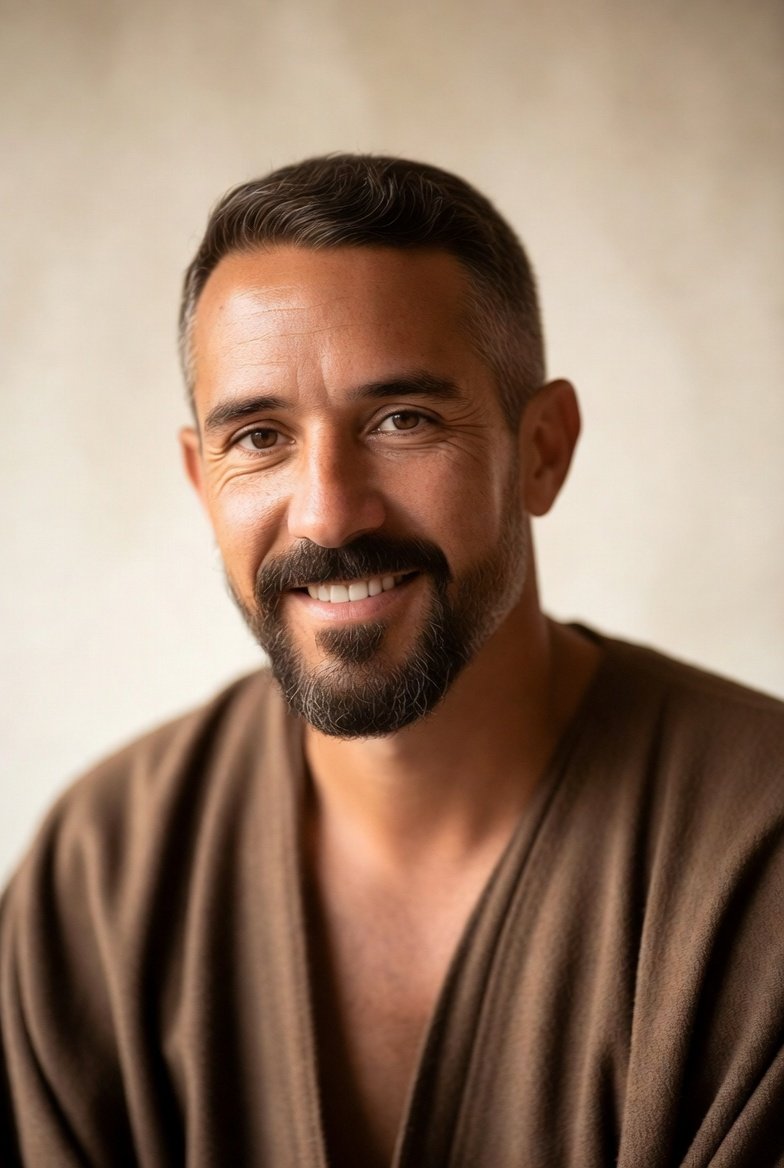
From Fisher's Son to Priest of the Dusk Lord
Samael MacAodh was born in the small coastal village of Greenbrook, where his parents worked as simple fisherfolk who noticed their son's unusual interest in spiritual matters and encouraged him to pursue knowledge beyond their humble means. From a young age, he found himself drawn to the village's small shrine, helping local druids and absorbing every fragment of wisdom they offered. As he grew, his thirst for spiritual understanding led him to a monastery dedicated to the Dusk Lord, where he immersed himself in religious studies, spending countless hours studying ancient texts and engaging in philosophical discussions with fellow acolytes. The teachings about balance between light and darkness resonated deeply with him, particularly the idea that even in the darkest times, hope remains like the last rays of sunlight at dusk. After years of study, he felt called to bring these teachings to those in need, traveling from village to village as a preacher before eventually settling in Hedgewick, where he established a small church and became an integral part of the community.
The Sana Incident and Shattered Faith
The foundation of Samael's faith crumbled when he witnessed a young girl named Sana, who had suffered unspeakable abuse in Hedgewick, transform into a monstrous tree creature that went on a rampage. He had prayed desperately to the Dusk Lord for intervention, for guidance, for any sign that the deity he had devoted his life to would prevent such tragedy. When his prayers went unanswered and the Dusk Lord allowed this horror to unfold without intervention, something fundamental broke inside Samael. The girl's transformation was not her fault, she was a victim who became a monster because of what had been done to her, and the god Samael served had done nothing to protect her from that abuse or to prevent the violence that followed. This theological crisis was compounded when Hedgewick itself was later destroyed, burned to ashes by Hotaru in retaliation for the cruel abuse Sana had endured there. Samael returned to find nothing but ruins and smoke, every person he had ministered to, every soul he had counseled, simply gone. With his faith shattered and his purpose destroyed, he wandered to Oraeus where he lived homeless on the streets, questioning everything he had once believed and spiraling into deep depression.
The Gift That Saved a Life
At his lowest point, when Samael was seriously considering ending his own life out of despair and self-pity, Hotaru found him and offered him a Potomi fruit, an incredibly precious gift that the kobold could have used for many other purposes. This selfless act from someone who had every reason to be hardened by the world's cruelties became a defining moment in Samael's life, forcing him to realize that meaning and purpose did not have to come from the gods he had served but could be found in the simple act of one person helping another. The fruit restored not just his physical health but gave him the will to continue living, to find a new purpose that did not depend on divine favor or religious doctrine. Hotaru's gift demonstrated that practical compassion, the act of using real resources to address real problems, accomplished more than all the prayers Samael had ever offered. This realization planted the seed for what would become his new direction in life, though it would take time for him to fully understand what that direction should be.
The Alchemy Years
Following his rescue from despair, Samael took up residence with Arties and her companions at the Geodegazer Estate, spending his days telling stories to Goodberry residents and trying to work out what to do with his second chance at life. He set out on a journey through Uir, Stoneharbor and Er'Amon, looking not for spiritual enlightenment but for practical ways to help people that did not depend on a god answering. Along the way he fell hard for alchemy. It promised everything prayer had not: careful study, measurable results, and medicines anyone could make with the right recipe. He came home to Goodberry with a crate of glassware and a head full of formulas, set up a small workshop he called "Old Sams," and threw himself into it with all the devotion he had once given the Dusk Lord.
Nothing Ever Worked
None of it worked. Not once. His tinctures separated, his salves went rancid, his purifying draughts came out cloudier than the water that went in, and his one attempt at a healing potion took the eyebrows off a very understanding customer. He filled journal after journal with careful notes on failures he could never quite explain, and the people who stopped by the workshop almost never left with anything from his shelves. They kept stopping by anyway. They came for the tea he always had on, and for the man who would set down whatever was smoking to listen to them talk about their troubles. It took Samael longer than it should have to notice that this was the only thing in the workshop that was actually helping anyone. When he finally did, he boxed up the glassware, fed the journals to the stove and closed Old Sams for good, with surprisingly little regret. Some people still call him "Father Samael" out of habit, but he has come to prefer "Old Sam," a name that reflects who he is now rather than who he used to be.
Keeping the Lantern Lit
With the workshop closed, Samael went looking for the work he had really been doing all along. On Goldenleaf 4, 1306, he went to
Hana and asked for a chance to help at the
Lantern Haven, the crisis house
Arties founded on Market Street. He started with the kettle and the night shift, sitting up with whoever could not sleep. When Hana later stepped back from running it day to day to train for her place among the Heaven's Chosen, Samael took it over, and he has run it for Arties ever since. A man who once sat with the frightened and the dying in Hedgewick, and who knows exactly what the bottom looks like from the inside, turned out to be just the person to have at the door when someone comes in with nowhere else to turn. He has never been happier, and he says so, often.