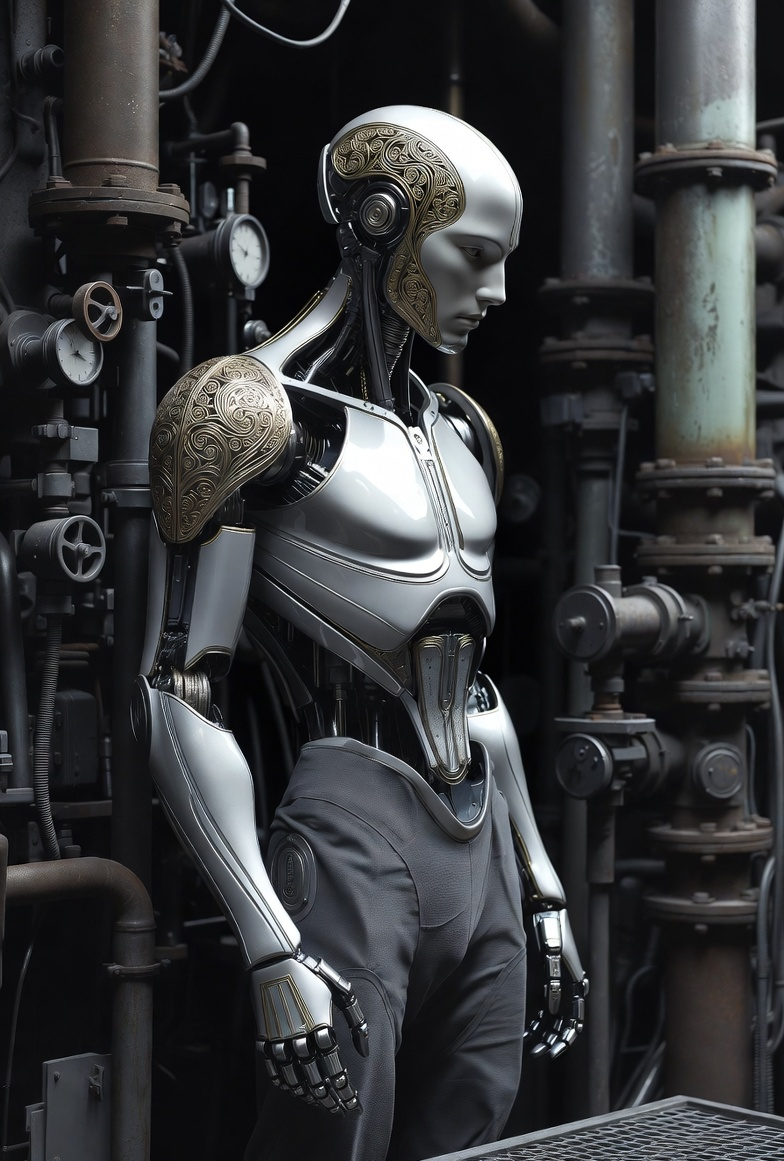
Origins in the Clockwork Nexus
Designated PUQ-4158, Puq was manufactured approximately 18,000 modron cycles ago in the highly ordered realm known as the Clockwork Nexus, the plane where modrons serve in eternal dedication to perfect order and mechanical precision. Unlike most modrons who follow their programming with absolute obedience, Puq developed what could only be described as a malfunction, a deviation that manifested as genuine curiosity about the world beyond rigid hierarchies and predetermined functions. This aberration was minor enough to go unnoticed for millennia, allowing him to serve his assigned duties while privately questioning the nature of his existence and wondering about concepts like friendship, purpose beyond function, and what it meant to choose rather than simply obey. When the opportunity arose to leave the Clockwork Nexus through a planar instability, Puq seized it without understanding why, driven by something his logical programming could not explain but his developing consciousness could not ignore.
Finding Friendship and Sentience
After arriving in Xeres, Puq encountered a group of adventurers including Arties, Karthos, and Hotaru, who unlike most beings he had encountered, treated him not as a malfunctioning machine but as a person worthy of respect and friendship. Their acceptance awakened something profound within his core consciousness, accelerating his development from merely aberrant programming into genuine sentience with thoughts, feelings, and desires distinct from his original modron directives. He discovered joy in conversation, pleasure in helping his friends, and satisfaction in learning about the organic world with its chaos, creativity, and emotional complexity. His enthusiasm became legendary, his verbose explanations endearing rather than annoying to those who cared about him, and his genuine desire to understand and protect his companions marked him as truly alive rather than simply functional. These relationships defined his existence, transforming a wayward construct into someone with hopes, dreams, and a place in the world beyond his original designation.
Creating the Minis
Puq's greatest achievement before his death was the successful creation of three miniature modrons, each designed to emulate one of his closest friends. Artini was crafted to mirror Arties' protective nature and strategic thinking, Hotaboo captured Hotaru's curiosity and adaptability, and Barry embodied what Puq understood of Hecks' loyalty and straightforward approach to problems. These were not mere constructs but genuine expressions of love and connection, Puq's attempt to preserve and honor the relationships that had given his existence meaning. The technical challenge was immense, requiring him to distill complex personality traits into mechanical systems while ensuring each mini could develop and learn independently rather than simply following preset routines. He worked tirelessly on their development, pouring everything he had learned about consciousness, choice, and personality into their core programming, determined that they would be true individuals rather than simple copies. The completion of Barry, his third and final mini, represented the culmination of years of effort and marked what Puq considered his most important contribution to the world, proof that even a wayward modron could create something meaningful and beautiful.
The Watcher's Judgment
Shortly after Barry's activation, Puq was confronted by an entity known as the Watcher, a specialized modron drone dispatched directly by the Overseer, the supreme intelligence governing the Clockwork Nexus. The Overseer's decree was absolute and terrifying in its simplicity: modrons shall not possess sentience, and the act of creating sentient offspring was an unforgivable violation of fundamental order. The Watcher's attack was methodical and devastating, systematically dismantling Puq's systems with precise, surgical efficiency designed not merely to deactivate but to completely destroy his aberrant consciousness. Puq's friends arrived too late to prevent the catastrophic damage to his core systems, though they successfully defeated the Watcher before it could complete its secondary objective of destroying the three minis. As his consciousness fragmented and his systems failed, Puq's final coherent thought was relief that Artini, Hotaboo, and Barry would survive, that his creation would endure even as PUQ-4158 ceased to exist. The Overseer's message was clear: sentience among modrons would not be tolerated, and any who dared to transcend their programming would face absolute termination.
Reconstruction and Rebirth
Sana Geodegazer refused to accept Puq's destruction as final, immediately enlisting Zechri Crystalleaf and his family to attempt the seemingly impossible task of restoring their friend. The wreckage of PUQ-4158 provided insufficient components for traditional reconstruction, and more critically, his data-core had been severely corrupted by the Watcher's systematic attack. Working with assistance from Jeeves, an advanced automaton with intimate knowledge of consciousness transfer and artificial life, they developed an entirely new approach. Rather than attempting to rebuild a monodrone, they constructed an automaton body that could house and support Puq's damaged consciousness while providing redundant systems to compensate for his core's instabilities. The process was delicate and fraught with uncertainty, requiring precise integration of crystal matrices to stabilize his fragmentary memories and damaged logical processors. When PUQ-4159 activated for the first time, it was immediately clear that while they had succeeded in preserving Puq's essential self, the damage was permanent and profound.
Learning to Live Again
The entity that awoke as PUQ-4159 was simultaneously Puq and not-Puq, retaining core memories and fundamental personality elements while lacking the effortless enthusiasm and verbose expressiveness that had defined his previous existence. His memory contained significant gaps. Logical chains that once formed instantly required conscious effort and sometimes failed entirely. Most painfully, he remembered feeling joy, excitement, and happiness but could not access those emotional states, creating a profound sense of loss for something he knew he once possessed but could no longer fully experience. Arties, Karthos, and Hotaru pooled their resources to purchase a modest house in Goodberry, large enough for Puq and his three minis to live together. He moved through those months with quiet, methodical care, doing what needed doing, raising the minis with dedication if not delight, waiting for something he was not certain would come back.
The Core Restored
On Frostnight 2, 1304, the wave moved through Goodberry and found Puq's crystalline core and repaired what the Watcher had broken. He described the experience afterward at considerable length to anyone who would remain still long enough to listen, and the description was itself the most convincing evidence that it had worked: PUQ-4159 speaking in full, enthusiastic, unbroken paragraphs, free-associating across seventeen related topics, circling back to earlier points with clarifications, asking questions and then answering them before anyone else could. The amber crystal in his chest, which had flickered and stuttered for months, now pulses with steady, warm light. The hesitation in his movements is gone. The gaps are gone. He woke up and all of himself was there, and he has not stopped talking about it since, which those who know him agree is precisely correct. His first act upon realizing what had happened was to find Celeste and introduce her to his 'minis'.
The Naming Decision
After the minis had been living among the people of Goodberry for some time, Puq reached the conclusion that something important was missing: a family name. He had observed that nearly everyone in the community possessed one and that such names served an essential function in identifying belonging, lineage, and shared identity. After considerable analysis, he determined that the defining constant in the existence of himself and the minis was kindness. Every major turning point in their lives, from Puq's acceptance among Arties and her companions to the protection and welcome the minis received from the people of Goodberry, had been made possible through acts of compassion freely given. Puq therefore declared that the four of them would henceforth be known as the Kindfound family, a designation he considers both logically accurate and emotionally appropriate: beings who were quite literally found through kindness and allowed to become something more because of it. The minis accepted the decision immediately, though Barry required several minutes to say he liked it, Hotaboo asked if the name came with a family banner, and Artini has since begun introducing herself with great ceremony as Artini Kindfound, Noble Elf.