Description
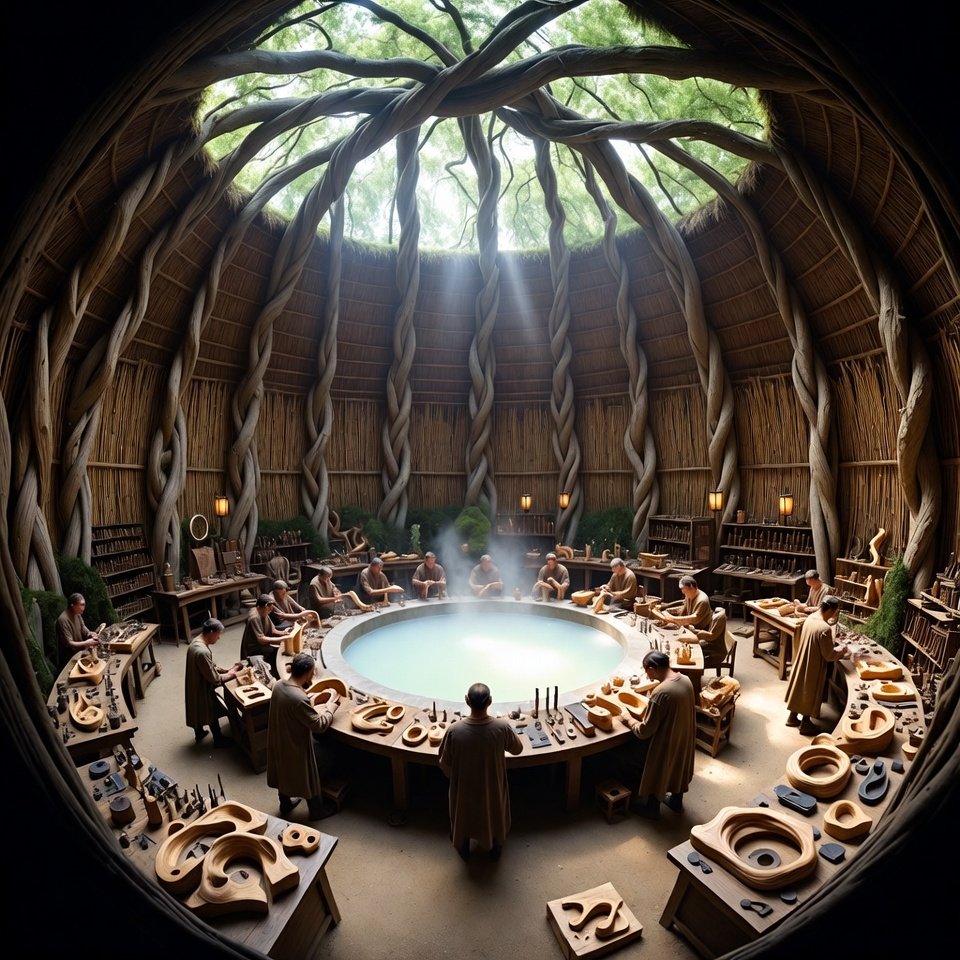
The Shapewood Forge resides within a dome-shaped structure formed by twelve ancient ash trees that have been coaxed into growing in a perfect circle, their uppermost branches braided together to create a living framework. Between these living pillars, walls of woven willow wands fill the gaps, replaceable panels that allow the workshop to be opened wide during pleasant weather or sealed tight during storms. The roof is thatched with layers of bark from naturally shed birch trees, overlapping in precise patterns that shed water while allowing smoke from the central hearth to escape through a clever arrangement of adjustable vents. Sunlight filters through gaps in the canopy, creating pools of illumination that shift throughout the day, while at night, lanterns filled with glowing moss-light provide steady illumination for craftspeople working on detailed projects.
The heart of the forge is not a traditional fire but rather a broad, shallow basin hewn from a single piece of white granite carried up from the Crystal Streams. This basin, nearly eight feet across and two feet deep, holds what the craftspeople call the Softening Bath, an alchemical preparation that represents generations of druidic experimentation. The bath consists of heated water infused with extracts from the sap of awakened willows, oils pressed from the seeds of certain rare ferns, mineral salts dissolved from specific clay deposits found deep in Mossglow Hollow, and the rendered essences of fungi that grow only on wood in advanced stages of decay. When wood is submerged in this mixture and the temperature maintained at precisely the right warmth through carefully banked coals beneath the granite basin, the cellular structure of the timber temporarily loosens, becoming pliable without losing its fundamental integrity.
The transformation is remarkable to witness. A stout oak branch that would normally require hours of laborious carving can be pulled from the Softening Bath after only twenty minutes and shaped with bare hands like potter's clay. The wood retains its grain and color but yields to pressure, can be stretched thin or compressed thick, twisted into spirals or bent into impossible curves. Craftspeople work quickly once the wood emerges, their hands protected by gloves made from the tanned hides of animals that died naturally, shaping the malleable timber over forms and molds, or simply sculpting it freehand like clay. The wood remains workable for approximately one hour after removal from the bath, gradually firming as it cools and dries, before finally returning to its normal hardness over the course of six to eight hours.
Surrounding the central basin are numerous workstations, each equipped for different aspects of the shaping process. Racks hold hundreds of wooden forms and molds, from simple curves to complex geometric patterns, all carved from dense hardwoods that resist the effects of the Softening Bath. Tables topped with smooth slate provide surfaces for rolling, pressing, and manipulating wood while it remains pliable. A collection of specialized tools hangs on the walls, including wooden rolling pins, smoothing paddles, texture stamps carved with intricate patterns, and joining jigs that hold multiple pieces in position while they cure together into seamless wholes. One corner of the workshop contains a smaller preparation area where raw timber is cut to appropriate sizes, stripped of bark if necessary, and inspected for flaws before being committed to the bath.
The facility allows for the creation of wooden objects that would be impossible or extraordinarily difficult through conventional woodworking. Bowls can be formed from single pieces of wood with walls of perfectly even thickness and no visible seams. Furniture can incorporate flowing, organic curves that appear to have grown naturally rather than being assembled. Decorative items feature impossible geometries, wood bent back upon itself or woven like fabric. Musical instruments gain bodies shaped for optimal acoustics without compromising structural integrity. The technique even allows for the creation of wooden hinges and joints that move smoothly despite being carved from a single piece of timber. Each finished piece, once fully cured, is as strong and durable as any conventionally worked wood, but bears the unmistakable mark of having been shaped rather than carved, its surfaces flowing and continuous rather than faceted by blade work.
Benefits
The Shapewood Forge now allows the creation of E-Grade wooden items with complex curves, seamless construction, and forms impossible to achieve through traditional woodworking. The facility can produce specialized wooden goods worth 2,000 gold per month through commissions for unique furniture, decorative items, musical instruments, and architectural elements. Any Craft (woodworking) checks made within the forge gain a +4 bonus due to the malleability of materials. This structure generates 7 Prestige.