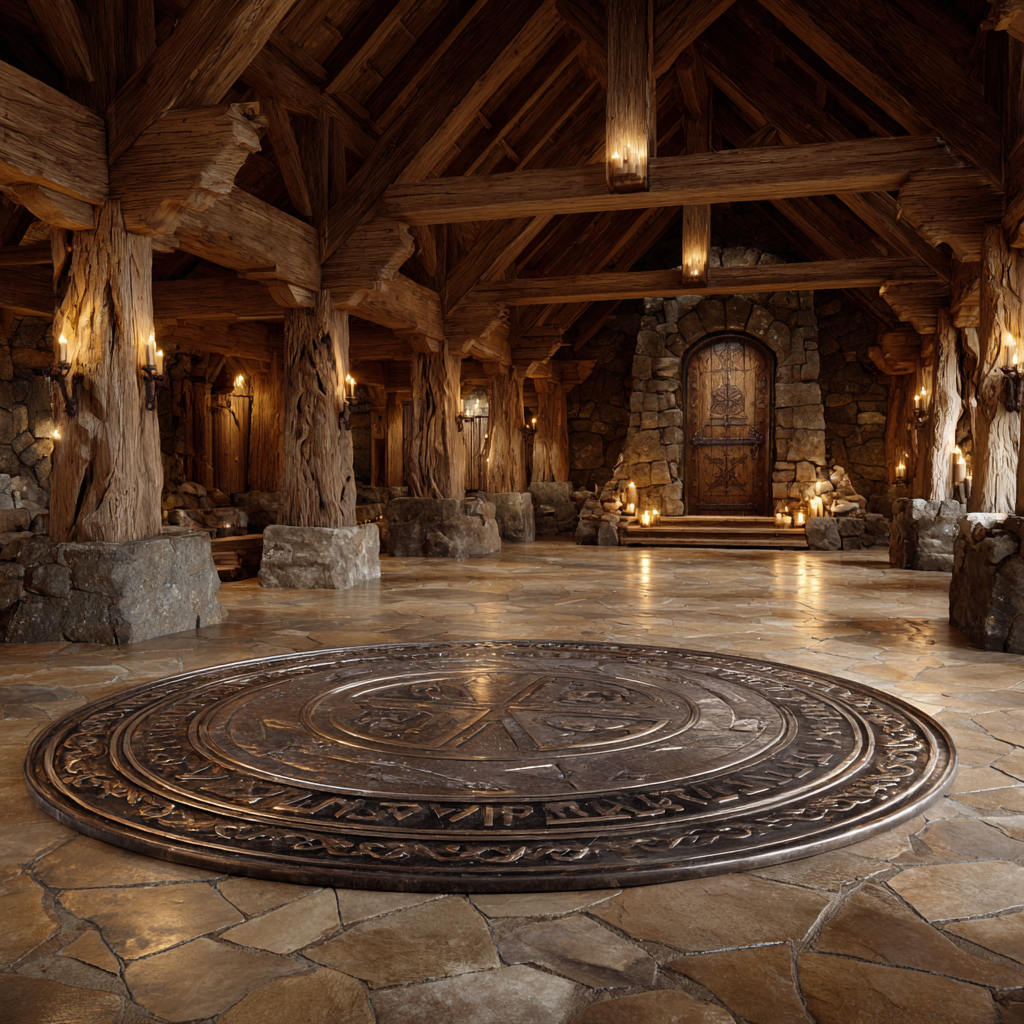
Description
The Ironwood Workshop stands in a grove of ancient oaks near the settlement's center, housed within a substantial timber-framed building that showcases the very material it produces. The structure's support beams, crossbraces, and joinery are all fashioned from gleaming ironwood, their surfaces polished to reveal wood grain that seems to shimmer with an inner metallic luster. The building is rectangular and spacious, measuring roughly forty feet by sixty feet, with high ceilings that allow for the manipulation of long timber pieces. Large sliding doors on both ends permit entry of whole logs, while wide windows along the sides flood the interior with natural light necessary for examining wood grain and checking enchantment quality. The exterior walls feature intricate carved panels depicting the transformation process, showing ordinary trees being blessed by druidic magic and emerging as something stronger and more enduring. A small spire rises from the center of the roof, topped with a living oak sapling that grows in a large planter, its roots fed by rainwater collected from the roof and its presence serving as a constant reminder that even transformed wood retains its connection to the living forest.
The transformation process begins in the preparation chamber, where raw timber from the Lumber Yard is carefully inspected and selected. Only the finest pieces qualify for ironwood conversion, as the magical process amplifies both the strengths and flaws of the base material. Knots, splits, rot, or irregular grain patterns all become magnified when the wood transitions to its hardened state, so selection is rigorous and exacting. Chosen pieces are planed smooth and shaped to near-final dimensions before enchantment, as working ironwood after transformation requires specialized tools and considerable effort. The wood is then ritually cleansed in a shallow stone basin filled with water drawn from the Crystal Streams and infused with crushed oak leaves, willow bark, and powdered heartwood from trees that died of natural old age. This cleansing removes any lingering negativity or spiritual contamination that might interfere with the transformation magic. After cleansing, the wood is arranged in the transformation circle, a permanent magical diagram carved into the workshop's stone floor and inlaid with silver wire that gleams when active.
The actual transformation requires a team of three druids working in concert, channeling nature magic through carefully choreographed rituals that compress decades of natural hardening and petrification into a single intensive working session lasting four to six hours. The lead druid stands at the circle's northern point, calling upon the ancient strength of elder trees and the endurance of stone. The eastern druid channels the resilience of living wood, ensuring the material retains flexibility and resistance to shattering despite its increased hardness. The western druid maintains the wood's connection to its living origins, preventing it from becoming truly dead and inert. As the ritual progresses, the wood begins to change visibly. Its color deepens and takes on a subtle metallic sheen, ranging from dark bronze for oak to silvery-gray for ash, golden-brown for maple, or deep charcoal for walnut. The grain becomes more pronounced and appears to shimmer with inner light. Most dramatically, the wood's density increases dramatically while its weight remains relatively unchanged, creating material that is simultaneously lighter than steel yet nearly as strong. The dimensional magic of Goodberry's bubble accelerates what would normally be an eight-hour ritual down to just over an hour and a half, though the druids must still maintain perfect concentration and coordination throughout.
Post-transformation processing occupies the workshop's southern half, where transformed ironwood receives final shaping, finishing, and quality inspection. Specialized tools made from earlier batches of ironwood are required to work the material effectively, as ordinary woodworking implements simply cannot cut or shape it. Ironwood planes, chisels, and saws line the walls, each one a masterwork in its own right and treated with the reverence due to tools that enable their own creation. Craftspeople work the hardened wood with techniques borrowed from both woodworking and metalsmithing, using draw knives to shape curves, files to refine edges, and buffing wheels to achieve mirror-smooth finishes. The workshop produces a wide variety of items: structural beams for buildings that will never rot or warp, tool handles that will never break, weapon shafts that combine wooden flexibility with steel-like striking power, armor plates that weigh half what metal equivalents would, shield cores that can turn aside sword strikes, and specialty items like lockboxes, door reinforcements, and siege equipment components. Each piece is carefully inspected for flaws, tested for proper transformation, and marked with the workshop's stamp, a stylized oak leaf within a circle, before being released for use or sale.
The workshop maintains extensive records of every transformation, documenting which wood species perform best for different applications, which ritual variations produce superior results, and which artisans have mastered working with the material. A small library occupies one corner, containing treatises on wood magic, metallurgical comparisons, structural engineering principles adapted for ironwood construction, and detailed specifications for ironwood items commissioned by various clients. The head druid maintains a personal grimoire containing refinements to the transformation ritual developed through years of practice, including variations for creating ironwood with specific properties like enhanced fire resistance, improved weather tolerance, or specialized coloration. Training new druids and craftspeople in ironwood production takes years, as the work demands both magical aptitude and exceptional craftsmanship. Apprentices begin by observing transformations, progress to assisting with ritual components, and eventually lead their own transformations under supervision. Master craftspeople similarly train journeymen in the specialized techniques needed to work the hardened wood, passing down knowledge that combines ancient woodworking traditions with innovations unique to this remarkable material.
Benefits
The Ironwood Workshop produces ironwood material every month, which can be crafted into various items or sold as raw material, generating 500 gold monthly in raw material sales while still being able to retain significant quantities for their own construction and crafting needs. Ironwood possesses hardness 10 (equivalent to iron) while weighing only 60% as much as comparable steel items, making it ideal for weapons, armor, shields, and structural components. Any weapon crafted from ironwood gains a +1 bonus to damage rolls due to the material's superior density and edge retention (this enhancement is nonmagical and does not stack with magical bonuses). Ironwood armor provides the same AC bonus as steel equivalents but with no armor check penalty reduction for weight, effectively making it lighter and more comfortable. Items crafted from ironwood never rust, rot, or decay from natural causes, and repairs to ironwood structures cost 50% less than equivalent wooden structures due to the material's exceptional durability. This upgrade generates 10 Prestige, representing the settlement's mastery of one of druidic crafting's most impressive achievements and its independence from metal-based metallurgy.