Description
The argument about what to call it lasted longer than the construction. The Vaitafe elders had a perfectly clear understanding of what Karthos was building: a whare for his toa, his warriors, a place of training and counsel and the keeping of oaths. That was an ancient and honorable concept and they had words for it. Karthos's non-tribal paladins — the ones who had arrived from cities and ordered institutions and hierarchies with charters and written codes — had an equally clear understanding: this was a guild hall for a military order, which also had a specific shape and a specific set of requirements. Both groups were right. The building that resulted does not compromise between those two visions. It holds both of them at full strength, and the tension between them has, over time, become one of the more productive features of the order it houses.
From the outside, there is no ambiguity about what the building is. It is the largest structure in the settlement after the Wharenui, built on a raised stone and packed-earth platform that elevates it slightly above the surrounding ground — a deliberate choice that gives it the visual authority of a place where significant things are decided. The walls are heavy timber, sealed against the salt wind with rendered oil and finished with wide exterior carvings that run the full height of the building at each corner. These corner carvings depict figures in full warrior's stance, weapons raised not in aggression but in guard — the posture of someone standing between their people and whatever is coming. The Vaitafe carvers who shaped them were given no brief beyond that description and produced something that Karthos's city-born knights, when they first arrived and saw the figures, went quiet in front of for a long moment before they said anything. The central door is wide enough for two people to walk through side by side in full armor, and the lintel above it is carved with a single line of text in the common tongue: The oath was made before witnesses. The witnesses remember. Below that, in a second line, the same sentiment in the Vaitafe tongue. Karthos wrote both himself.
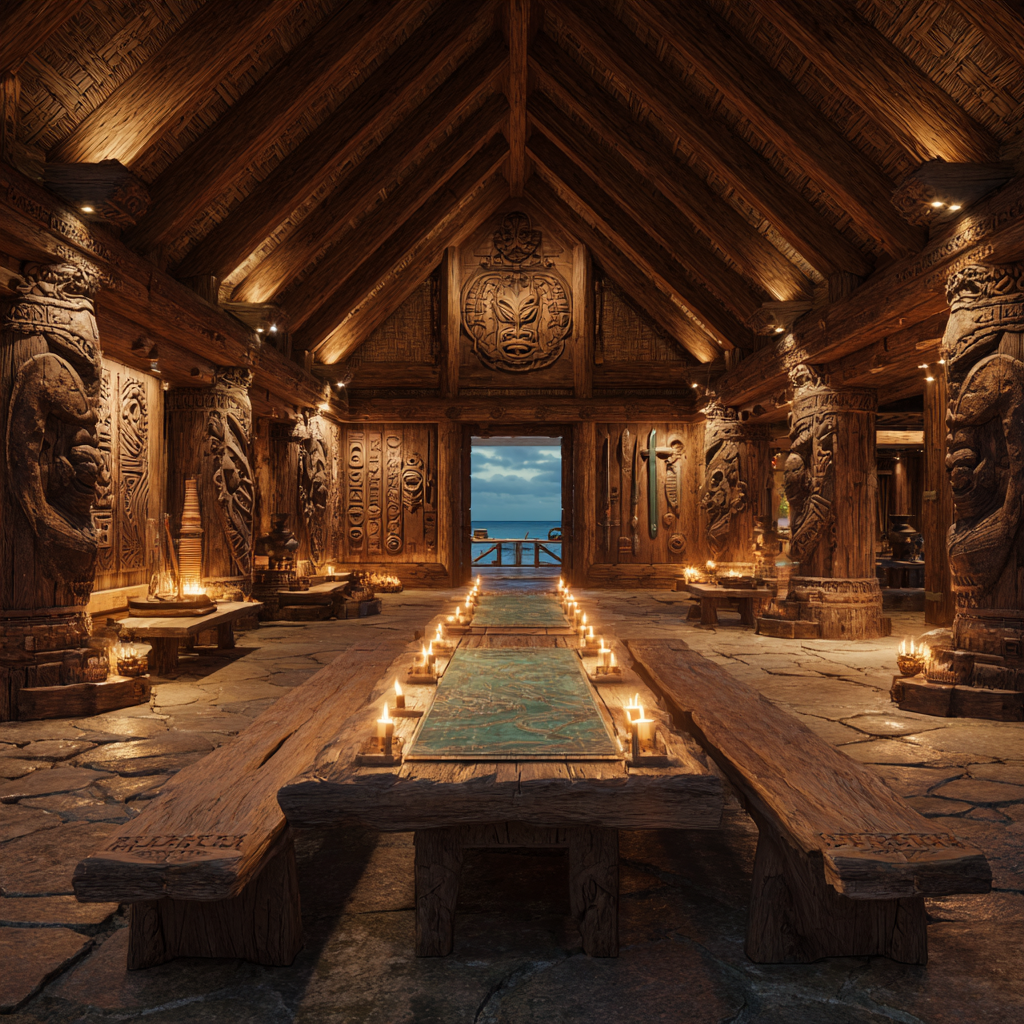
The interior divides naturally into three zones, though no wall separates them — the flow between them is open, which was a deliberate architectural choice reflecting Karthos's own conviction that an order cannot function if its sacred space, its working space, and its fighting space are sealed off from one another. The front third of the hall is the Oath Chamber: a broad, high-ceilinged room where new members are received and where the order conducts its formal proceedings. The floor here is smooth-fitted stone, salvaged and hauled at considerable effort from the coastal rock formations east of the settlement. Stone does not move when you kneel on it. It does not give. The elders said this was correct for a room where promises are made. Along the walls hang the weapons and shields of every member who has sworn the order's oath, each one mounted above a carved panel recording the member's name, their home, and the date they knelt on the stone floor. The panels of members who have died in service are set at eye level. The panels of living members are set higher, above them, as if the dead are holding the living up. This arrangement was proposed by one of the Vaitafe warriors who joined the order in its first year, and Karthos accepted it immediately.
The middle third is the Working Hall: long tables of heavy driftwood plank, benches, map racks along one wall, a message board made from a flat section of hull timber salvaged from the Storm Debris Zone, and a kitchen alcove where whoever drew the morning shift starts the fire and has water heated before the others arrive. This is where the order plans, argues, eats, reports, and generally exists as a working organization rather than a ceremonial one. The non-tribal members of the order are most at home here — it looks, functionally, like the working rooms they remember from guild halls and watch houses in their home cities — but the Vaitafe members have also claimed it, particularly the two long benches nearest the window that looks out over the water, where the morning light comes in flat and clear and good for reading charts. The Whare Administrator, a meticulous and patient individual who handles the order's records, correspondence, and accounts, keeps their desk in the corner of this room by long-established convention. The Administrator is technically a civilian appointment, not an oath-sworn member, which everyone in the order privately considers a mild fiction given how indispensable the role has become.
The rear third is the Training Hall, and it is the room that the building was fundamentally designed around, because everything else can be done somewhere else in a pinch, but serious weapons training in a salt-wind coastal environment requires a dedicated indoor space with correct flooring, correct clearance, and correct resilience to the kind of use it gets. The floor is fitted timber over a sand-packed base, giving it enough give to reduce joint injury during extended drilling without becoming soft enough to compromise footing. The ceiling is high — deliberately so, to accommodate weapon forms that require full extension overhead. Wall-mounted racks hold training weapons in wood, bone, and blunted metal, covering the full range of both the Vaitafe traditional arsenal and the weapons common to Karthos's non-tribal members, because the order trains across both traditions by design. Every member of the order is expected to have working competence in at least two weapon forms, one from each tradition, before their first full year is finished. This requirement has caused more friction and more growth within the order than any other single rule, and Karthos has never wavered on it.
Attached to the rear of the main building, connected through a covered walkway, is the Quiet Room: a small, low-ceilinged chamber with a single window facing the sea, a fire pit, and nothing else. Members of the order use it for private meditation, for sitting with a decision that needs more than strategy to resolve, and for those conversations that need to happen away from the Working Hall's constant activity. The room was added on the suggestion of the Tohunga, who told Karthos that a warrior without a place to be alone with their own thinking is a warrior who will eventually make the wrong decision in the wrong moment. The room has no lock on its door and is never formally reserved. If the door is closed, everyone in the order understands what that means.
Benefits
The Whare Toa Tapu functions as the formal seat of Karthos's paladin order in the Tidal Expanse and provides a permanent organizational home for the order's operations, records, and membership. The building generates 100 gold per month in fees from associate members, contracted training services provided to the settlement's warriors and militia, and the occasional commission from visiting merchants who wish to engage the order's services as escorts or investigators.
All members of the paladin order who are based in the Tidal Expanse gain a +2 morale bonus to Will saving throws while within the settlement's boundaries, reflecting the psychological grounding of having a permanent, recognized home for the order. This bonus extends to any paladin of the order who returns to the settlement after an extended absence for as long as they remain within its boundaries.
The cross-training requirement produces measurable results at the table. Any member of the order who has completed their first year of dual-weapon tradition training gains Exotic Weapon Proficiency in one traditional Vaitafe weapon of their choice as a bonus feat, and any Vaitafe warrior who joins the order gains proficiency in one non-tribal weapon form of their choice by the same means. Karthos may recruit one additional paladin-class NPC to the order's roster per month without needing to make a separate Diplomacy check, representing the building's draw on oath-sworn fighters who recognize the order's legitimacy and permanence.
The Oath Chamber's wall of mounted weapons and memorial panels functions as a passive record of the order's history. Any attempt to magically falsify or alter the order's membership records, oath history, or founding documents must overcome a DC 20 caster level check, as the accumulated weight of witnessed oaths in the Oath Chamber resists magical revision in a way that ordinary documents do not. This is not a spell effect and cannot be dispelled. It is simply what happens in a room where that many sincere promises have been kept. This upgrade generates 8 Prestige.