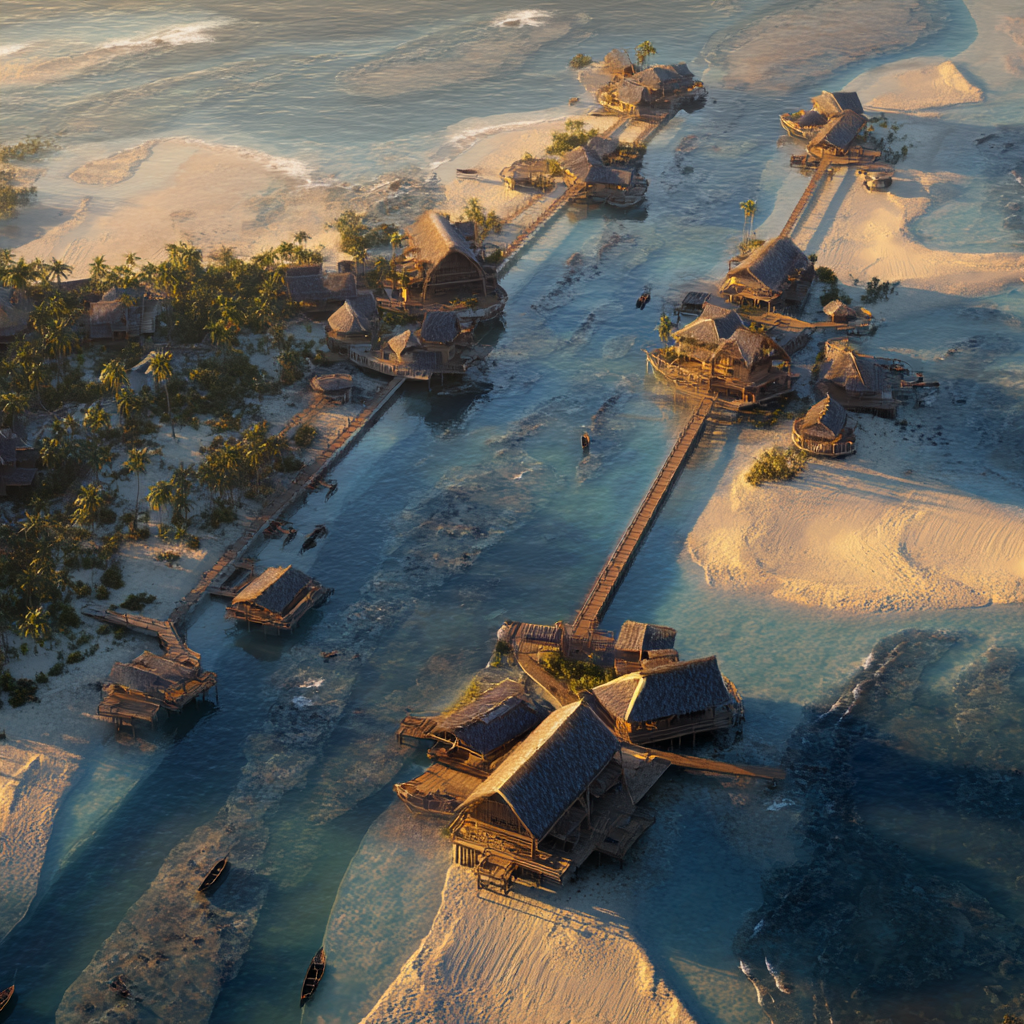
Description
Nobody wants to think about where it all goes. The fishermen gutting their catch before dawn, the Kauta Whare feeding eighty people three times a day, the horses at the Waka Shed, the children, the traders passing through, the families of the settlement who have simply lived here long enough that they stopped thinking about it entirely, all of them produce waste, every day, without pause, and a settlement that does not have a plan for that fact is a settlement slowly poisoning its own water, its own shellfish beds, and its own people. The Tidal Expanse figured this out the easy way. There are other settlements on this coastline that figured it out the hard way.
The system begins with a disagreement that took several months to resolve. The Vaitafe had always practiced dispersal, waste went to the outer bars, to the deep channels, into the sea, guided by custom and common sense and the knowledge that the tide would take it away. This worked when the population was small enough for the ocean to absorb without consequence. When the settlement grew past a certain point, and when the first city-born residents arrived bringing with them the memory of what an unmanaged growing town smells like in summer, the disagreement became unavoidable. The non-tribal residents wanted containment: sealed pits, collection routes, a designated compound. The elders were not opposed to managing waste, the sea is sacred, and fouling it recklessly dishonors Tangaroa, but they were deeply opposed to the idea of accumulating filth in one place on the island's limited solid ground. The system that was eventually built is the product of both positions, and it is better for being both.
The engineering core of the system is a network of tidal flush channels, narrow trenches cut at precise angles through the lower Spine Bars in the outer settlement zones, sized and positioned so that every incoming tide fills them fully and every outgoing tide empties them completely, carrying their contents out past the reef shelf and into the deep dispersal zone well beyond the settlement's fishing grounds and oyster beds. These channels are not sewers in the city sense. They do not carry waste under pressure through sealed pipes. They are engineered geometry: channels that the tide works for free, twice every day, without a pump or a bucket or a worker required. Above each channel, at intervals determined by the settlement's building layout, stand the Flush Houses.
The Flush Houses are the most immediately visible part of the system to any resident. They are small, private structures, four walls, a closing door, a thatched half-roof that covers the user but leaves ventilation open to the sky, built on raised platforms directly over the tidal channels. The floor of each Flush House is a slatted platform of wide-set hardwood planks, sealed at the edges and angled slightly inward toward a central drop opening fitted with a removable carved wooden cover. The design is straightforward and effective. The twice-daily tide does the cleaning. Between tides, the covers stay down. Eight Flush Houses are distributed through the settlement, positioned to serve residential clusters, the working districts near the Crafting workshops, the Feasting Pavilion, and the Guest Fale where travelers stay. The placement was the most contentious part of the project; everyone agreed the Flush Houses were necessary and no one wanted one near their dwelling. The Tideworks Director, the individual responsible for the whole system, settled the argument by placing them at the most hygienic and practical locations without further debate, a decision that was unpopular for approximately one month and has never been questioned since.
The organic waste stream from the kitchens, the food preparation areas, and the fish cleaning stations is handled separately. A composting site sits at the settlement's northern edge, downwind of the prevailing sea breeze and the direction that matters, where kitchen waste, fish scraps, spent seaweed from the Seaweed Farms, and organic material that does not enter the tidal flush system is layered into low mounded beds between alternating strata of dry sand and crushed shell. The shell is the key ingredient: its mineral content accelerates decomposition, neutralizes odor with a speed and thoroughness that surprised even the city-born residents who had seen composting operations before, and produces an agricultural amendment that is periodically distributed to the Sweet Potato Mounds and Taro Plots as a supplement. The composting site is managed by two workers who maintain the beds, regulate the layering, and ensure that nothing enters the mounds that would attract pests or contaminate the finished material. They have developed their own terminology for what does and does not belong in the beds and enforce it without ceremony.
The Tideworks Director is not a glamorous appointment. It is, in practice, the most indispensable administrative post in the settlement beneath the Duke's own council, a fact that the Director knows and the council occasionally forgets until the Director reminds them. The Director maintains detailed records of the channel geometry and the seasonal tidal variation that affects flush efficiency, certain months see slower tides that require adjustments to the channel covers to prevent stagnation. They coordinate with the Tohuanga whenever a contamination concern arises near the freshwater cisterns, and they are the person the Flame Warden calls when a Flush House near a structure catches fire. The Director also manages the only formal relationship that the Tidal Expanse has with the smell of its own functioning, which is a job that requires a specific personality: practical, unruffled, and entirely unbothered by the fact that half the settlement will never fully appreciate what they do.
Benefits
The Tidal Flush System dramatically improves public health conditions across the Tidal Expanse. All residents and visitors within the settlement gain a +2 resistance bonus to saving throws against disease and poison originating from contaminated food, water, or unsanitary conditions. This bonus stacks with any bonus provided by the Freshwater Cistern upgrades, representing the compounding effect of clean water supply and effective waste removal operating together.
The system also protects the settlement's resource economy. Without managed waste disposal, the oyster beds, shellfish grounds, and tidal fishing zones would gradually degrade as the population grows. With the Tidal Flush System operational, this degradation does not occur; the settlement's marine harvest upgrades do not lose productivity due to population-scale waste contamination, regardless of how large the population grows.
The Tidal Flush System suppresses the threat of large-scale disease outbreaks. In any situation where the GM would normally roll to determine whether a settlement-wide illness event occurs due to population density, waste accumulation, or water contamination, that roll is made with a +8 bonus to the DC required to trigger the outbreak. Events powerful enough to overcome this threshold are treated as exceptional or supernatural in origin, not the result of ordinary neglect.
The composting operation at the northern beds produces agricultural amendment distributed to the farmland and garden plots. This functions as a permanent, self-sustaining resource that cannot be depleted and does not need to be purchased separately. This upgrade generates 6 Prestige.