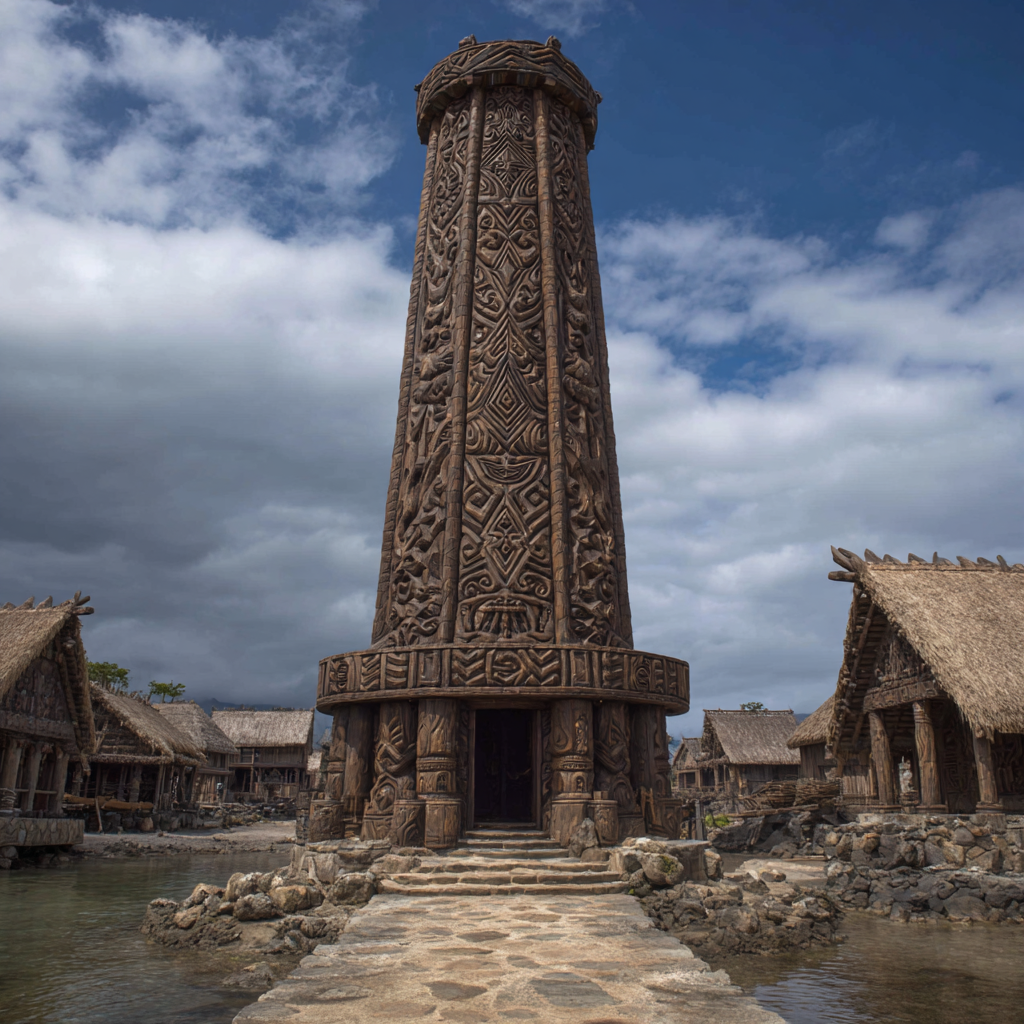
Description
The drum platform itself sits thirty feet above ground, a circular structure twenty feet across with a sturdy railing carved in wave patterns. This elevated position ensures the drum sounds carry unobstructed across the entire settlement and far beyond, while also providing the drummers with commanding views in all directions. Access to the platform comes via a steep stairway that spirals around the central pillars, with each step carved from solid wood and reinforced with iron brackets. The stairs are wide enough for two people to pass, allowing rapid ascent during emergencies. Halfway up, a small landing provides a rest point and houses backup signal equipment including conch horns and signal flags.
The drums themselves are masterworks of Vaitafe craftsmanship and spiritual significance. Three massive war drums sit in iron-reinforced cradles on the platform, each carved from a single hollow log of ironwood that took craftsmen months to shape and tune. The largest drum, called Te Whatitiri (The Thunder), measures six feet in diameter and four feet tall, its voice so deep and powerful that it can literally be felt in the chest of anyone within a hundred yards. The drumheads are made from layers of specially prepared sharkskin stretched tight and lashed with intricate rope work, creating a surface that produces sharp, carrying tones. The drum faces are painted with fierce guardian spirits whose eyes seem to watch in all directions, and the bodies are carved with geometric patterns representing different types of danger: waves for sea threats, flames for fire, crossed spears for enemy raiders, storm clouds for weather warnings.
Two smaller drums flank Te Whatitiri, each three feet across and tuned to different pitches that allow the drummers to create complex rhythmic patterns. These drums, named Tawhirimatea (Wind) and Moana (Ocean), can be played individually or in combination with the great drum to signal different types of alarms. The settlement's inhabitants learn from childhood to distinguish between the patterns: a rapid staccato on the smaller drums means fire, a deep rolling thunder from Te Whatitiri signals enemy attack by sea, alternating beats between all three drums warns of approaching storms. More complex rhythms convey specific tactical information to trained warriors, essentially turning the tower into a primitive but highly effective communication system that requires no literacy to understand.
The tower never stands empty. Dedicated drummers maintain a constant presence, ready to sound alarms at any hour. These drummer-watchmen undergo rigorous training not only in the physical endurance needed to beat the massive drums with proper force but also in the recognition of threats and the precise rhythmic codes that convey information. During peacetime, the drums mark the passage of time, with distinctive patterns announcing sunrise, noon, sunset, and the tide changes. During festivals, the drummers perform elaborate compositions that combine rhythm and ritual, their beats synchronizing with dancers below in displays of cultural pride. But when danger threatens, the drums fulfill their true purpose, their earth-shaking thunder galvanizing the settlement into organized response and announcing to any who might approach that the Vaitafe people are alert, prepared, and unafraid.
Benefits
The Alarm Drum Tower provides instantaneous communication across the entire settlement and can be heard clearly up to 3 miles away across the tidal flats. When alarms are sounded, all settlement defenders gain a +2 bonus to initiative checks due to the advance warning and can reach their posts in half the normal time. The drums can convey complex tactical information through coded rhythms, allowing coordinated responses to different types of threats. Additionally, the tower's commanding height provides exceptional visibility, granting a +3 bonus to Perception checks for spotting distant threats. The impressive structure and its thunderous drums generate 5 Prestige, as the tower serves as both a practical defensive asset and a powerful symbol of the Duke's authority and the settlement's strength.