Description
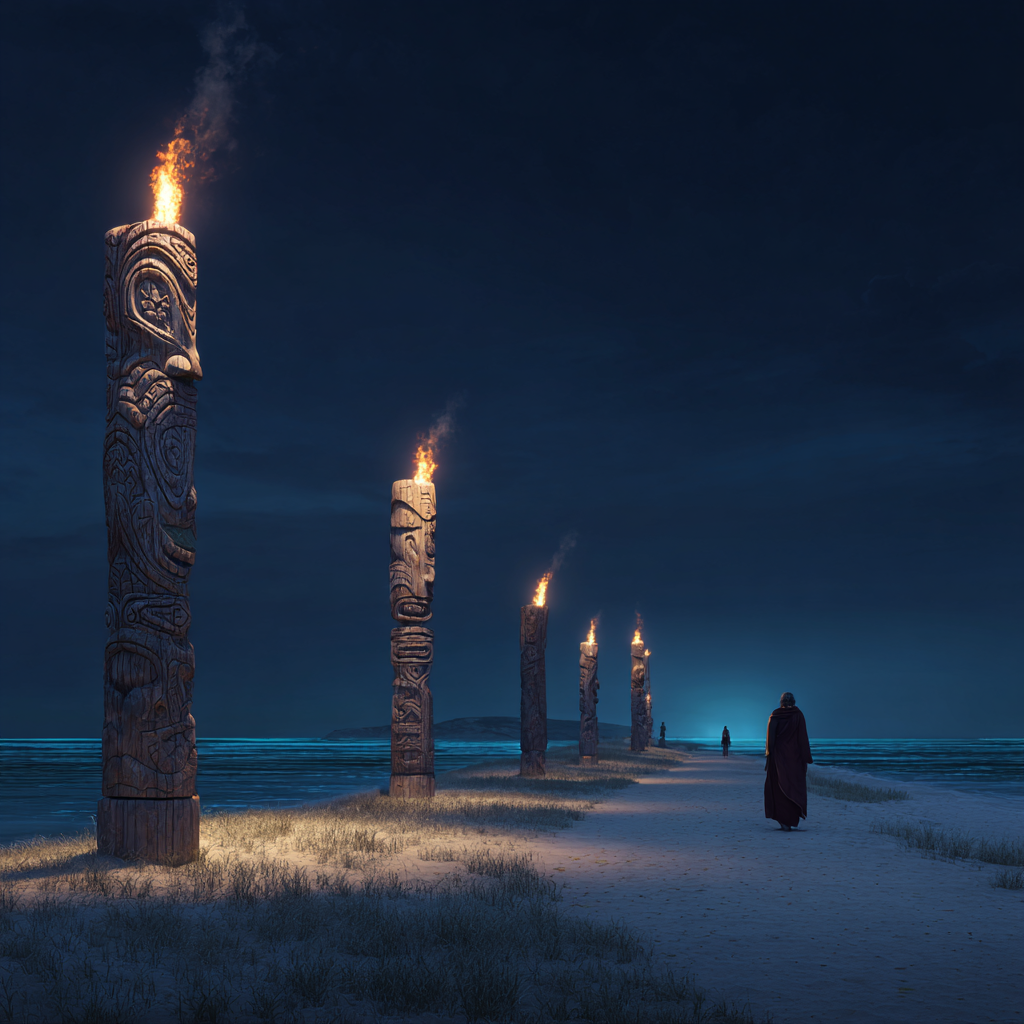
Whakapapa is the word for genealogy — the unbroken chain of names and relationships that connects every living Vaitafe person to those who came before them and, through them, to the land, the sea, and the sky. It is not metaphor. It is not sentiment. It is the actual structure of the world as the Vaitafe understand it, the backbone that holds identity in place. When the elders looked at the carved ancestor posts standing along the settlement's paths and burning their oil flames into the dark, someone — accounts differ on who, because the person who had the idea was careful never to claim credit — said: what if they were not just carvings of the ancestors? What if they were the ancestors?
The ritual that followed was months in preparation and an entire night in execution. The Tohunga led it, assisted by the elders who had living memory of the individuals whose faces had been carved into each post. This was essential: the ritual did not call blindly into the dark. It called by name. Each post had been carved with the specific intent of honoring a particular person, and on the night of the binding, their full whakapapa — every name in their line going back as far as the elders could recite — was chanted at the post from first dark to first light while the sacred flame from the Firehouse burned at the base of the carving. At dawn, every elder present said the same thing independently, without conferring: the faces had changed. Not dramatically. Not in a way that could be pointed to or measured. But the hollows of the eyes were deeper, and the grain of the wood around the mouth had shifted slightly, as though the carving had exhaled.
The flame that now burns in each post's clay bowl is not fed by oil. It has not been fed by oil since the morning after the ritual, when the Tohunga removed the oil reservoirs and set them aside. The flame burns the color of late afternoon light — not quite orange, not quite gold, something between the two that catches the eye differently than firelight normally does. It does not flicker in the wind. It does not respond to rain. It casts no smoke. On several occasions residents have tested it by blocking the bowl with a wet cloth, and the flame has simply burned through the cloth without consuming it and continued burning. The non-tribal residents of the settlement, those who arrived from cities and towns where magic was something a specialist did in a tower somewhere, have taken a while to normalize this. Most of them have now normalized it.
What took longer to normalize — and what has never quite become ordinary, even for the Vaitafe who expected it — is what the posts do when something is wrong. Under normal circumstances the flames burn steady and warm, a reliable amber. When something enters the settlement that the ancestors do not recognize as welcome — not merely a stranger, which happens every week, but something that carries genuine threat or wrongness — the nearest post's flame shifts. It goes a cold, pale blue-white, the color of deep water, and holds that color for as long as the cause remains in its line of sight. If the threat moves, the next post along the path shifts as well, and then the next. The effect travels through the settlement as reliably as a messenger, and faster. The Fire Wardens and the Duke's household learned to read the pattern within the first season: a single blue post means something nearby warrants attention. A moving line of blue posts means something is being tracked, and you should already be moving.
The ancestors do not speak. This was asked about directly, and the Tohunga's answer was careful: they are not present in the posts the way a living person is present in a room. They are present the way a grandmother is present in the way you hold a fishing line — in the trained instinct, in the knowing without being told. They perceive through the wood. They express through the flame. Asking them for more specific guidance than that is like asking the tide to explain itself. It does what it does, and the people who live beside it learn to read it, and that is the relationship.
The Caller is the person who maintains that relationship. Where the mundane Ancestor Torch Posts needed Flame Keepers to light and tend the oil, the Whakapapa Lights need someone who can speak to the posts — not in the full ritual sense of the binding night, but in the quieter, daily maintenance of connection. The Caller walks the posts each morning and each evening without a lighting pole, since there is nothing to light. Instead they speak quietly to each post: the ancestor's name, one or two words of greeting, a report of the settlement's current condition. This takes about the same amount of time as the old lighting rounds. Observers who watch the Caller at work note that the flame in each post brightens slightly as the Caller passes, as if acknowledging the attention. The Caller notes when a post seems more alert than usual — a harder-to-define quality than it sounds, but experienced Callers describe it as a subtle change in the flame's upright posture — and reports this to the Duke's household as a matter of routine. Most of the time these observations amount to nothing. Occasionally they do not.
Benefits
The Whakapapa Lights replace and supersede the Ancestor Torch Posts entirely. The oil flames are gone; the ancestor-spirit flames require no fuel, no maintenance supplies, and cannot be extinguished by mundane means. Any non-magical attempt to extinguish a Whakapapa Light — covering it, dousing it, cutting down the post — fails automatically. The post re-manifests its flame within one round even if physically destroyed, though a destroyed post's carving must be re-consecrated by the Tohunga before the ancestor within it fully recovers its awareness, a process requiring one week.
The cold blue warning system provides the settlement with a passive magical alarm. Whenever a creature with hostile intent toward the settlement or its residents enters the area illuminated by any Whakapapa Light post, the nearest post shifts to pale blue-white. This warning is not intelligent enough to distinguish levels of threat, but it is entirely reliable — it triggers on genuine hostile intent, not merely on strangers or on creatures that happen to be dangerous. The Duke's household and the Fire Wardens are assumed to understand how to read the pattern. The warning provides all settlement defenders with a +2 bonus to Initiative checks during the first round of any combat that began inside the settlement, as they are never fully surprised.
All Perception checks made outdoors within the settlement after dark gain a +3 circumstance bonus, improved from the +2 of the mundane version. The ancestor-spirit light is steadier, brighter in conditions of rain or fog, and covers slightly more area per post than the oil flames did. The anti-ambush Stealth DC for attackers on a lit path rises to DC 18, improved from DC 15. Any undead, fiends, or creatures with the Evil subtype within the light of a Whakapapa post must succeed on a Will save (DC 14) or take a −1 penalty to attack rolls and skill checks while illuminated by it, as the concentrated ancestral presence is deeply uncomfortable for such beings. This upgrade generates 7 Prestige.