Description
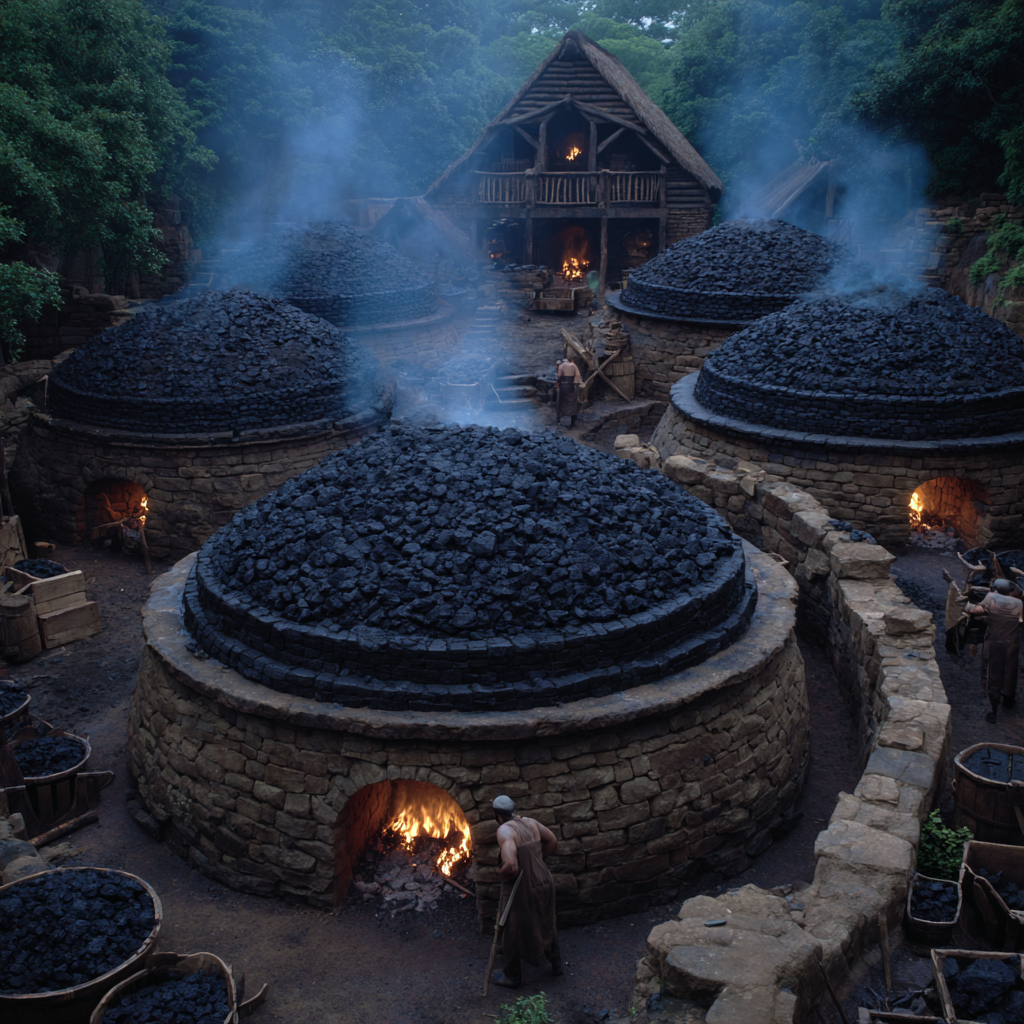
The Charcoal Burning Pit occupies a deliberately isolated clearing approximately three acres in size, positioned downwind from the main settlement and separated from the surrounding forest by a stone-lined firebreak fifty feet wide that has been cleared of all combustible material and packed with gravel. This location was chosen with extreme care, as charcoal production involves controlled fire that, if mismanaged, could threaten the entire grove. The clearing's soil has been excavated and replaced with clay and sand to prevent accidental underground fire spread, and a permanent water reservoir fed by channeled stream flow sits adjacent to the work area, providing immediate access to water for emergency fire suppression. The site features six earthen burning mounds arranged in two rows of three, each mound positioned far enough from its neighbors that a problem with one cannot cascade to the others. These mounds are permanent installations, their bases dug into the earth and lined with fire-resistant clay bricks, their shapes carefully engineered through years of refinement to produce optimal burning conditions. Around the perimeter, wooden storage sheds house finished charcoal, tools, and supplies, while a small office and rest area provides shelter for workers during the multi-day burning cycles.
The charcoal-making process begins with careful wood selection and preparation. The operation uses wood deemed unsuitable for the lumber yard due to rot, excessive knots, irregular grain, or small diameter, ensuring no commercially valuable timber is wasted in burning. Fallen branches, storm debris, and trees that died standing but dried before falling make excellent feedstock. Wood is cut into uniform lengths of approximately three feet and split to similar thicknesses, creating pieces that will burn consistently. These prepared sections are then stacked in the earthen mounds in careful patterns, starting with larger pieces at the bottom and working up to smaller ones near the top, with strategic air channels left between layers to control oxygen flow during burning. A full mound holds approximately three cords of wood and, when properly constructed, resembles a beehive or dome roughly twelve feet across at the base and eight feet high at the peak. Once stacked, the wood pile is covered with a thick layer of damp leaves and grass, then sealed beneath six inches of moist earth mixed with charcoal dust from previous burns. This earthen coating insulates the wood and controls air intake, forcing the wood to smolder rather than flame, a critical distinction that determines whether the process produces charcoal or merely ash.
The burning process requires constant attention and considerable skill. A small fire is lit in the center chamber of the mound, igniting the carefully arranged fuel within. As the wood begins to burn, the collier, the master craftsman responsible for the burn, monitors the mound continuously through visual inspection of smoke color and by feeling the mound's exterior temperature with bare hands. White or light gray smoke indicates the wood is burning too hot and fast, requiring the collier to seal air vents by packing more earth onto the mound. Blue or clear smoke shows the burn is proceeding correctly, the wood pyrolizing as volatile compounds cook out while the carbon structure remains intact. Yellow smoke means moisture is still escaping from the wood, a normal early stage. Throughout the burn, which typically lasts three to five days depending on wood type and moisture content, the collier makes dozens of small adjustments, opening or closing vent holes, adding more earth to hot spots, ensuring the entire load converts evenly. The accelerated time properties of the grove reduce this to approximately 15 to 30 hours, allowing faster production cycles while maintaining quality. When the smoke turns thin and the mound temperature begins dropping, the collier seals all vents completely and allows the mound to cool slowly over another full day. Opening the mound prematurely would allow oxygen to reach the hot charcoal, causing it to ignite and destroy the product.
Once cooled, the mound is carefully opened, revealing the transformed wood now converted into charcoal, pieces that retain the original wood's shape but are now lightweight, carbon-rich, and burn with intense heat and minimal smoke. The charcoal is sorted into three grades based on quality and size. Premium charcoal from hardwoods burned at optimal temperatures is prized by blacksmiths and metalworkers, as it burns hot enough to forge steel and produces virtually no sparks or impurities that could weaken metal. This grade commands the highest prices and is sold to smithies, armories, and craft workshops throughout the region. Standard charcoal suitable for cooking and general heating makes up the bulk of production and sells to inns, bakeries, and households that prefer its clean-burning properties over smoky wood fires. Charcoal dust and small fragments are collected separately and sold as raw material for ink production, water filtration, or mixed with clay to create heat-resistant crucibles. The facility produces approximately 500 pounds of premium charcoal, 1,200 pounds of standard grade, and 300 pounds of dust and fragments per week when operating at full capacity with multiple mounds in various stages of burning and cooling. The operation employs a master collier who oversees all burns and trains apprentices in the exacting craft, three collier assistants who maintain fires and monitor active burns, and two laborers who handle wood preparation, mound loading, finished product removal, and general facility maintenance.
The Charcoal Burning Pit operates under strict safety protocols enforced by Duke Hotaru himself, as the inherent fire risk makes this one of the few settlement operations that could genuinely threaten the grove if mismanaged. Rangers patrol the area during active burns, watching for escaped embers or unexpected wind changes. The facility never operates during dry conditions or high winds, and production schedules are adjusted seasonally to account for fire danger levels. Despite these precautions, the operation has proven safe and profitable, transforming wood waste into valuable products while demonstrating that even fire, properly controlled and respectfully wielded, has its place in a druidic community. The facility's reputation for producing exceptionally pure charcoal free from chemical additives or treatments has made it a preferred supplier for quality-conscious craftsmen, and the certification mark burned into each sack guarantees customers are purchasing charcoal made from sustainably sourced deadfall rather than harvested living trees. The pits stand as testament to the principle that waste is merely resources awaiting proper transformation, and that with skill, patience, and respect for the materials being worked, even the scraps and remnants of fallen trees can find valuable purpose.
Benefits
The Charcoal Burning Pit generates 200 gold per month in profit from charcoal sales after accounting for operating costs and labor. The facility can provide unlimited charcoal at no cost for settlement use, benefiting any smithing, crafting, or cooking operations. The availability of high-quality charcoal grants a +1 bonus to Craft checks involving metalworking, as superior fuel enables better temperature control and cleaner forging conditions. The facility generates 4 Prestige, reflecting the settlement's practical resourcefulness and ability to find value in materials others might discard, though the inherent fire risk and somewhat industrial nature of the operation garners slightly less prestige than more nature-harmonious facilities.