Description
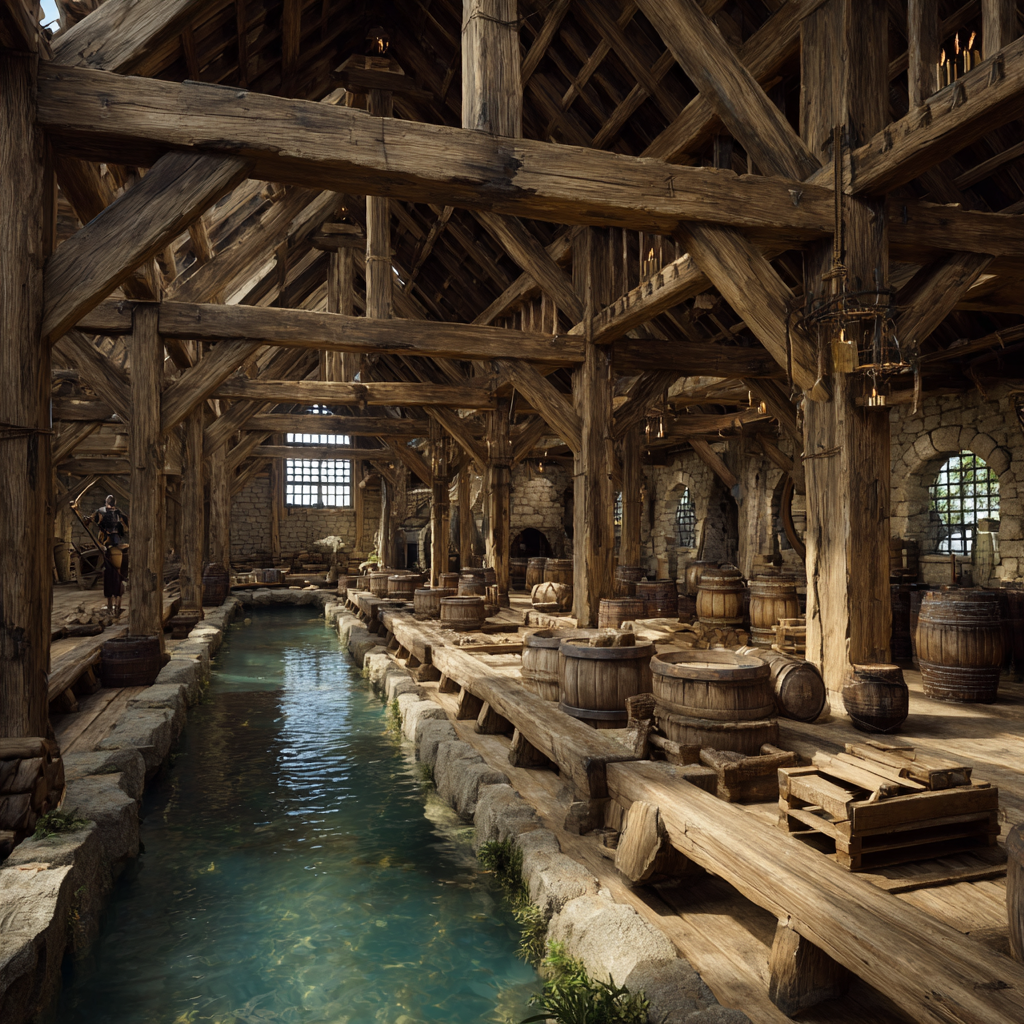
The Bark Paper Mill occupies a spacious longhouse built from living wood near one of the Crystal Streams, positioned to take advantage of the clean, flowing water essential to paper production while remaining close enough to the forest to facilitate easy transport of raw materials. The structure stretches one hundred and twenty feet in length and forty feet in width, its walls formed from trained saplings that have been encouraged to grow in parallel lines and then woven together at their tops to create a lattice framework. Between these living supports, panels of tightly woven reed and clay have been fitted to create solid walls that keep out wind and rain while allowing ventilation through carefully positioned gaps near the roofline. The roof itself is a masterwork of layered bark shingles harvested from fallen trees, overlapping in perfect patterns that shed water while remaining lightweight enough not to stress the supporting framework. Large windows fitted with oiled linen allow natural light to flood the interior during working hours, while lanterns filled with bioluminescent moss provide illumination for early morning or evening shifts. The mill's proximity to the stream allows for a sophisticated water wheel system that powers several mechanical processes, reducing the physical labor required and increasing production efficiency.
Inside the mill, the production process has been divided into distinct stations that flow logically from raw material to finished product. The first station handles preparation, where bark that has been carefully harvested from carefully managed trees or salvaged from naturally fallen specimens is sorted by type and quality. Birch bark is prized for its natural whiteness and smooth texture, oak bark produces paper with a warm brown tone favored for certain applications, and the rare silverfern bark found only in the Elderwood Grove creates paper with a subtle shimmer that commands premium prices. Workers at this station strip away outer layers unsuitable for papermaking, cut the bark into manageable sections, and soak them in large wooden vats filled with water mixed with ash lye, a process that softens the fibers and begins breaking down the material. The second station features pounding blocks where softened bark is beaten with wooden mallets against smooth stone surfaces, breaking it down into individual fibers that will eventually be reformed into paper. This work is physically demanding but rhythmic, and experienced pounders can maintain steady beats for hours, their movements synchronized to create a distinctive percussion that echoes through the mill and announces to the settlement that production is underway.
The third station represents the heart of the papermaking process. Here, the beaten bark fibers are mixed with water in large shallow vats to create a pulp suspension. Workers use fine mesh screens mounted in wooden frames to dip into the vats, lifting them carefully to allow water to drain through while fibers settle on the mesh surface in thin, even layers. The skill required to create uniform sheets cannot be overstated, as too much pulp produces paper too thick and stiff for comfortable writing, while too little creates transparent sheets prone to tearing. Master papermakers can judge the correct amount by weight and feel alone, producing sheet after perfect sheet with practiced precision. Once formed on the screens, the wet paper is carefully transferred to wool felts where it is stacked with alternating layers of felt and paper creating towering structures that are then placed under wooden presses. These presses are tightened gradually over hours, squeezing out excess water and compressing the fibers into tight bonds that give the finished paper its strength and smooth surface. The water wheel drives a mechanical press for bulk production, but master craftsmen maintain several hand presses for creating the finest quality sheets where personal attention ensures perfection.
The fourth and final production station handles drying, finishing, and quality control. Pressed sheets are carefully separated from their felts and hung on racks in the mill's drying room, a section of the building where warmth from carefully maintained fires circulates through channels built into the floor, creating gentle heat that dries paper evenly without scorching or warping it. Once dry, sheets are inspected for flaws, sorted by quality grade, and then finished according to their intended purpose. Standard writing paper receives a light coating of sizing made from natural plant starches that prevents ink from bleeding and feathering. Premium paper is burnished with smooth stones to create an almost glass-like writing surface prized by scribes and artists. Specialty papers receive additions like pressed flowers, colored pigments, or metallic dusts that transform them into luxury items suitable for important documents, formal invitations, or artistic works. The mill produces several distinct product lines: bulk writing paper sold in large quantities to merchants, governments, and educational institutions; premium letter paper packaged in attractive boxes for personal correspondence; artist paper in various textures and sizes; and specialty papers for specific applications like map-making, spell scrolls, or musical notation.
The mill's economic success stems from both quality and ethical sourcing. The paper produced here rivals the finest parchment in durability and writing characteristics while costing significantly less to produce, making it accessible to customers who previously could not afford quality writing materials. More importantly, the mill's commitment to sustainable harvesting practices has become a powerful marketing advantage. Every sheet carries a small seal impressed during pressing that certifies it was produced without harming living trees, appealing to environmentally conscious customers and druidic circles across Xeres. The mill maintains relationships with paper merchants in major cities, shipping bulk orders via trade caravans that arrive quarterly to collect inventory. Specialty papers are sold directly from a small attached shop where customers can examine samples and place custom orders. The mill employs a workforce that includes skilled papermakers who learned the craft elsewhere and brought their expertise to the settlement, apprentices learning the trade, and laborers who handle the physical work of sorting, pounding, and material transport. The master papermaker oversees quality control, develops new techniques, and manages relationships with major clients, ensuring the mill's reputation for excellence continues to grow. Revenue from paper sales provides reliable income that helps fund other settlement projects while creating jobs and establishing the Elderwood Grove as a center for quality craftsmanship that respects nature rather than exploiting it.
Benefits
The Bark Paper Mill generates 180 gold per month in profit from paper sales after accounting for operating costs, labor, and materials. The mill's reputation for sustainable, high-quality products attracts merchants and creates trade relationships. The mill can also produce custom paper products for settlement use at no cost, including maps, important documents, or spell scrolls. The facility generates 5 Prestige, reflecting the settlement's successful combination of economic productivity and environmental stewardship, and its growing reputation as a source of quality goods.