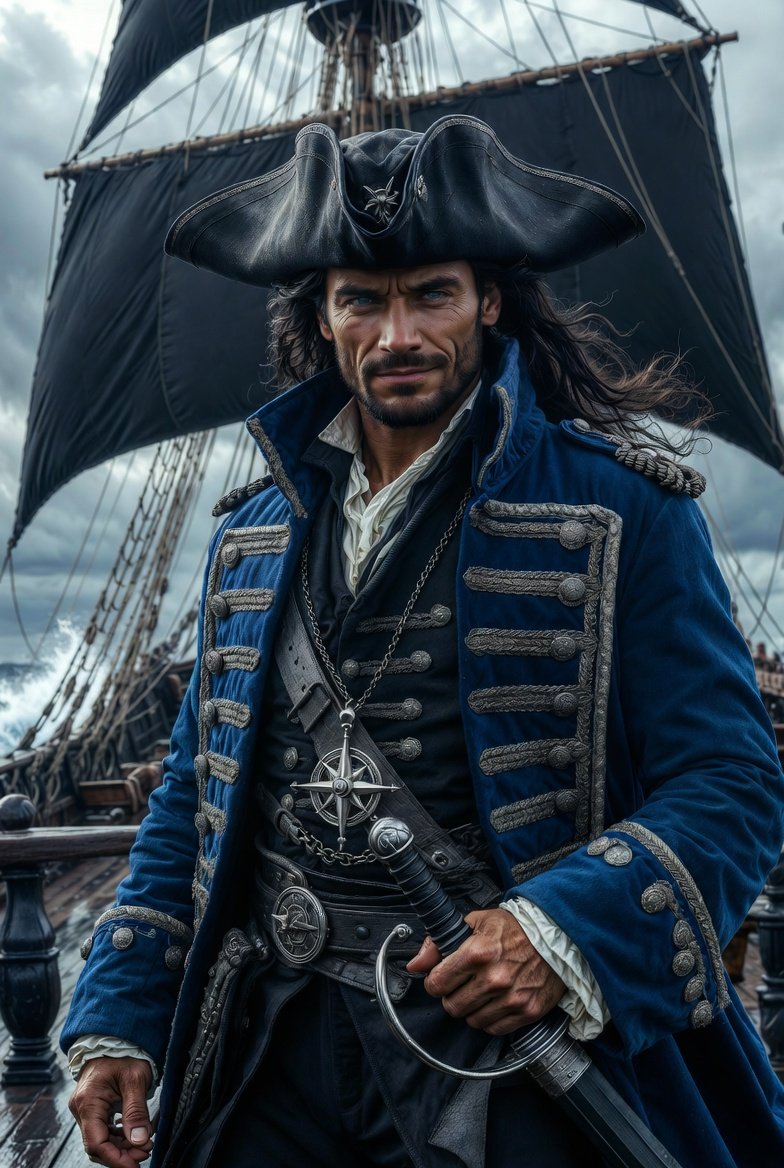
Orphan of the Docks
Silas was born in the slums of a major port city to parents he never knew, raised by the rough community of dock workers and sailors who took pity on a motherless child. He grew up running errands for ships' crews, learning the language of the sea before he could properly read common tongue. By age eight, he was working as a cabin boy, by twelve he was climbing rigging with the best of them, and by fifteen he could navigate by stars and read weather patterns that baffled sailors twice his age. The sea was his school, and he proved an exceptional student, absorbing knowledge with the desperate intensity of someone who knew that competence was his only path to survival and advancement.
The Mutiny That Made a Captain
At nineteen, Silas served aboard a merchant vessel under a captain who was both incompetent and cruel, running his ship through dangerous waters while abusing his crew. When the captain's poor decisions led them into an ambush by raiders, it was Silas who organized the defense and rallied the crew. In the aftermath, with the captain dead and the ship crippled, the crew elected Silas to lead them home. He not only succeeded but used his knowledge of the raiders' patterns to turn the tables, capturing three of their vessels and claiming them as prizes. When authorities tried to arrest him for mutiny, his crew stood with him unanimously, and the sheer audacity of his success made him a folk hero among common sailors. Rather than face a trial he knew would be rigged, Silas took his ships and crew and disappeared into the vast ocean, becoming a pirate not by choice but by necessity.
Building the Sovereign Fleet
Over the next decade, Silas built what would become the Sovereign Fleet through a combination of brilliant tactics, personal charisma, and an innovative approach to piracy. Unlike most pirates who operated as scattered raiders, Silas organized his forces like a proper navy, with clear command structures, shared resources, and coordinated strategies. He recruited not just desperate criminals but skilled sailors tired of serving incompetent officers in legitimate navies, offering them meritocracy and fair shares of plunder. He established codes of conduct that forbade random violence against innocents and ensured that captured crews were given the choice to join or be released at safe ports. This approach, considered revolutionary among pirates, created fierce loyalty within his fleet and made him less hated by common people than traditional pirates. The Sovereign Fleet grew from three ships to thirty, then to over a hundred, becoming a naval power that rivaled small nations.
The Battle of Crimson Straits
Silas's reputation as a tactical genius was cemented during the Battle of Crimson Straits, where his fleet of forty-seven ships faced a combined naval force of ninety vessels from three kingdoms who had united specifically to destroy him. Using his knowledge of tides, currents, and weather, Silas drew the enemy fleet into a narrow strait during shifting winds and incoming storm. His ships, positioned perfectly and crewed by sailors who trusted his judgment absolutely, executed a devastating series of maneuvers that turned the strait into a killing ground. By the battle's end, the enemy had lost over sixty ships while Silas's fleet suffered only minor damage. The defeat was so catastrophic and so clearly the result of superior tactics that naval academies began secretly studying Silas's methods, and several admirals quietly resigned rather than face the possibility of meeting him in open battle. After Crimson Straits, no one questioned why he was called the Pirate Captain of the World.
The Leviathan's Crown
Silas's flagship, the Leviathan's Crown, is a marvel of naval engineering and a symbol of his power. Originally a massive warship from an imperial fleet, Silas captured it in a daring night raid and spent years modifying it into something unique. The ship is faster than anything its size has any right to be, heavily armed with both conventional weapons and magical enhancements acquired from various sources, and crewed by the absolute best sailors in the Sovereign Fleet. The Crown has never been defeated in single combat, and its distinctive black sails with silver trim are recognized and feared across every major ocean. Silas treats the ship with reverence, maintaining it personally and ensuring it receives the finest supplies and maintenance. Sailors say the Leviathan's Crown is more than just wood and canvas, that it has a spirit of its own that responds to Silas's commands as if the ship itself recognizes its true master.
Creating a Code
Unlike the chaotic brutality associated with most pirate operations, Silas established what became known as the Stormbreaker Code, a set of laws that govern the Sovereign Fleet and have been adopted by many independent pirate crews. The Code includes provisions about fair division of plunder, treatment of prisoners, prohibition on harming innocents, consequences for betrayal, and democratic election of ship captains. Ships flying the Sovereign Fleet flag are expected to uphold these standards or face expulsion and potential pursuit. This Code serves multiple purposes: it maintains discipline within his massive fleet, makes him less hated by common people who might otherwise support naval forces against him, and allows him to claim a moral high ground that separates him from common pirates. Critics call it hypocritical for a pirate to have rules, but Silas argues that honor and lawlessness are not mutually exclusive, and that his Code creates order in what would otherwise be chaos.
Current Operations
Today, the Sovereign Fleet operates across all major oceans, with various squadrons led by captains Silas has personally trained and promoted based on merit. They target wealthy merchant vessels, corrupt officials, slave ships, and military convoys, while generally leaving common traders and fishing vessels unmolested. Silas has established secret ports and supply bases throughout the world, creating an infrastructure that allows his fleet to operate indefinitely without relying on any nation's goodwill. He maintains a network of informants in every major port, giving him intelligence about ship movements and valuable cargo that allows him to strike with precision. Various kingdoms have placed enormous bounties on his head, but attempts to collect have invariably failed, with would-be bounty hunters either joining his crew, fleeing in terror, or disappearing without trace. At this point, Silas Stormbreaker is less a pirate and more a sovereign power unto himself, commanding loyalty and resources that many kings would envy.