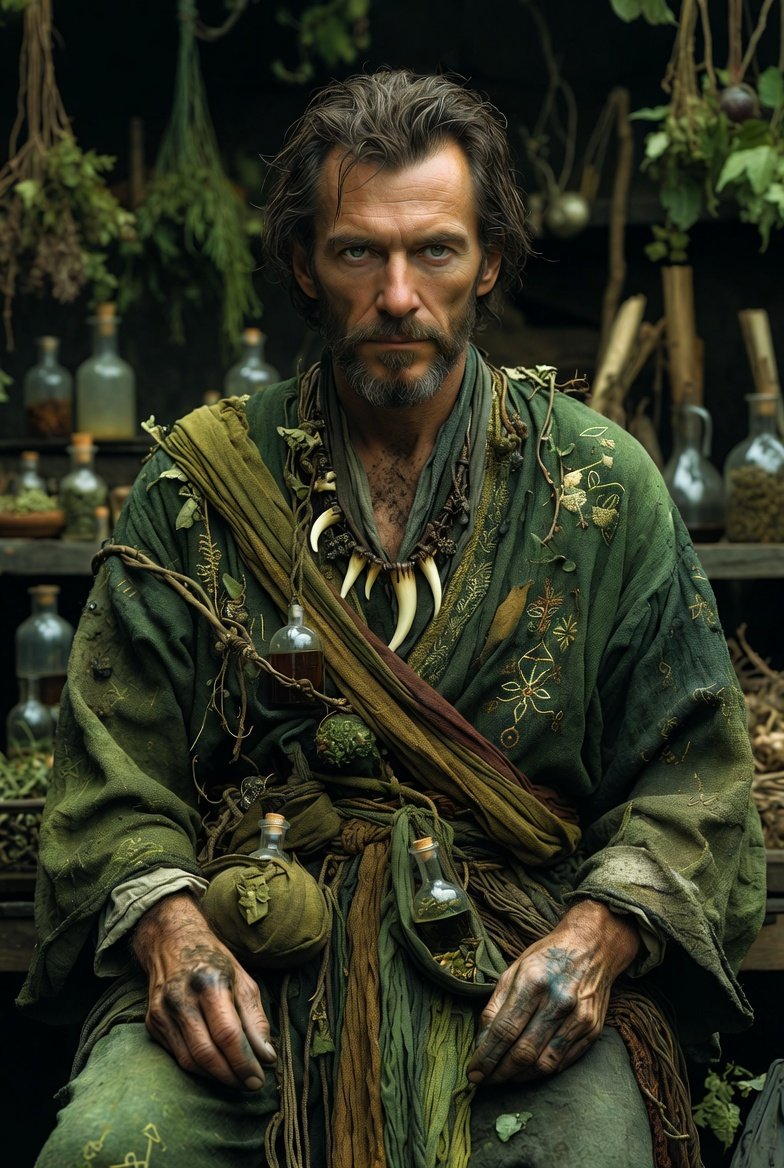
Finding Home in Greenbrook
Rowan Greenmist was not born in Greenbrook but rather discovered it thirty years before his death while wandering as a young druid seeking to understand the relationship between civilization and nature. Most communities he encountered treated the natural world as something to be controlled or exploited, but Greenbrook was different. The village's harmony with nature and its lack of formal power structures immediately resonated with his own beliefs and values. What he intended as a brief rest during his travels became an extended stay, then a permanent home. The villagers welcomed him not because they needed a druid but because his gentle wisdom and willingness to help with any task, from delivering babies to mediating neighborly disputes, made him a natural part of their community. Over time, his natural ability to bridge gaps between different perspectives made him an unofficial mediator in village matters, a role he never sought but accepted as a way to serve the community that had given him a home.
The Reluctant Alderman
Though Greenbrook operated without formal government, the practicalities of the wider world eventually required someone to represent the village's interests in regional matters. The community recognized this need but struggled with how to designate someone without creating the power structures they had intentionally avoided. The solution came from an unexpected source: the children of Greenbrook playfully began calling Rowan "Alderman" after noticing how he tended to both plants and people with equal care and attention. The nickname stuck, and adults began using it with affection and a touch of irony, everyone understanding it was more a description of function than a title of authority. Rowan himself would gently remind people that it was just a nickname rather than an official position, uncomfortable with any suggestion that he held power over others. This discomfort with formal authority would ironically become one of his greatest diplomatic assets, as other leaders found his genuine humility disarming.
Diplomatic Philosophy and Methods
Rowan's approach to diplomacy reflected Greenbrook's values and his own druidic worldview. He believed that successful negotiations, like healthy ecosystems, should be patient, organic, and focused on finding natural points of harmony rather than forcing artificial compromises. He often conducted diplomatic meetings while tending gardens or walking through nature, believing the natural world provided both inspiration and perspective that sterile meeting rooms could never offer. His habit of brewing unique tea blends for each diplomatic encounter became legendary among regional leaders. Some claimed he could match a tea's properties to the exact emotional needs of a negotiation, using calming chamomile for tense discussions or energizing mint for deadlocked talks that needed fresh perspective. His methods were unconventional but remarkably effective. He resolved trade disputes by getting involved parties to work together in village gardens, discovering common ground through shared labor. He eased tensions between neighboring communities by organizing joint harvest festivals that reminded people of their interdependence.
Success Through Natural Wisdom
Despite his lack of formal diplomatic training or interest in traditional political maneuvering, Rowan developed a reputation throughout the region for achieving success through unexpected means. His genuine lack of personal ambition meant he could be trusted to advocate for others' interests without hidden agendas. He would point to how different plants thrive together in the same garden without competing, or how the brook finds its path around obstacles without conflict, as models for how communities could coexist. These weren't empty metaphors but deeply held beliefs that informed every negotiation and mediation he participated in. His greatest achievement wasn't any single treaty or agreement but rather his success in helping Greenbrook maintain its peaceful way of life while still engaging constructively with an increasingly complex wider world. He proved it was possible to participate in regional politics without compromising core values or adopting the power-seeking behaviors he found distasteful.
Teaching and Mentoring
When not engaged in diplomatic duties, Rowan dedicated himself to teaching Greenbrook's children about natural harmony and druidic practices. He believed that the village's future depended on passing down both practical knowledge about living in balance with nature and the philosophical understanding that made such balance possible. His teaching methods were hands-on and experiential, involving students in tending gardens, identifying medicinal herbs, and learning to read weather patterns. He also mentored younger members of the community in diplomatic skills, training them to mediate local disputes and represent Greenbrook's interests. He took particular pride in his extensive herb garden, which served as both a teaching tool and a practical resource for the village's needs. Each plant had a story, a use, a place in the ecosystem, and Rowan knew them all intimately. He maintained detailed journals documenting his observations of plant properties and seasonal cycles, creating a valuable resource for future generations.
The Peace Talks and Fatal Error
Rowan's final diplomatic mission was his most important: representing Greenbrook at the historic peace talks that would eventually lead to the formation of the Southern Coalition. He approached these talks with his characteristic optimism and natural wisdom, believing that just as different plants could coexist in a garden, different communities could find harmony through patient understanding. During the negotiations, John Farthing, the mayor of Tully, complained of an upset stomach brought on by stress and unfamiliar food. In a gesture of goodwill between potential allies, Rowan offered to prepare a simple stomach relief potion, a remedy he had brewed countless times for Greenbrook villagers. What should have been a routine act of kindness became a fatal mistake when he accidentally used the wrong ingredient in his preparation. The error was completely avoidable, the kind of simple mistake that even experienced alchemists occasionally make when tired or distracted. The poison acted quickly on Mayor Farthing, and despite desperate attempts to counteract it, the mayor died within hours.
Following His Own Path
When Rowan realized his mistake and watched John Farthing die from the potion he had prepared in good faith, the weight of what he had done shattered something fundamental in him. This man who had spent thirty years helping others, delivering children, healing the sick, mediating conflicts, and promoting harmony had accidentally killed a good man at a moment meant to bring peace. In his grief and horror, Rowan made a decision that those who knew him understood even as they mourned it. He took the same potion himself, reasoning that if his carelessness had cost John Farthing his life, he should not escape the consequences of his own error. He died within hours of the mayor, his final act a taking of responsibility that aligned with his lifelong philosophy of accountability and natural consequences. The assembled leaders at the peace talks witnessed both deaths within the same day, a tragedy that cast a shadow over the proceedings but also served as a sobering reminder of the stakes involved. Rowan's death, like John Farthing's, became part of the foundation of the Southern Coalition, a reminder that the greatest threats often come not from enemies but from the small, avoidable mistakes made by well-meaning people.
What He Left Unfinished: Greenbrook's Way of Life
Above all else, Rowan had spent his diplomatic career trying to ensure that Greenbrook could maintain its unique harmony with nature and rejection of formal power structures even as the outside world grew more complex and conflict-ridden. He understood that total isolation was neither possible nor desirable, and worked instead to build enough goodwill and understanding with neighboring communities that Greenbrook would be left in peace to continue its way of life. He had hoped that other communities might even adopt some of Greenbrook's practices, spreading the philosophy of natural harmony through example rather than force, a practical strategy built on thirty years of successful mediation and relationship building that his death left incomplete.
What He Left Unfinished: The Next Generation
Rowan had understood that his role as Greenbrook's representative to the outside world was temporary and that the village would need others who could carry on this work. He had dedicated considerable time to mentoring younger community members in both druidic practices and diplomatic skills, teaching them how to mediate conflicts and represent Greenbrook's interests without adopting the power-seeking behaviors he found distasteful in traditional politics. His goal had been to create not just individual replacements for himself but a culture of peaceful problem-solving that would outlast any single person, a culture his students carried forward without him after Frostmoon.
What He Left Unfinished: Regional Peace
While Rowan's primary loyalty was always to Greenbrook, he genuinely believed the diplomatic philosophy he practiced could benefit the wider region, and he hoped that demonstrating the effectiveness of patient, nature-inspired mediation could influence how other communities approached their conflicts. The peace talks that ultimately claimed his life represented the culmination of this vision: multiple communities coming together to find common ground rather than competing for dominance. He believed such a coalition would create enough stability that communities like Greenbrook could thrive without constantly fearing external threats. His death at those talks, tragically, became part of their foundation rather than the vindication of his vision he had hoped to see.
What He Left Unfinished: The Herbal Compendium
On a more personal level, Rowan had maintained a lifelong project of documenting and understanding every plant in the region and its potential uses. His extensive herb garden had been both a practical resource and a research project, with new specimens constantly being added and studied, and his detailed journals of seasonal variations, growing conditions, and medicinal and alchemical properties represented decades of careful observation. He had dreamed of eventually compiling these observations into a comprehensive guide that could benefit any community wanting to live in closer harmony with nature. The tragic irony of his death by his own mistaken preparation stands in stark contrast to that unfinished work, a reminder that even deep knowledge provides no immunity from simple human error.