Xeres / Characters / Rangi Matariki

Rangi Matariki

The ink remembers what the living forget.
Master Tattooist Human Rokoura The Stormghast
📋

Basic Information

Full Name
Rangi Matariki
Nickname
"The Tide-Writer"
Race (Grade)
Human (F)
Class
Artisan (Master Tattooist)
Height
6'2"
Birthday
Mistfall 22, 1270
Age
Loading...
🩸

Bloodline Ability

🔮Unknown

This Bloodline ability has not yet been unveiled to you.

🪞

Physical Description

Rangi Matariki
Rangi Matariki, The Tide-Writer
Appearance

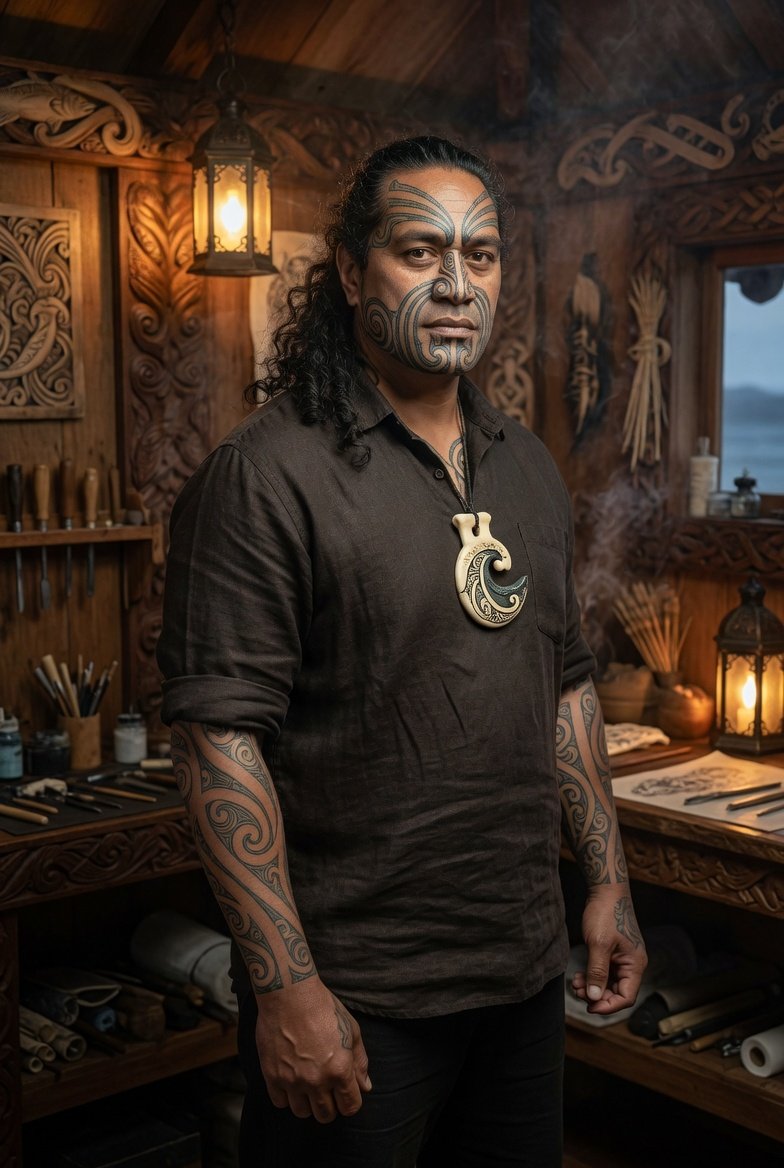
Rangi is the kind of person who takes up a room simply by occupying it. He stands at six-foot-two with the broad, grounded build of someone who spent his formative years hauling nets and rowing into deep water, and the decades of precise hand work since then have added an unusual quality to him: enormous capable hands that somehow move with the patience and control of a surgeon when a comb and ink are involved. His skin is a warm, deep brown and tells a story in its own right. Both arms are covered from knuckle to shoulder in traditional Vaitafe ta moko, the patterns so densely layered and so immaculately executed that people who know the craft will stop mid-sentence just to look. His jaw carries partial facial tattooing as well, the lines curving up across his left cheekbone in the old style, though he stopped shy of the full face coverage and has never publicly explained where he drew that line or why. His hair is dark and thick, worn back in a loose tie that comes undone more often than not, and his eyes are a deep amber-brown that people frequently describe, afterward, as the most attentive eyes they have ever been looked at with.

Unique Characteristics

Rangi smells faintly of sea salt and the specific mineral sharpness of volcanic ash ink, which is a scent so tied to the Vaitafe craft that older practitioners consider it a kind of signature. His hands are always clean, conspicuously so, the hands of a man who has made cleanliness a professional religion. He wears a single carved bone pendant in the shape of a stylized wave, which is the only ornamentation he keeps on his person while working, and he removes everything else before he begins a session. When he is thinking he goes very still, the kind of stillness that reads initially as discomfort and resolves, after a moment, into the recognition that this is simply what focused attention looks like on him. People in Rokoura have learned that Rangi still is a different thing from Rangi uncomfortable, and the distinction matters.

🧭

Personality

Positive Traits
  • Extraordinary mastery of traditional Vaitafe tattooing
  • Deeply patient listener
  • Loyal to a fault once trust is established
  • Willing to teach the meaning and history behind the craft
  • Comfortable in silence, a reliable anchor in tough talks
Challenging Traits
  • Slow to warm up
  • Can be inflexible about process
  • Carries quiet, persistent grief over Vaitafe's destruction
  • Has turned away more clients than most tattooists take
  • Occasionally underestimates how abrasive his bluntness lands

You want to know what it means before I do it. Good. Come back when you know why you want to know.

The ink is not decoration. I have walked people to the door over that word. I will do it again.

My mother taught me this. Her mother taught her. The village is gone. The craft is not. That is the only thing I am responsible for now.

Likes
  • The sound of a bone comb meeting skin on a session he trusts
  • Deep water; he grew up on the coast and never lost its pull
  • People who ask real questions and wait for the answer
  • Kaia's progress, tracked with far more care than he admits
  • Holy day gatherings where nobody has to explain themselves
Dislikes
  • The phrase "looks cool" applied to sacred Vaitafe patterns
  • Being rushed in any context, but in the studio especially
  • The way cities treat grief as a phase rather than a fact
  • People who mistake his stillness for discomfort
  • A list of names in his head he hasn't finished finding
📜

Background & History

The Consultation
Rangi does not take walk-ins. He has never taken walk-ins. If you want Rangi to tattoo you, you start with a conversation, and that conversation is less like a meeting with an artisan and more like being asked to account for yourself to someone who has a very specific set of standards and the experience to know when you are meeting them. He asks about your life. Your history. Your losses. What you have done that you are proud of and what you are less proud of. He listens to all of this with the same unhurried attention. Then he tells you what he thinks a tattoo could mean for you, or whether he thinks you are ready for one at all. Some people leave that conversation without a booking and come back a year later. Some leave and never come back. Rangi considers both outcomes acceptable. The ones who are bothered by this process are, in his experience, exactly the people the process was designed to filter out.

On the City
Rangi has lived in Rokoura for eleven years and has never once pretended to be someone who does not find parts of it ridiculous. The speed of it. The noise. The way people in cities treat traditions like accessories, picking them up and setting them down based on what is fashionable that season. He says these things plainly and without particular heat. He is not performing disapproval. He has simply noticed things. What he also notices, and says with equal plainness when asked, is that the city has given him something the village could not: enough people moving through to find the ones worth knowing. Rokoura did not replace Vaitafe. Nothing replaces Vaitafe. But it has given him a studio, a handful of people he trusts completely, and a craft that continues. Rangi has decided that is enough, and he has decided it deliberately, which means it holds in a way that accidental contentment never does.

On the Tattoo as Spirit
The Vaitafe do not believe a tattoo is decoration. Rangi does not believe a tattoo is decoration. This is the one point on which he will push back with something approaching sharpness, because it is the one place where the misunderstanding does actual harm. In Vaitafe tradition, the ink is a conversation between the person wearing it and the ancestors who came before. The pattern is not chosen for aesthetics. It is arrived at through reflection, through honesty, through understanding what you are carrying and what you hope to carry forward. Rangi's tattoos, when he agrees to do them, are built from that process. Every line means something. Every curve corresponds to something in the life of the person who wears it. He has never once agreed to tattoo something because it "looks good." He has walked potential clients to the door over exactly this phrase. He would do so again without hesitation.

Roots in Vaitafe
Rangi was born in the Vaitafe village in 1270, the second son of a Matai elder and a master ta moko practitioner named Hine, who began teaching him the craft before he was old enough to hold a comb steady. He grew up in the full current of Vaitafe life: the malae at the center of everything, the fale tele filled with the sound of the village deciding things together, the Pe'a Ceremony the first time he witnessed it at age nine and understood for the first time that his mother's work was not craft in the way a potter's work is craft. It was something that passed through people. He spent his teens on the water and his evenings in his mother's workshop, and by the time he was twenty he had completed his own full ta moko, done in the traditional hand-tap method over the course of three separate sessions spanning a full year.

The Departure
Rangi left Vaitafe at twenty-three. This was not a falling out and not a rejection of anything his village was. It was a conversation he had with his mother over two evenings, in which he told her he believed the craft was going to disappear if it stayed only inside the village, and she told him she had been waiting for him to say that for three years. He left with her blessing, a set of her uhi, and a carved pendant she made for him the night before he went. He spent four years traveling between coastal cities, doing traditional work for any Vaitafe people he encountered and taking on outsider clients only when he judged them ready. By the time he reached Rokoura he had already built a quiet reputation, and the city was large enough to sustain a permanent practice. He has been here since.

The Destruction of Vaitafe
In 1303 the Eldritch forces of Oraeus destroyed Vaitafe entirely. Rangi was in Rokoura when it happened. He received word through a trader three weeks after the fact, which is a particular kind of grief: the kind where the thing has already finished being terrible by the time you find out it was happening. His mother did not survive. Neither did the majority of the elders he had grown up learning from. He took four days away from the studio, which is the only time in eleven years he has closed it for a reason other than a holy day, and when he returned he did not speak about those four days and nobody asked. What changed, visibly, is that he began training an apprentice the following month. He had resisted taking one for years. He did not explain the connection. People who knew him understood it without being told.
🎯

Goals

Continuing the Craft
Rangi's central goal, the one that organizes everything else, is ensuring that the traditional Vaitafe ta moko does not die with the village that produced it. This has moved from background intention to urgent project in the year since Vaitafe's destruction. He is currently training one apprentice, a young woman named Kaia Huru who showed up at his studio at sixteen with her mother's blessing and more natural feel for the comb than Rangi had at the same age, which he has told exactly nobody. He is also working on a written record of patterns, meanings, and the oral history behind them, something he puts time into late at night when the studio is closed. He knows it is imperfect. He knows a written record cannot hold everything. He is doing it anyway.

Building Something That Lasts in Rokoura
Rangi wants the studio to become something more than a place where good tattoos happen. He has, quietly and without making announcements about it, been acquiring connections among Rokoura's Vaitafe community, which is scattered and loose in the way of diaspora communities, people who carry the culture at different levels of depth and with different levels of consistency. He hosts informal gatherings on the holy days, mostly food and music and conversation, with no agenda stated and no attendance expected. He is not trying to build an institution. He is trying to keep a thread intact. The city can tell the difference between someone building power and someone tending something, and so far it has left him alone to do it.

Finding the Survivors
Rangi has a list. Not a written one, but the kind that lives in the back of a mind and does not leave. He knows of perhaps a dozen people who were away from Vaitafe when it was destroyed and who, by accident of timing, survived. He has found three of them since. He is not searching in a dramatic or organized way. He simply asks the right questions of the right traders, listens to what coastal travelers have heard, and follows what threads appear. When he finds someone, he brings them food and sits with them as long as they need. He does not call this a mission. He would not appreciate the word applied to it. It is simply what he does.
📍

Current Status & Relationships

Residence
Role
Master Tattooist
Apprentice
Other
Hine Matariki
Mother, Deceased
ATTENTION!
Rangi will not tattoo a person he has not spoken with at length. This is not a quirk or a business affectation. This is the process. If someone approaches him wanting Vaitafe-style ta moko, they should expect a genuine, probing conversation about who they are and what they are asking for before anything else happens. He can and will refuse if he believes the request is cosmetic rather than sincere. He can and will take on a client who has never heard of the Vaitafe if they demonstrate genuine respect and willingness to understand. He is not gatekeeping out of hostility. He is gatekeeping out of love for something that matters to him deeply. People who engage with that honestly will find him one of the more rewarding NPCs they have met. People who try to charm or pressure their way past it will find that those tools do not work on Rangi at all, and he will simply wait them out.
Rangi Matariki
Identity
Residence
Role
Master Tattooist
Status
● Active