Xeres / Characters / Nari Te'Ahi

Nari Te'Ahi

I know how to mend nets. I know how to mend things. I will start there.
Te Kupenga Ora Human Rokoura The Bloom Nymph
📋

Basic Information

Full Name
Nari Te'Ahi
Vaitafe Title
Te Kupenga Ora
Race (Grade)
Human (E)
Craft
Master Net-Maker
Height
5'8"
Birthday
Rainsong 3, 1258
Age
Loading...
🩸

Bloodline Ability

🔮Unknown

This Bloodline ability has not yet been unveiled to you.

🪞

Physical Description

Nari Te'Ahi
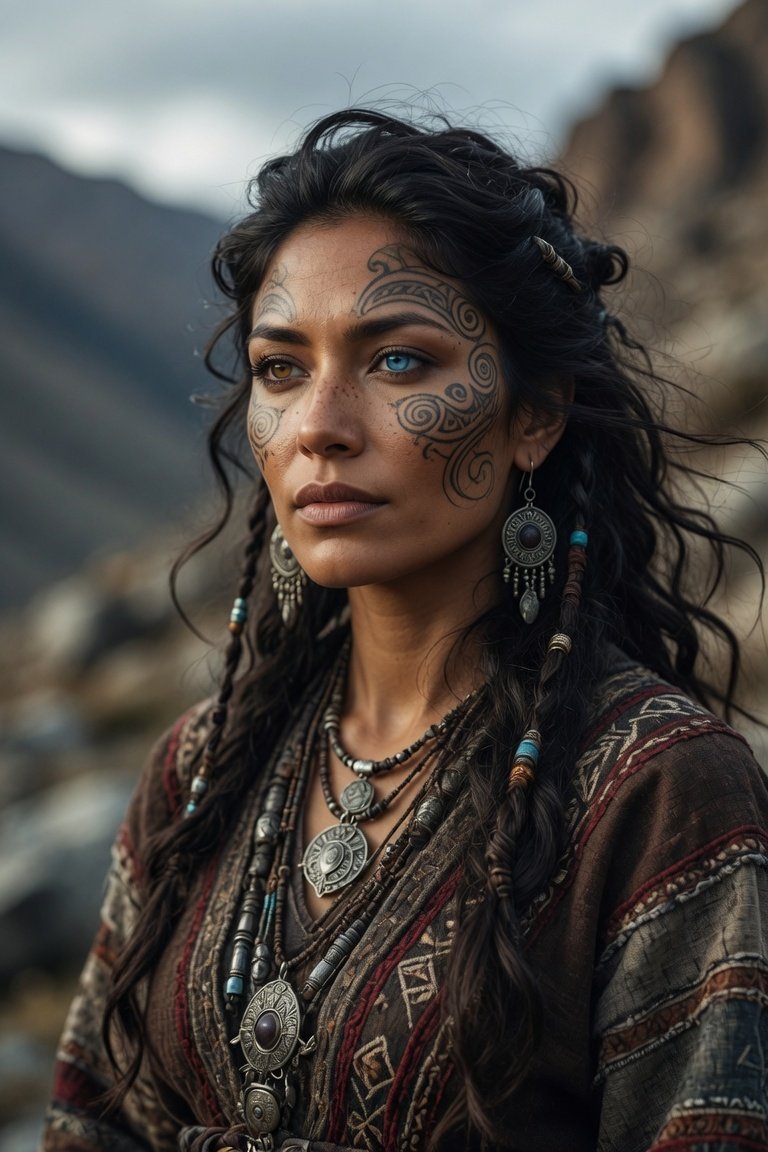
Nari Te'Ahi, in the highlands during her traveling years
Appearance

Nari Te'Ahi is forty-eight years old, with warm tan-brown skin, dark wavy hair she wears loosely gathered with small bone pins and braided cord, and the particular quality of stillness in the hands that belongs to people who spend years doing precise, patient work. She is tall and broad-shouldered, built from decades of hauling nets and working coastal conditions, and she carries that strength without display, it is simply there, in the way she moves and stands. Her face carries a scattering of freckles and the deep lines around the eyes of someone who has spent most of her life squinting at water in bright sun.

Her most immediately striking feature is her eyes: the right is a warm amber-gold, the left a vivid, startling blue. Heterochromia of this kind is uncommon enough that it is the first thing most people register and the thing they remember longest. In Vaitafe tradition, a child born with two-colored eyes is said to be "watched by both the sun and the sea", called to things that bridge between what should not meet. Her family name, Te'Ahi, means "of the fire." She carries a fire name, but her left eye belongs to the ocean. The tradition says this means something. She has spent forty-eight years finding out what.

Tā Moko

The tā moko that covers her left cheek, jaw, and the curve of her chin is not decoration. In Vaitafe tradition, the tā moko is a living document, the story of a person's whakapapa, their craft, their position, their journey, written in spiral and line on the face for the world to read. Nari's moko was begun at the coming-of-age ceremony and has been added to across the forty years since.

A Vaitafe elder who knows how to read moko can trace her lineage through the patterns: her family line in Vaitafe, her grandmother's fishing grounds, the craft of the net-maker passed from mother to daughter for five generations. The koru spirals, the curled form of a new fern frond, symbol of new life and continuation, are worked through the design in a way that references the coiling of net cord. Near her jaw, the patterns shift in a way that marks her years of travel: the moko does not lie about where you have been. She added to it herself, in the traditional way, when she was learning the highland lake routes. An elder reading her face would see a woman who went far from home and was marked by the journey. They would be correct.

Attire & Jewelry

She wears traditional Vaitafe-style woven garments in dark earth tones, deep burgundy, brown, and black, with geometric patterns worked into the weave that identify her craft and family to those who know the visual language. The weaving itself is old and well-maintained; she has repaired sections many times over the years. She wears multiple layered necklaces (bead-work in turquoise and dark stone, and a large silver medallion pendant bearing a central dark stone) and dangling earrings in the same palette that were her mother's. The jewelry is the only thing she has left from Vaitafe that she did not carry out of her own head.

🧭

Personality & Temperament

Positive Traits
  • Patient in the deep, unhurried way of long practice
  • Deliberate with words; says what she means, once
  • Warm to genuine people, wary of performance
  • Carries grief openly, naming those she lost
  • Dry, well-timed humor that surfaces unexpectedly
  • Reads water and weather with near-preternatural instinct
Challenging Traits
  • Carries quiet guilt over being away when Vaitafe fell
  • Slow to accept help after decades of self-reliance
  • Goes quiet when thinking, which can read as disapproval
  • Tolerates problems longer than she probably should
  • Grows restless indoors without always saying so

The koru does not grieve that it was a fern once. It grows toward light. I have been doing this my whole life. I am still doing it. The direction is just different now.

A net is not meant to hold everything. It is meant to let the small things through and keep only what you came for. That is most of what wisdom is, in my experience. Knowing what you came for.

Ask me a straight question and I will give you a straight answer. Most people are not actually prepared for that.

Likes
  • Being on the water before dawn, when it is still
  • The smell of salt and rain together
  • Children asking questions about the moko, she always answers
  • Watching someone learn something well
  • Rokoura's east-facing beach at low tide
  • A good net, made properly, that holds its shape in current
  • Knowing the difference between alone and lonely
  • Stories told in the old way, with the full genealogy
Dislikes
  • Waste: of material, time, or people who needed help
  • Being asked for Vaitafe's story rather than its meaning
  • Shortcuts in craft that save time and cost quality
  • Being indoors for too long without clear reason
  • Saying Verin Nightwhisper's name without good reason
  • Calling the Vaitafe "lost" instead of scattered
📜

Background & History

Born to the Water
Nari was born in Vaitafe in the rainy season of 1258, third child of a net-maker mother and a deep-water fisherman father. She was given the family name Te'Ahi, "of the fire", a lineage name that had passed through four generations of her mother's line, each woman carrying the fire name into water-work, each one finding her own way to bridge the two. Nari grew up on the water before she grew up on land, sitting in the bow of her father's canoe from the age of three, learning to read the surface for what lived beneath it. By the time she could tie a proper net-knot at eight years old, she already understood that the net was not the important part, the water was, and the net was just how you asked it a question.

The Decision to Follow the Water
She left Vaitafe in the spring of 1286, twenty years before she would arrive in Rokoura. She had spent twenty-eight years fishing the same coastline and the same river mouths, learning every current and depth and season. She was good at it, the best net-maker in Vaitafe by her mid-twenties, with a technique and a quality of cord that the village elders had started calling "the Te'Ahi weave" without asking her permission. The recognition was real and it was not enough. She could feel the edge of what she knew, and beyond it was water she had never been on, fish populations with different patterns, currents that obeyed different rules. She told her family she would be back within two seasons. She left with a roll of net-cord, her tools, and the quiet certainty of someone who had never been seriously wrong about water. She was right about the water. She was wrong about two seasons.

The Traveling Years
She followed the coast south, then inland along river systems, then to highland lake districts where the fish were different species entirely and the fishing traditions had developed in near-total isolation from anything she knew. She found, in each place, that the Vaitafe way of making nets was better, not in a self-congratulatory sense, but technically: the knot patterns held in turbulent water better than local methods, the weave structure allowed the nets to move with current rather than fight it, the cords were stronger per thickness than anything she found elsewhere. She began trading nets. Trading meant staying long enough to make stock. Making stock meant learning the local waters well enough to make nets suited to them. She sent word home when she could find messengers going east. She received word back sometimes. The communication was imperfect, the channels between settlements in Xeres are not reliable, and she told herself each year that this was the year she would turn back. Each year the water offered one more thing she had not yet seen. She is honest with herself that this is an explanation, not an absolution. She was away for twenty years, and she will carry that without dressing it in better language than it deserves.

The Word That Found Her
She was working the highland lake routes, the rocky mountain country, far from any coast, when a trader she had dealt with before found her and gave her the news without ceremony, because there was no ceremony equal to what he was telling her. Vaitafe was gone. Ahorangi was gone. The eldritch magic of the king of Oraeus had come through both villages and the people who survived had done so by not being there. She spent three days very still in a way that the other people at the trading post later described as frightening, and then she packed her things and started asking questions. She was methodical about it. She had a trading network spread across two decades of routes and contacts and she used all of it: every traveler who had passed through the east, every merchant who moved in the direction of Haven, every rumor and secondhand account. She assembled a picture of what had happened, confirmed it piece by piece, and then found one surviving Vaitafe trader on the western circuit who knew the names of others who had been away when the villages fell. She has been finding names since.

The Road to Rokoura
She heard about Rokoura through a Vaitafe woman she found in a coastal trading port, a weaver who had been in the eastern cities when Vaitafe fell, and who was making her way east on the same intelligence Nari was following. The name Karthos Garkalsadon meant nothing to her. The name Aroha did, she had known Aroha's mother, had taught her own net-knotting to the same generation Aroha came from, and the knowledge that Karthos had married Vaitafe-born and was building a settlement in the tradition told her everything about the kind of place it was trying to be. She arrived in Rokoura with her tools, her net-cord, a full twenty years of accumulated knowledge about waterways across half the continent, and the complete record, as much as any one person can carry, of the Vaitafe net-making tradition, which she is now the most qualified living practitioner of. She intends to teach it to anyone who wants to learn, before the knowledge exists only in her.
🌱

Goals & Purpose

Teach the Tradition Before It Is Lost
She is forty-eight years old and in good health and she will not assume either of those things is permanent. The full Vaitafe net-making tradition, technique, ritual intent, the twenty variations she has developed across different water types, the vocabulary of the craft, lives almost entirely in her. She is teaching actively and she will continue to teach until there are enough practitioners that her own departure from the world does not take the tradition with her. This is not a goal she considers optional.

Contribute to Te Whare Whakapapa
The House of Lineage in Rokoura is exactly what it sounds like, a place for the records of the Vaitafe people to be preserved and continued. Nari carries in her memory the genealogical lines of multiple families she knew in Vaitafe: names, craft inheritances, whakapapa connections. Some of this knowledge exists nowhere else. She is committed to depositing everything she holds into the Whare, working with the people there to record it in the proper form. She considers this a debt she owes the dead, and she pays her debts.

Build Something That Stays
She has been moving for twenty years. She is finished with it. She wants a dock and a workshop, her nets in the water of the same cove each season, and the slow accumulation of a life that has stopped being peripatetic and started being placed. Rokoura is where she has decided to be placed. She has not second-guessed this decision since she made it, which for her means it is correct.
🌊

Current Status

Residence
Role
Master Net-Maker
ATTENTION!
Nari Te'Ahi is not a fighter. She has traveled alone through difficult territories for twenty years and she is not without capability in the practical sense, she is physically strong, situationally aware, and has talked or walked herself out of more dangerous situations than most people encounter, but she is a craftsperson, not a combatant, and she will tell you so directly if you misread her role.

Her primary value is as a source of Vaitafe lore and cultural knowledge, a master of her craft, and a repository of genealogical information that exists nowhere else. She will speak honestly to people she respects and she will tell you clearly when she thinks you are wrong about something. She is one of the most knowledgeable people in Rokoura about the Vaitafe tradition, and she shares that knowledge freely with people who are doing something useful with it.
Nari Te'Ahi
Nari Te'Ahi
Identity
Residence
Role
Master Net-Maker
Status
● Active