Māia Tāwhirimātea
A chieftain who stood when his world fell.
Basic Information
Full Name
Māia Tāwhirimātea
Nickname(s)
None
Race (Grade)
Human (E)
Class
Warrior Chieftain
Height
6'6"
Birthday
Yearend 12, 1271
Age at Death
32 years
Birthsign
The Twilight Phoenix
Bloodline Ability
-- Unknown ---
This Bloodline ability has not yet been unveiled to you.
Physical Description
Appearance
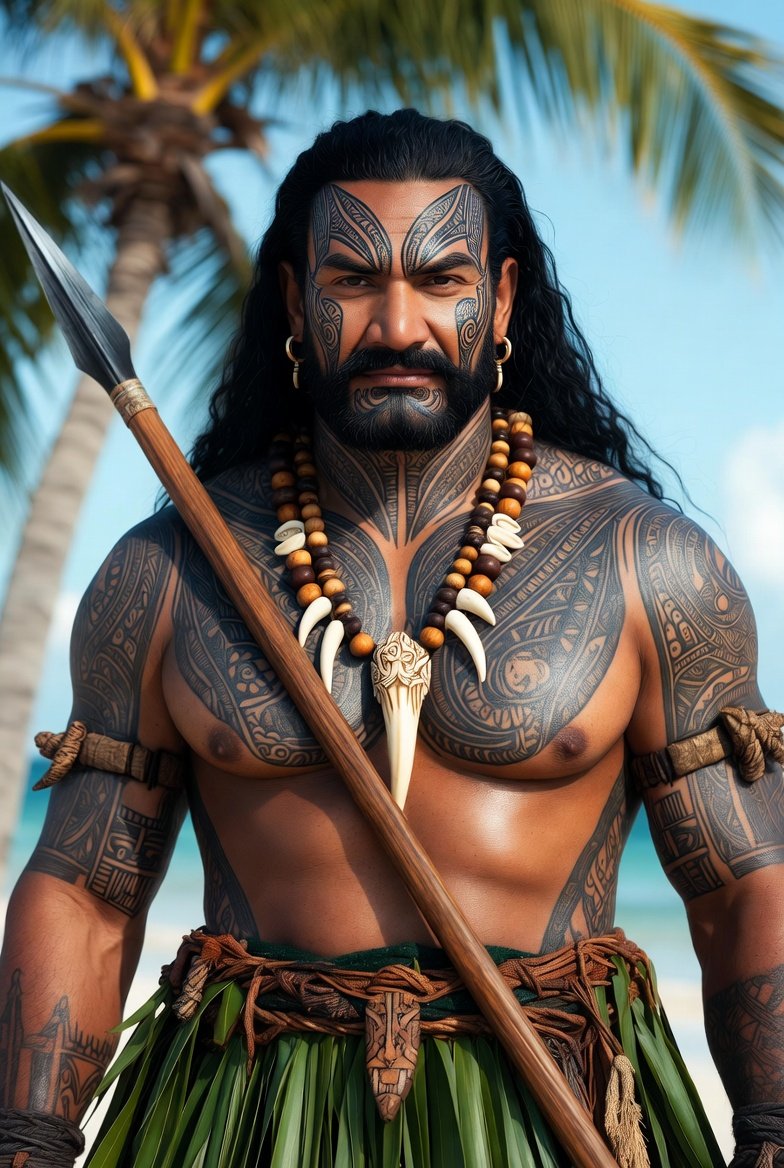
Māia Tāwhirimātea was an imposing figure who embodied the physical ideal of Vaitafe warriors. Standing at 6'6", he was not merely tall but massively built, a wall of muscle from shoulder to shoulder that spoke to years of rigorous training and the physical demands of traditional island life. His sun-bronzed skin was adorned with intricate traditional tattoos that told the story of his lineage, achievements, and spiritual journey, each mark placed with ceremonial significance by the tribe's master tattooists. His long, dark hair was often worn in elaborate braids decorated with feathers from sacred birds and shells collected from ceremonially significant locations. His deep brown eyes were piercing and intense, holding within them what seemed like the accumulated wisdom of all the chieftains who had come before him. Every movement he made carried purpose and power, the physical grace of a warrior combined with the dignified bearing of a leader who took his responsibilities seriously.
Unique Characteristics
What set Māia apart even among the physically impressive Vaitafe warriors was his sheer size and presence. He dominated any space he entered not through aggression but through the undeniable reality of his physical form and the spiritual authority he carried as chieftain. His hands, large enough to completely encompass a man's head, bore the calluses of a lifetime working with traditional weapons and tools. He wore traditional Vaitafe warrior garb: woven fiber wraps, bone ornaments, and ceremonial pieces that marked his status as chieftain. Around his neck hung a pendant carved from whale bone, a symbol of leadership passed down through generations of Vaitafe chieftains. His voice, when he spoke, carried the deep resonance of someone accustomed to being heard over crashing waves and howling winds. Those who met him reported an almost physical sensation of being evaluated, as if his gaze could measure not just their body but their spirit and intentions.
Personality
Positive Traits
- Fiercely protective of his people and traditions
- Demonstrated exceptional physical prowess
- Deep spiritual connection to natural world
- Fair and kind leader to his own people
- Unwavering in defense of Vaitafe values
- Brave to the point of self-sacrifice
Challenging Traits
- Deeply distrustful of outsiders and technology
- Sometimes inflexible about traditional ways
- Visible contempt for modern conveniences
- Prioritized community over individual desires
- Could be stern and intimidating
- Resistant to outside influence or change
Strength is not just in the arm that wields the spear, but in the heart that bears its weight. Our ancestors guide us, and their wisdom is our true power. We do not fight for conquest; we fight to preserve what is sacred.
The spirits of our ancestors watch over these shores. To abandon our ways is to abandon them, and I will not dishonor their memory.
Let them come with their machines and their arrogance. The ocean was here before them and will be here after. We are part of that eternal cycle, and it gives us strength they cannot comprehend.
Likes
- Maintaining traditional Vaitafe customs
- Spiritual rituals and ancestral ceremonies
- Physical prowess and martial excellence
- Environmental harmony and natural balance
- Teaching younger warriors tribal ways
Dislikes
- Modern technology in any form
- Outside influence on Vaitafe culture
- Disrespect toward nature or spirits
- Individualism prioritized over community
- Those who abandon traditional ways
Background & History
Born to Tradition
Māia Tāwhirimātea was born and raised in the heart of the Vaitafe village on the island of Ahorangi, a secluded paradise that had remained largely untouched by the outside world's relentless march toward what others called progress. From his earliest memories, Māia displayed an uncanny connection to the natural world and the spirits that the Vaitafe believed inhabited every rock, tree, and wave. His parents recognized this gift early and ensured he received the most comprehensive spiritual education available, studying under the tribe's eldest shamans and learning to commune with the ancestral spirits who guided their people. As a child, he would spend hours sitting by the shore or deep in the island's forests, claiming he could hear the voices of those who had come before, feel their presence in the wind and water.
The Path of the Warrior
As Māia grew into adolescence, his spiritual gifts were matched by exceptional physical prowess. He excelled in all the traditional skills of his people: fishing in the treacherous waters around Ahorangi, navigation by the stars across vast ocean distances, and particularly the ancient martial arts passed down through countless generations of Vaitafe warriors. His size and strength, combined with his spiritual insight, marked him as exceptional from an early age. By the time he reached adulthood, few could match him in combat, and none questioned his dedication to preserving the traditional ways. He underwent the ritual tattooing that marked his progression through warrior ranks, each mark earned through specific achievements and spiritual milestones. His teachers spoke of him with pride, noting that he embodied the ideal combination of physical might and spiritual wisdom that the greatest Vaitafe warriors had always displayed.
The Sea Spirit Crisis
Māia's ascension to the role of chieftain came earlier than anyone expected, following a crisis that threatened the entire Vaitafe people. A powerful sea spirit, angered by some unknown transgression, began causing devastating storms that destroyed fishing boats, damaged homes, and threatened to wash away parts of the village itself. The previous chieftain and the tribe's shamans attempted various appeasement rituals, but nothing worked. The storms only grew worse, and whispers began to spread that the spirits had turned against the Vaitafe permanently. It was Māia, then only in his mid-twenties, who proposed leading an expedition to the spirit's deep ocean dwelling to make direct appeal. Despite the obvious danger, he gathered a small group of the bravest warriors and paddled out into the heart of the storm. What happened during that encounter was never fully explained, but Māia returned three days later with his warriors, exhausted but alive, and the storms ceased immediately. His bravery, spiritual insight, and success in resolving the crisis earned him the respect and admiration of the entire village, and he was unanimously chosen as the new chieftain.
Guardianship of Tradition
As chieftain, Māia staunchly maintained the traditional ways of the Vaitafe with a fervor that sometimes bordered on absolutism. He believed deeply that his people's connection to the spirits and the natural world was what gave them strength and purpose, and that any dilution of these traditions would weaken them fundamentally. He viewed modern technology and outside influences as threats to the delicate spiritual balance that sustained Vaitafe life, often reacting with visible disgust when traders or visitors brought such items to the island. He would make a characteristic sneer whenever he encountered technology, a expression that became well-known among his people. Despite his stern demeanor toward outside influences and his sometimes inflexible approach to tradition, Māia was known for his kindness and fairness when dealing with his own people. He ruled with a firm but gentle hand, always striving to make decisions that benefited the community as a whole rather than any individual. He was particularly devoted to teaching the younger generation, spending hours instructing young warriors in traditional combat techniques and spiritual practices.
The Growing Shadow
Māia's greatest challenge as a leader was maintaining the isolation and traditional lifestyle of the Vaitafe in a world that increasingly encroached upon their borders. He saw this as a sacred duty, believing that preserving their way of life was crucial not just for the Vaitafe but for maintaining the spiritual balance of the entire world. As reports reached Ahorangi of conflicts and strange powers emerging across Xeres Prime, Māia became even more convinced that the Vaitafe's isolation was their greatest protection. He rejected diplomatic overtures from outside powers, refused trade agreements that might create dependency on foreign goods, and worked to strengthen the island's defenses against potential invasion. When whispers began to spread about eldritch forces and unnatural powers being wielded by distant cities, Māia intensified the spiritual protections around Ahorangi, consulting with shamans and performing rituals meant to keep such corruptions far from their shores. He believed that by remaining pure in their traditions and strong in their connection to the natural spirits, the Vaitafe could weather any storm the changing world might bring.
The Day the World Ended
In the early weeks of Goldenleaf 1303, everything Māia had worked to prevent came to pass in the most horrific way imaginable. Oraeus, wielding eldritch powers that defied natural law, launched an assault on the island of Ahorangi. What emerged from the corrupted vessels was a nightmare made flesh: a pink eldritch horror standing one hundred feet tall, its very existence an affront to the natural order that the Vaitafe held sacred. The creature's presence corrupted the land around it, causing plants to wither and die, animals to flee in terror, and even the ocean itself to recoil from its touch. Māia rallied his warriors immediately, organizing a desperate defense despite the obvious impossibility of their task. He knew from the moment he saw the creature that this was a battle they could not win, but surrender was not in his nature. Instead, he focused on buying time, ordering non-combatants to flee while he and the warriors engaged the horror directly.
The Final Stand
The battle was brutal and one-sided from the beginning. Traditional weapons and warrior prowess meant little against a creature of pure eldritch corruption that stood as tall as the ancient trees and seemed impervious to physical harm. Warriors fell in waves, their bravery meaningless against such overwhelming alien power. But Māia refused to yield, continuing to fight even as he watched his people die around him. He called upon every spiritual technique he had ever learned, attempting to channel the ancestral spirits against this abomination, but the creature's very nature seemed to corrupt and dispel such powers. As more warriors fell and it became clear that the evacuation was still incomplete, Māia made his final decision. He ordered the remaining warriors to fall back and help with the evacuation while he alone engaged the horror, using every ounce of his considerable strength and skill to hold its attention. For precious minutes, he succeeded, moving with desperate speed and striking with all his might, accomplishing nothing but buying time. His family, his tribe, the people he had dedicated his life to protecting, watched from fleeing boats as their chieftain made his last stand. Māia Tāwhirimātea died as he had lived, standing between his people and destruction, fighting an unwinnable battle with unflinching courage. The tragedy was that his sacrifice, monumental as it was, proved insufficient. Most of those who fled would fall to other horrors or simply disappear into the chaos that followed. The Vaitafe culture that Māia had fought so hard to preserve was effectively destroyed, surviving only in the scattered few who had been dispersed to other corners of Xeres before the attack. The world lost not just a warrior and leader but an entire way of life that day on Ahorangi.
Goals
Preserving Vaitafe Culture
Above all else, Māia was committed to preserving the traditional Vaitafe way of life in its purest form. He believed that his people's spiritual connection to the natural world and their ancestral spirits was not just a cultural preference but a fundamental aspect of who they were. His goal was to maintain this connection for future generations, ensuring that children born on Ahorangi would grow up with the same deep understanding of tradition that he possessed. He worked tirelessly to document oral histories, ensure proper training in traditional skills, and maintain the spiritual practices that he believed kept the Vaitafe strong. He saw himself not as creating something new but as faithfully preserving what had been entrusted to him by countless generations of chieftains before him. This preservation extended to every aspect of life, from fishing techniques to martial arts to spiritual rituals, all of which he viewed as interconnected parts of a sacred whole.
Maintaining Spiritual Balance
Māia genuinely believed that the Vaitafe's traditional lifestyle and spiritual practices contributed to a larger balance in the world, not just on Ahorangi but across all of Xeres. He saw his people as guardians of ancient wisdom that kept certain natural and spiritual forces in harmony, and he feared that abandoning these practices would have consequences extending far beyond their small island. His goal was to strengthen these spiritual connections, working closely with shamans to ensure that rituals were performed correctly and that the younger generation understood their significance. He wanted to deepen the Vaitafe's relationship with the ancestral spirits and the natural forces they communed with, believing that this would provide protection against whatever threats the changing world might bring. This wasn't superstition in his mind but practical wisdom accumulated over countless generations of living in harmony with powers that others had forgotten or never understood.
Training the Next Generation
As chieftain, Māia took personal responsibility for training young Vaitafe warriors, seeing this as crucial to the tribe's future. His goal was not just to teach combat techniques but to instill the values and spiritual understanding that made Vaitafe warriors different from mere fighters. He wanted each young warrior to understand that their strength came not just from their muscles but from their connection to ancestors, to community, and to the natural world. He spent hours working with young trainees, sharing not just martial techniques but the philosophy behind them, the spiritual significance of each movement and strike. He hoped to create a new generation of warriors who would be as dedicated to preserving Vaitafe culture as he was, capable of defending the island while also maintaining the traditions that made it worth defending.
Protecting Ahorangi from Outside Corruption
In the years leading up to the attack, Māia became increasingly focused on protecting Ahorangi from what he viewed as corrupting outside influences. His goal was to maintain the island's isolation not out of xenophobia but from a genuine belief that contact with the outside world would weaken the spiritual and cultural bonds that made the Vaitafe strong. He worked to strengthen physical defenses, train more warriors, and establish spiritual protections around the island. He wanted to create a situation where Ahorangi could remain separate from the conflicts and changes sweeping across Xeres Prime, a preserved sanctuary where traditional ways could continue undisturbed. When he heard about eldritch powers and unnatural forces being wielded elsewhere, he intensified these efforts, believing that only by remaining pure in their traditions could the Vaitafe resist such corruptions. Tragically, his greatest fear came to pass in a way he could never have anticipated, and his preparations proved utterly inadequate against an enemy that operated on principles foreign to everything he understood.
Current Status
Allegiance
The Vaitafe People (Chieftain)
Role
Chieftain and Spiritual Leader
Primary Relationships
Family:
Māia's Wife (Deceased)
Māia's Children (Deceased)
Community: Vaitafe Warriors (Fallen Defenders) Vaitafe Elders and Shamans (Spiritual Advisors) The Vaitafe People (Tribe)
Survivors: Aroha Garkalsadon (Scattered Tribeswoman)
Community: Vaitafe Warriors (Fallen Defenders) Vaitafe Elders and Shamans (Spiritual Advisors) The Vaitafe People (Tribe)
Survivors: Aroha Garkalsadon (Scattered Tribeswoman)
⚔️ Cultural Loss Warning
Māia Tāwhirimātea's death represents more than the loss of a single warrior or leader; it marks the effective extinction of the Vaitafe people as a cohesive culture. His heroic last stand, while buying precious minutes for evacuation, could not prevent the systematic destruction of everything he had dedicated his life to protecting. The traditional knowledge, spiritual practices, martial techniques, and cultural wisdom that had been passed down through countless generations died with him and the warriors who fell defending Ahorangi. Those few Vaitafe who survived and scattered across Xeres carry fragments of this heritage, but without the community structure and spiritual connection to their homeland, much has been irrevocably lost. Māia's legacy serves as a tragic reminder that some enemies cannot be defeated through bravery and strength alone, and that cultural preservation requires more than just the will to fight. His death also stands as testimony to the horrific power of the eldritch forces that Oraeus wielded, capable of destroying in hours what had taken generations to build and maintain.