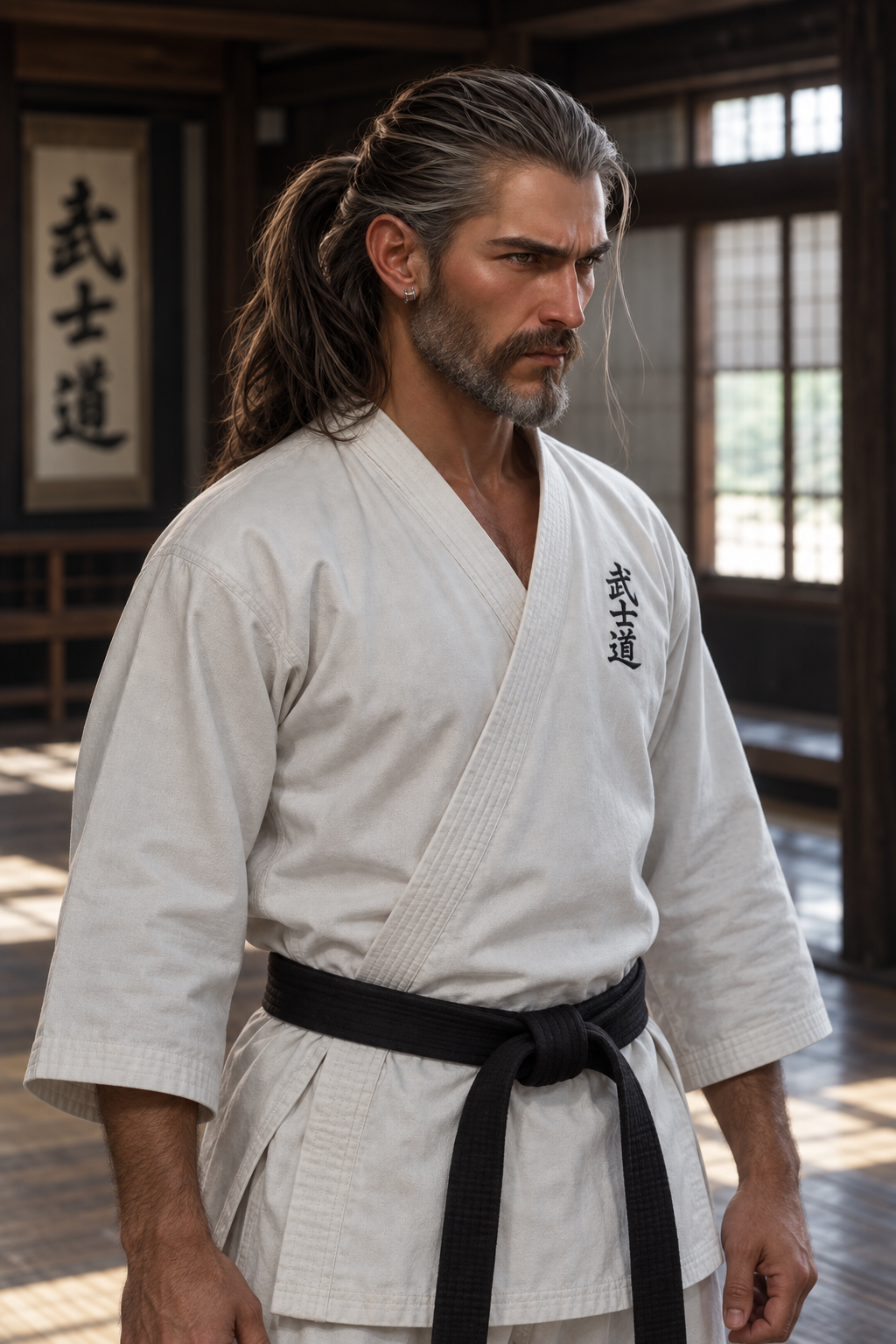
A Harbor Boy from Tazzinburgh
Corren was born in 1206 on the waterfront of Tazzinburgh, the son of a net-mender and a deckhand who was more often at sea than at home. He grew up small, quick, and constantly in fights he hadn't started and couldn't finish. The harbor was full of Pan'Chean sailors, and one of them told him, over a shared bowl of noodles, that the island's warriors could put a grown man on the ground without ever closing their fists. At twelve, tired of losing, Corren stowed away on a Pan'Chean trader to find out if it was true. He was discovered three days out, worked off the rest of the passage scrubbing decks, and was put ashore in Pan'Che with nothing but the clothes he'd hidden in.
The Broom and the Gate
A foreign boy with no family name had no place anywhere in Pan'Che's rigid order of samurai, merchants, and artisans, and for most of a year Corren lived on scraps around the docks. What saved him was stubbornness. He followed a pair of traveling monks north into the Jade Mountains, and when they refused to take him in, he sat outside their monastery gate for nine days until the old master, Ryozen, came out, handed him a broom, and went back inside without a word. Corren swept that courtyard every morning for a year before anyone taught him a single stance. He stayed fifteen years, and Ryozen taught him everything the monastery had to give except one thing: a form the old man called the Eternal Form, which he said could not be taught, only found.
Sent Down the Mountain
When Corren was twenty-eight, Ryozen told him there was nothing left for him to learn on the mountain, and that whatever remained would have to be learned everywhere else. He sent him down with a gi, a bowl, and no destination. Corren never saw his master again. Word reached him years later, in a foreign city, that the old man had died in his sleep sitting upright in meditation, which Corren considers the only fitting way Ryozen could have gone.
Forty Years of Road
The decades that followed were never a plan. Corren crossed the water to Aurenthal and spent six years on the Lionelle training grounds, losing, then losing less, then not losing at all, until the prides stopped testing him and started asking him questions instead. He spent nearly a decade in Thornhaven, where a whole city of obsessive masters taught him that mastery is not a destination but a chore you do every morning for the rest of your life. In between and afterward, he guarded caravans, escorted pilgrims, broke up more tavern fights than he could count, and never once took a coin for fighting in a ring. He never stayed anywhere long enough to call it home, and he never missed a single morning's practice.
The Heavens Were Watching
At thirty-eight, during his Thornhaven years, Corren rose one morning to find a fruit of pale gold resting on the flat stone where he had practiced every dawn since arriving in the city. He had never heard of the Heavens rewarding patience, and still isn't certain that is what happened, but his Gnoll hosts knew an evolutionary treasure when they saw one and insisted on standing watch over him while he ate it. The transformation took eleven days. He came out of it leaner, denser, and aging at a fraction of his former pace, and went back to practicing the next morning as though nothing had changed.
A Dojo Among the Roots
Corren came to Gelderai in 1276 guarding a caravan up the trade road from Tazzinburgh and meant to stay a week. On his second night in the Rootways, he stepped between a half-elf boy and the four older youths beating him; the fight lasted about as long as it takes to describe it. The boy followed him for three days asking to be taught. Corren said no every time, then found an empty hollow between two buttress roots, swept it out, hung a hand-carved sign over the entrance, and opened the Dojo of the Eternal Form. For thirty years he taught anyone willing to learn: humans, half-elves, mongrelfolk, orphans, caravan hands off the trade roads, and, as the years wore on, a steady trickle of young elves from the Boughways who had heard that the human in the roots could do things their own masters couldn't explain. His students called him Sensei, a Pan'Chean word for teacher that almost no one in Gelderai had heard before he arrived. Tuition was whatever a student could pay. Every student, whatever they paid, spent their first month sweeping the floor and carrying water.
The Night the Rootways Fell
When the undead incursion tore into Gelderai, it came in along the forest floor, and the Rootways took the worst of it first. The dojo's single entrance, a narrow gap between two buttress roots, was the most defensible doorway on the street, and within the hour the hall behind it was full: students, their families, neighbors, strangers. Corren put his senior students in charge of getting everyone out along the trade road and took the doorway himself. He held it until the last of them were clear, then walked out behind them with his gi black with grave-dust, carrying nothing but the carved sign from over the door. He does not describe what he fought that night. His students do, when he isn't in the room.
Back to the Sea
Of the three cities taking in Gelderai's refugees, Corren chose Rokoura, the smallest, for two reasons: it sits beside the sea he was born beside and hadn't lived near in decades, and it was small enough that one more teacher might actually matter. He has been in Rokoura less than a month. Every morning before sunrise he practices alone on the sand of Ākau Nui, and by the end of his second week, a dozen local children had begun copying his forms from what they believed was a careful, unnoticed distance.