Pyrite Crucible
Description
Built around Arties' expertise, the Pyrite Crucible is a specialized refinery for processing the mine's excess pyrite into iron stock, alchemical sulfur, and polished decorative goods, turning fool's gold into something genuinely valuable.
Anyone who has spent time around the mine knows the problem. Pyrite, iron disulfide, fool's gold, turns up in abundance alongside the veins that actually matter. It looks the part: brassy, cubic, gleaming. It fools the eye. But it's not gold, and until now it's been shoveled aside into growing heaps on the mine's eastern edge, useful to nobody and costing workers time to clear.
Arties changed that.
The Pyrite Crucible occupies a low, broad building adjacent to the mine complex, its thick stone walls built to absorb the persistent heat of the roasting kilns within. A pair of broad chimneys mark it from the road, trailing thin wisps of pale smoke on most days, the byproduct of the roasting process that drives everything else the facility does. The smell near those stacks has a faint, sharp edge to it: sulfur, clean and acrid, the smell of something being broken down and made useful.
Inside, the workflow is methodical. Raw pyrite ore arrives from the mine on carts, sorted and weighed at the receiving station near the main door. Arties has developed a grading system scrawled across a large chalkboard on the far wall: coarse ore for the kilns, finer crystalline pieces set aside for decorative work, and any specimens of unusual size or luster pulled for potential sale as curiosities. Nothing is wasted.
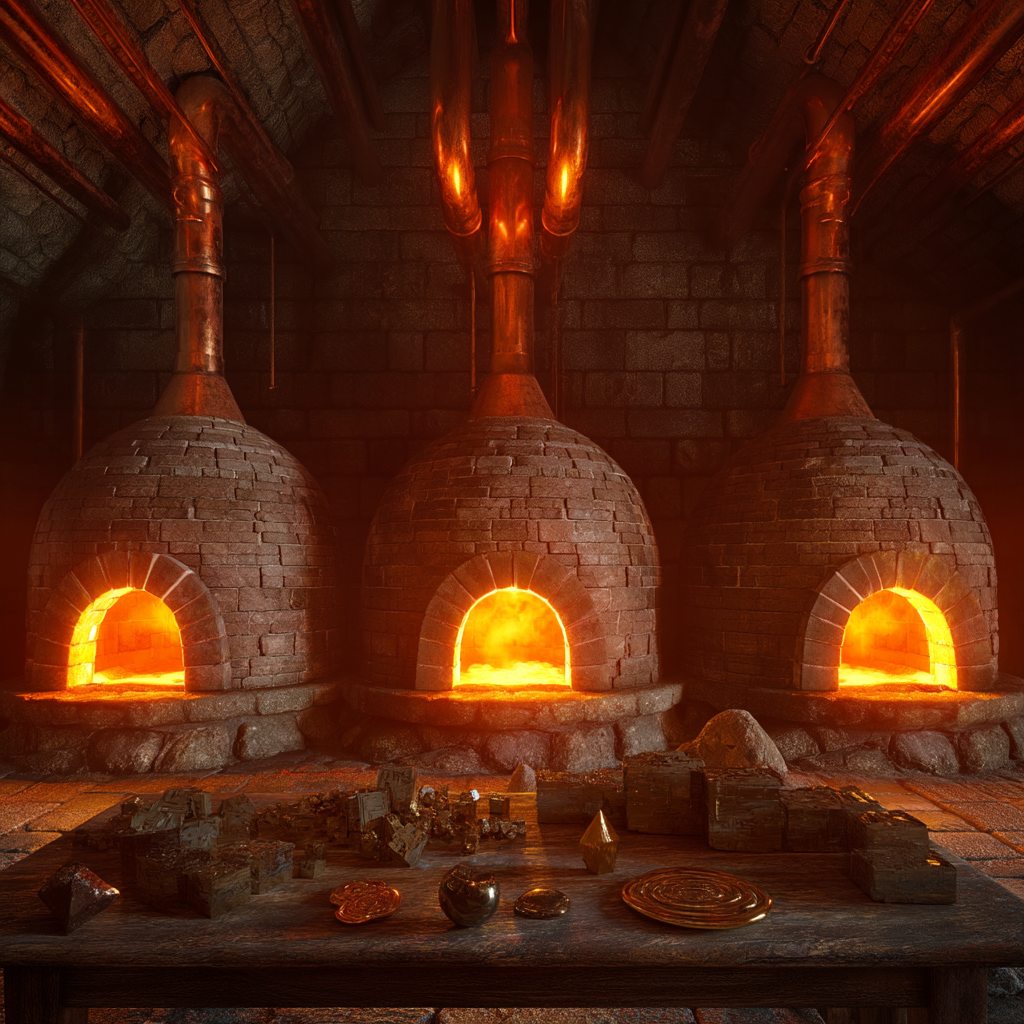
The roasting kilns dominate the center of the building, three brick-lined chambers fed by bellows systems, each capable of sustaining the sustained temperatures needed to drive off the sulfur content of the ore. The released sulfur dioxide is captured through a clever series of sealed pipes and condensation chambers Arties designed herself, collecting as liquid sulfur and eventually sulfuric compounds useful to the Apothecary for tinctures, reagents, and certain preservation processes. The remaining iron-rich slag is refined further in a smaller smelting furnace at the back of the building, producing workable iron stock that feeds the Smithy directly.
A separate, quieter corner of the building handles the decorative trade. Pyrite's natural geometry, those perfect cubic crystals, that gold-bright sheen, has its own market among jewelers, collectors, and the simply vain. Workers here don't roast; they cut, polish, and mount. Pyrite inlay work has become a minor specialty of Goodberry, recognizable by its warm metallic glitter and distinctly lower cost than actual gold gilding. Arties oversees this section personally, and it shows: the finished pieces are carefully presented in cedar-lined display cases near the front of the building, waiting for merchants or the Guildhall to move them.
The Crucible keeps unusual hours. The kilns run around the clock in shifts, and on most nights a faint amber glow escapes from under the main doors, accompanied by the low rhythmic sound of the bellows. Arties is often found there well after dark, adjusting intake ratios or testing a new condensation configuration, apparently convinced that the process has another few percent of efficiency still to give.
Benefits
The Pyrite Crucible converts the mine's excess pyrite stockpile each month into three categories of output. Each month, the facility processes up to 500 lbs of raw pyrite from the estate's stockpile, yielding roughly 180 lbs of refined iron stock (which may be applied directly toward the Smithy's material costs), a batch of alchemical sulfur compounds worth approximately 75 gold in trade to the Apothecary or open market, and a quantity of polished decorative pyrite goods sold through the General Store or Guildhall for approximately 100 gold.
If Arties is assigned to the Crucible as its primary operator, all three output categories increase by 25%, and she gains a +2 circumstance bonus to any Craft (Alchemy) checks made within the facility. Any NPC assigned as a secondary operator gains a +1 on relevant checks from her documentation and process notes.
The Crucible has a synergy with the Apothecary: the sulfur compounds produced here count as on-hand reagents for alchemy purposes, removing the need to purchase or forage for sulfur-based ingredients each month. Similarly, its iron output qualifies as raw material for the Smithy, reducing that building's supply upkeep by a modest amount each cycle.
The facility generates 5 Prestige, not because pyrite is glamorous, but because a town that finds uses for its waste is a town that knows what it's doing.
Note: This facility can be purchased multiple times, increasing the factory's output accordingly.