Goodberry Ironworks
Description
The Ironworks is Goodberry's answer to an industrial problem: the mine produces far more iron than the city can consume, and raw ore sitting in stockpiles is money sitting still. This facility converts that excess into finished goods, trade ingots, civic infrastructure, and military hardware at a scale no single smithy could approach.
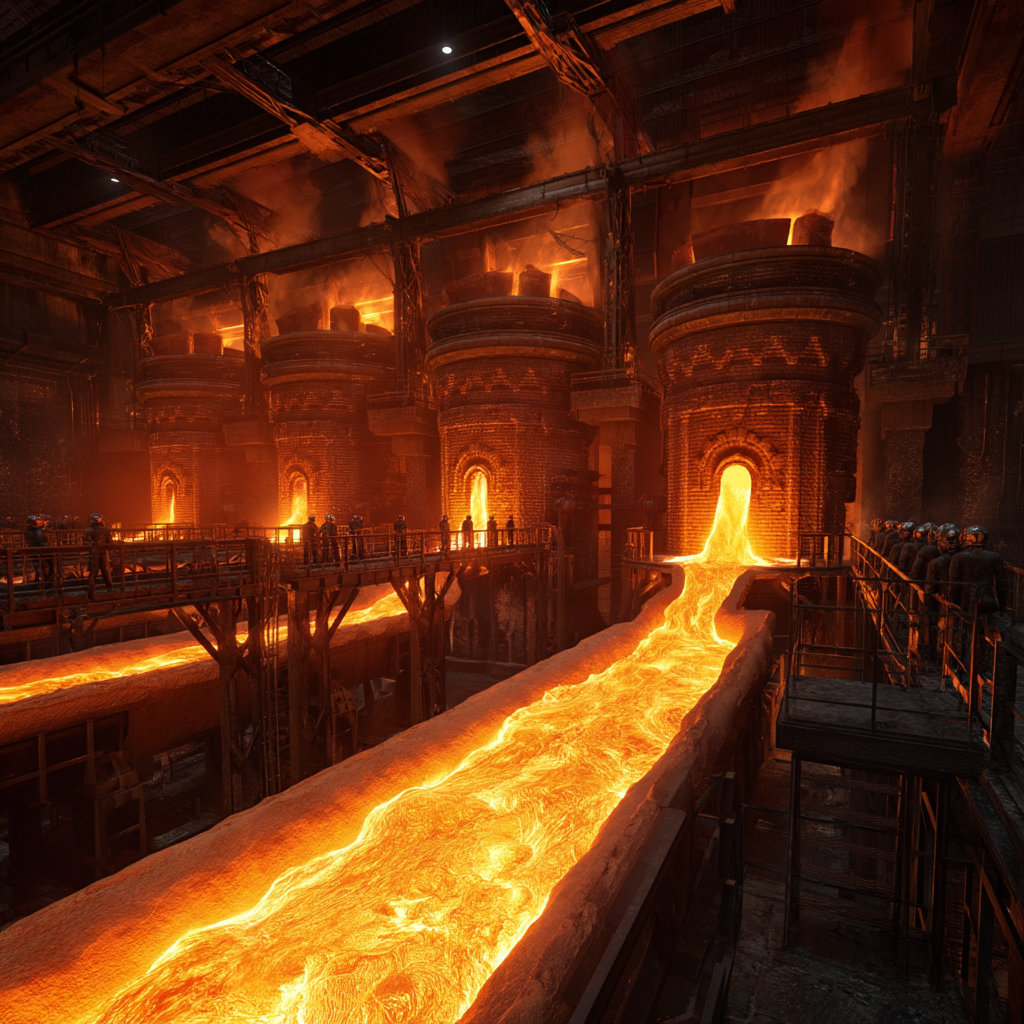
You can smell the Ironworks before you see it. The acrid tang of slag, the particular dry heat that precedes a blast furnace by fifty yards, the low, bone-felt percussion of the trip hammers, these things announce it from well across the district. It occupies the largest single footprint of any structure in Goodberry outside the walls themselves: a sprawling complex of interconnected buildings, open yards, cooling pools, and covered walkways, all oriented around the roar and glow of its four central blast furnaces.
The furnaces are the heart of the operation and the reason for everything else. Each one stands nearly thirty feet tall, brick-lined and iron-banded, fed from above by ore chutes and charcoal hoppers that workers tend on elevated catwalks. The heat they produce is staggering, the interior of the casting floor is uninhabitable without proper protection, and the workers who tend the tap holes wear thick aprons, face shields of smoked glass, and iron-toed boots as a matter of survival. The furnaces run continuously, day and night, cooling only for quarterly maintenance. Newcomers to Goodberry who see the orange glow on the clouds above the Ironworks at night sometimes mistake it for a fire. It isn't. That's just the works, going about its business.
Molten iron leaves the furnaces through a network of sand-cast channels that direct flow into the facility's various downstream operations. The casting yard handles the bulk of output: standardized pigs of refined iron, shaped in rows of sand molds, cooling in ranked lines until they can be stacked and moved. These ingots are the Ironworks' primary trade product, a uniform, reliable form factor that merchants, smiths, and foundries across the region know and trust. Goodberry iron has a reputation now. It's clean, consistently graded, and available in quantity. That last part matters most.
Beyond the casting yard, the complex divides into specialized wings depending on the month's production priorities. The rolling mill, powered by a substantial waterwheel drawing from a diverted run of the Whispering Stream, flattens refined iron into sheets, rods, and bar stock. The stamping floor uses a set of large drop hammers to produce standardized hardware: nails, spikes, hinges, brackets, couplings, and the hundred small iron components that construction and shipbuilding eat by the barrel. The armament wing, when active, feeds the Smithy with pre-shaped blanks for swords, spearheads, and armor plates, dramatically accelerating what the Smithy can produce per week. The shipwright has standing orders for iron fittings that the Ironworks fulfills on a monthly cycle.
Managing all of this is a Foundry Master, a position the operation took some time to fill correctly. The role requires someone who understands metallurgy, logistics, worker management, and enough accounting to track which production mode is generating what margin. The current Foundry Master keeps a meticulous production ledger and posts the monthly output summary in the Town Hall each cycle.
The workforce is significant. Tapping crews, casting workers, rollers, hammermen, quality sorters, logistics staff, charcoal handlers, the Ironworks is one of the largest single employers in Goodberry, and it shows in the district that's grown up around it. A cluster of boarding houses, a tavern that runs all three shifts, and a small bathhouse have all appeared within two blocks of the main gate in the past year, following the workers as workers always do.
There is one standing rule at the Ironworks that nobody debates: the furnaces do not go cold. Relighting a cooled blast furnace takes three days and a significant investment in materials. Every supervisor on every shift knows this. Every new hire hears it on their first day. The furnaces do not go cold.
Production Modes
Each month, the Ironworks is assigned one primary production mode by the estate's management. The mode determines how the facility's capacity is allocated and what it produces. A secondary mode may be run at half capacity alongside the primary, at the GM's discretion, if the workforce and materials allow.
Each mode consumes up to 80,000 lbs of raw iron per month from the stockpile, with the remaining ore feeding the Smithy and other downstream needs at no additional cost.
| Mode | Output | Monthly Income | Other Effects |
|---|---|---|---|
| Trade Ingots | Refined iron sold to regional merchants and smiths | 2,400 gp | Default mode. Increases by 200 gp per active portal city with a trade relationship. |
| Construction | Nails, brackets, rods, sheet iron, and structural components | 1,200 gp | Reduces construction cost of any new estate upgrade purchased that month by 15%. Excess stock can be sold or banked for future builds. |
| Armaments | Weapon blanks, armor plates, and military hardware | 800 gp | Supplies the Guard and Armory for free. The Smithy produces masterwork-quality items this month at no additional material cost. Equip a militia unit without purchasing supplies separately. |
| Shipwright Supply | Hull fittings, anchor chain, cannon fittings, keel bolts | 1,000 gp | Requires Harbor Complex. Reduces ship construction time and cost at the Shipwright's Workshop by 20% this month. |
| Agricultural Tools | Plows, scythes, hoes, wheel rims, barrel hoops | 600 gp | Boosts all farm and orchard income by 10% this month. Reduces upkeep costs by 10%. |
| Export Surplus | Raw ore and semi-refined ingots pushed through portals for bulk export | 3,200 gp | Maximum income mode. No downstream benefits, pure revenue. Requires at least 6 active portal cities to run. |
Benefits
The Ironworks is classified as a Major Economic Structure. Its presence alone generates 12 Prestige, more than any other single mundane upgrade in Goodberry, reflecting its visible dominance of the city's industrial identity and its reputation across the region as a reliable source of high-volume iron goods.
The facility provides a standing material subsidy to the Smithy, Masterwork Forge, Airship Workshop, and Shipwright's Workshop: none of these buildings need to independently source iron. Their material upkeep costs are reduced to zero so long as the Ironworks is operational.
Any iron-dependent upgrade built while the Ironworks is in Construction mode has its gold cost reduced by 15%. This applies once per month and stacks with any other cost-reduction effects.
The Ironworks is a prerequisite for the Steel Converter upgrade, which allows a portion of iron output to be alloyed into steel each month, dramatically increasing the value of finished goods and unlocking additional production modes.