Description
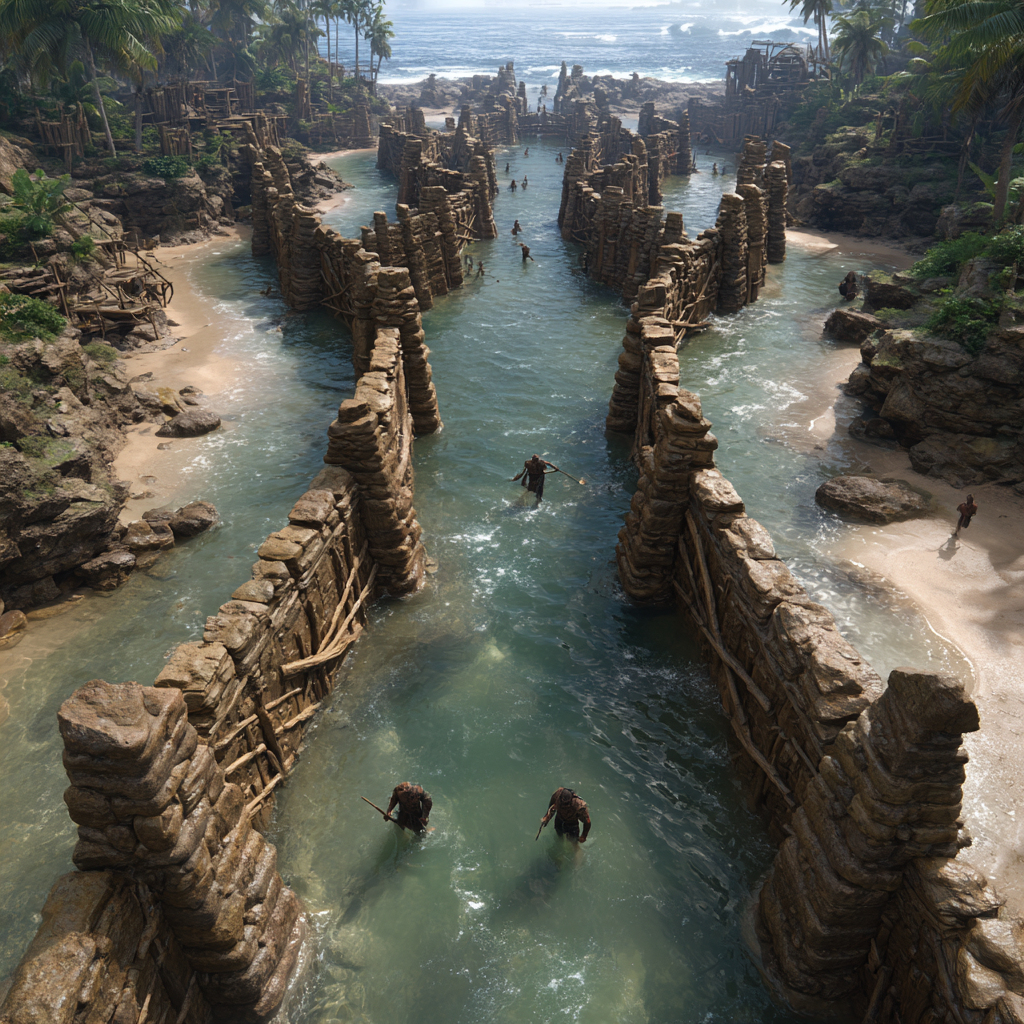
At the narrow point of each V, where the stone walls nearly meet, a sophisticated trap mechanism completes the structure. Sturdy wooden posts driven deep into the channel bottom support a framework of woven slats that create a gradually narrowing passage leading to a large holding chamber. This chamber, measuring roughly ten feet in diameter and six feet deep, is constructed from vertical wooden poles lashed tightly together with barely enough space between them for water to pass but far too narrow for any fish larger than a few inches to escape. A hinged gate on the landward side allows workers to access the chamber for harvest while a removable cover across the top prevents seabirds from stealing the catch. The entire wooden structure is treated with fish oil and resin to resist rot and is designed to be easily disassembled and repaired as needed, as the Vaitafe understand that the constant action of tides and occasional storm surges will require ongoing maintenance.
The genius of the weir design lies in its passive operation. As the tide floods in, fish swim freely through the tidal channels, following the rushing water into the shallows where they feed on the abundant small creatures stirred up by the moving water. The weir walls are low enough and the gaps between stones wide enough that fish pass over and through them with ease during high tide, entering the area behind the weir without perceiving any barrier. But as the tide turns and water begins to drain from the flats, fish instinctively follow the current back toward deeper water. The V-shaped walls guide them inexorably toward the narrow opening where the trap chamber waits. Once inside, fish find themselves in a spacious holding area with plenty of water and oxygen, but the dense vertical poles make escape impossible. By the time low tide arrives, each weir typically holds dozens or even hundreds of fish, trapped alive and healthy, awaiting harvest.
Maintaining and harvesting the weirs follows a precise schedule dictated by the tides. Teams of workers visit each weir complex during the first two hours of low tide, when access is easiest and the trapped fish are most concentrated. They approach along marked paths, wading through ankle-deep water while carefully watching for hidden sandrays and other hazards. At each weir, they open the access gate and use long-handled nets to transfer fish from the holding chamber to carrying baskets. The fish are sorted by type and size, with the smallest specimens often released to mature for future harvests. Once emptying is complete, workers inspect the structure for damage, replacing any broken slats, tightening loose lashing, and clearing away accumulated debris that might impede water flow. During storm season, additional inspections occur to repair damage from the powerful waves that sometimes break over the weirs, but the robust construction ensures these traditional fishing structures continue functioning year after year with only modest maintenance.
The weirs have become more than just fishing infrastructure. They serve as teaching tools where young Vaitafe learn to read tides and currents, understand fish behavior, and practice the patient observation that characterizes the tribe's relationship with the ocean. Each weir complex has been given a name commemorating an ancestor or celebrating a particular characteristic, and small carved stones placed atop the walls mark them as places of respect where the ocean's generosity is acknowledged with gratitude. The reliable harvest they provide has become foundational to the settlement's food security, producing a steady supply of fresh fish regardless of weather conditions that might prevent boat fishing. In the accelerated environment of Goodberry, where fish populations replenish at remarkable rates, the weirs can be harvested twice daily following each low tide without depleting the resource, a bounty that earlier generations of Vaitafe could scarcely have imagined.
Benefits
The Tidal Trap Weirs provide a passive fishing method that yields hundres of pounds of fish per day on average. The weirs operate continuously with minimal labor, requiring only harvest and maintenance. Fish caught in weirs are alive and fresh, commanding premium prices and providing superior quality for settlement consumption. These fish generate an additional 350 gold every month. This upgrade generates 2 Prestige.