Description
The material preparation section occupies one end of the workshop, where enormous quantities of pandanus leaves undergo processing specifically tailored for sail making. Unlike mat weaving that uses relatively short strips, sail work requires the longest possible fibers to minimize the number of joins in the finished product. Workers split pandanus leaves down their length into strips approximately one inch wide, then scrape away the tough outer layers to reveal the strong inner fibers. These strips are then carefully graded, with only the finest quality materials being selected for sail production, as inferior fibers that might be acceptable for baskets or mats would create dangerous weak points in a sail subjected to storm-force winds. Selected strips undergo a specialized treatment process involving repeated soaking in seawater followed by controlled drying, a technique that strengthens the fibers while making them more flexible and resistant to mildew. Some materials receive additional treatments with natural oils that enhance water resistance without adding significant weight. Prepared strips are organized by length, quality, and treatment type on massive racks that line the preparation area's walls, creating a reference library of materials that sail makers can draw upon as work progresses.
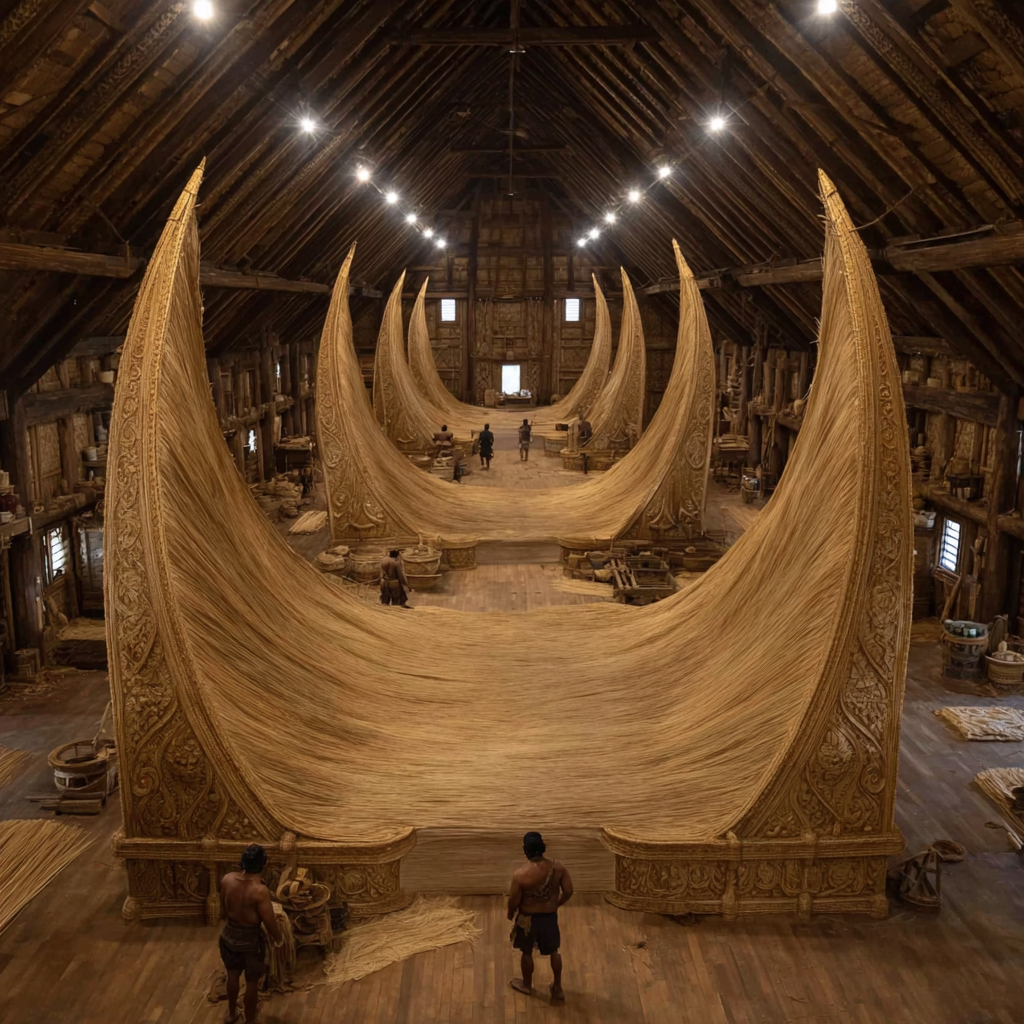
The main weaving area occupies the workshop's vast central space, where multiple sails can be under construction simultaneously at different stages of completion. The fundamental technique involves a specialized form of close weaving that creates a tight, wind-resistant fabric while maintaining enough flexibility to billow and curve properly when filled with wind. Sail makers work in teams, with experienced weavers handling the critical structural edges and corners while apprentices fill in the central sections under close supervision. The process begins by establishing the sail's perimeter using the strongest materials woven in doubled or tripled patterns for reinforcement. As work progresses inward, weavers constantly assess the developing sail's shape, making minute adjustments to tension and weave tightness that will determine how the finished sail responds to wind pressure. Traditional Vaitafe sails feature a distinctive curved lower edge that helps shed water and allows better control in varying wind conditions, a design refinement that requires exceptional skill to execute properly. The workshop maintains pattern templates for standard sail sizes, but master sail makers pride themselves on creating custom designs that match specific vessels' characteristics and their owners' sailing styles.
A dedicated reinforcement and finishing station handles the critical final stages that transform woven panels into functional sails. Reinforcement begins with the attachment of edge roping, using specially prepared cordage from the settlement's Rope Twining facility that distributes stress across the sail's perimeter. Corner patches receive multiple layers of material, creating reinforced points where the greatest forces concentrate during use. Reef points, the attachment locations that allow the sail's effective area to be reduced in heavy weather, are added using a complex binding technique that prevents tearing even under extreme stress. Sail makers install grommets fashioned from bone rings or woven fiber loops at precise intervals, providing attachment points for rigging lines. Each sail receives a thorough inspection where it is suspended at full extension and examined from every angle, with any weak spots or irregularities being repaired before the sail is approved for use. A final treatment with a proprietary mixture of oils and plant resins makes the sail water-resistant while preserving the material's breathability, essential for preventing the mildew that would quickly destroy an improperly treated sail in the humid coastal environment. Completed sails are carefully folded using techniques that prevent creasing, then stored in a climate-controlled section until delivery to boat owners or shipment to distant buyers.
The Sail Making workshop produces the essential components that transform hulls into vessels capable of harnessing wind power for transportation, fishing, and trade. The workshop maintains close collaboration with the Boatbuilder's Yard, with sail makers often consulting during vessel design to ensure optimal integration of hull characteristics and sail configuration. Master sail makers can examine a boat's proportions and predict exactly what sail dimensions and shapes will provide the best performance, knowledge gained through decades of experience and observation. The workshop produces sails ranging from small triangular pieces for single-person fishing canoes to massive rectangular sails that power the largest trading waka. Beyond new sail production, the workshop provides critical repair and modification services, as sails damaged by storms or worn through use must be quickly restored to keep the settlement's fleet operational. The reputation of Vaitafe sail makers extends throughout the region, with captains willing to travel considerable distances to commission sails from craftspeople whose work is renowned for combining traditional aesthetics with unmatched durability and performance. Apprentices train for years to master the complex skills required, learning not just weaving techniques but also the principles of wind dynamics, material science, and the subtle art of matching sail to vessel that separates adequate work from true mastery.
Benefits
The Sail Making workshop generates 5 Prestige, reflecting both the specialized expertise required and the essential nature of sails to the settlement's maritime economy. Each master sail maker employed generates 150 gold per month in sales revenue from completed sails sold to local boat owners and distant buyers seeking superior Vaitafe craftsmanship. The workshop provides sail repair and maintenance services to all settlement vessels at no cost, ensuring the fishing fleet and transport boats remain fully operational. The Duke may commission one custom sail per year at no cost, suitable for ceremonial vessels or diplomatic gifts.