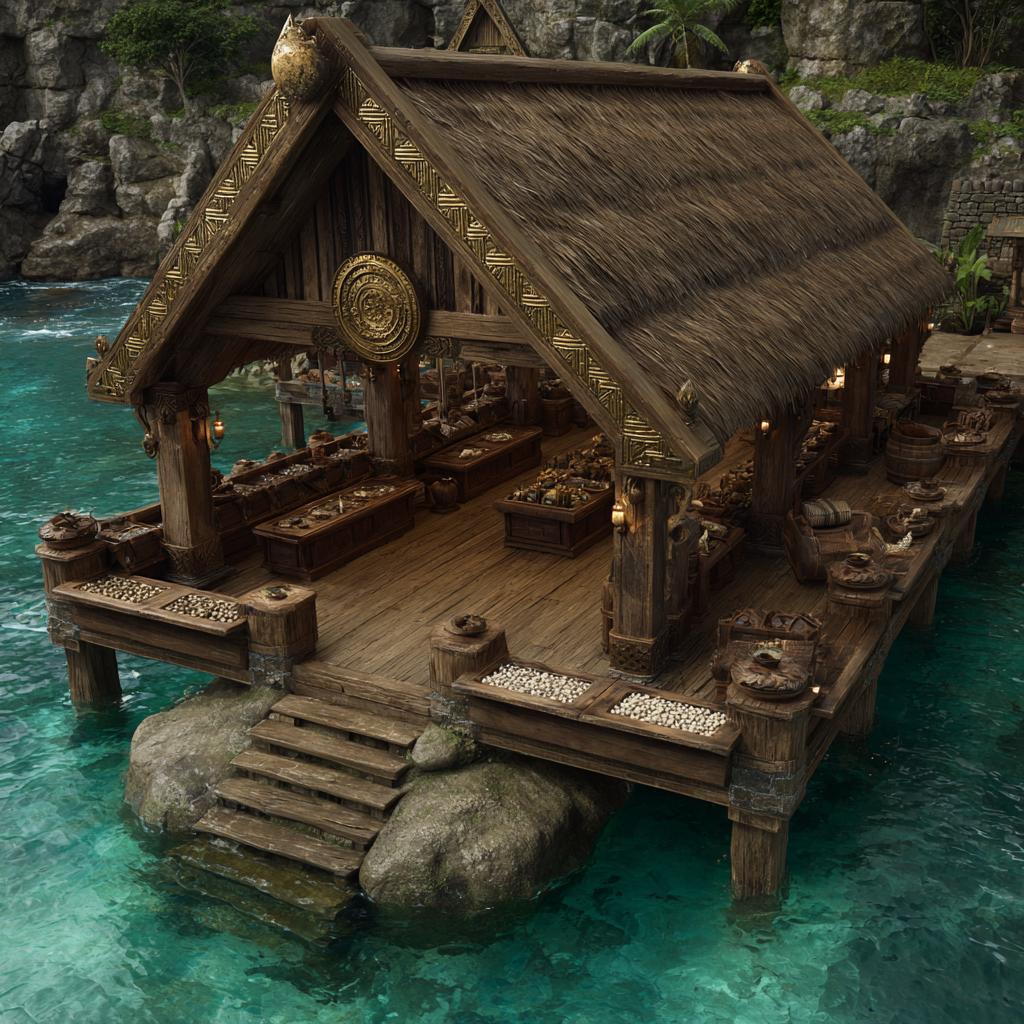
Description
The first section serves as the divers' preparation area, featuring benches where workers can sit and organize their equipment before ventures into the Pearl Fields. Coiled ropes hang from wall pegs, each one carefully maintained and regularly inspected for fraying or weakness, as a diver's life may depend on having a reliable line back to the surface. Woven bags with tight mesh, designed to hold oysters without allowing smaller specimens to fall through, are stacked in organized rows. Stone weights wrapped in protective leather allow divers to descend quickly through the water column, while carved wooden floats help them return to the surface when their breath runs out. Most importantly, the station houses a collection of diving stones, smooth river rocks that divers hold in their hands while descending, later dropping them on the bottom to mark productive areas for future expeditions. A large carved board displays the current tide schedule, moon phases, and weather predictions, as successful pearl diving absolutely requires selecting the right day when tides are low, waters are calm, and visibility is optimal.
The second section functions as the processing and grading area where harvested oysters are opened and their precious contents evaluated. Long tables with smooth surfaces provide workspace for the delicate task of oyster shucking, performed with specialized curved knives that can slip between shell halves without damaging any pearl that might be inside. The pearls themselves are immediately transferred to shallow wooden trays lined with soft fabric, where they are washed in freshwater from a dedicated cistern to remove any organic residue. A grading station features calibrated measuring tools, comparison stones of known quality, and a remarkable magnifying lens acquired through trade that allows evaluators to examine pearls for the subtle shimmer that indicates sea-dream mana infusion. Pearls are sorted into categories based on size, color, luster, and magical properties, with the finest specimens kept in small locked boxes while standard pearls are stored in larger containers. Even the empty oyster shells are saved, as their mother-of-pearl interiors can be carved into decorative inlays or ground into the pigments used in traditional Vaitafe art.
The third section serves as both a storage vault and a strategic planning area. Heavy wooden chests with complex locking mechanisms hold the settlement's accumulated pearl inventory, each chest labeled with detailed information about its contents. A large table dominates the center of this room, where maps of the Pearl Fields are constantly updated based on information gathered during diving expeditions. These maps, drawn on treated leather that resists water damage, show the locations of productive oyster beds, areas that have been recently harvested and need time to recover, dangerous currents, and underwater hazards like sharp rocks or drop-offs. The Vaitafe have learned through careful observation that oyster beds in Goodberry's accelerated environment produce pearls in approximately one-fifth the normal time, meaning areas that would naturally require five years to replenish can be harvested again after just a single year. This remarkable advantage allows for sustainable pearl diving that generates steady income without depleting the resource, but only if harvests are carefully planned and recorded.
Pearl diving itself is considered one of the most prestigious and dangerous occupations in the settlement. Divers must possess exceptional swimming ability, remarkable breath control, and the courage to descend into cold, dark waters where ripfang sharks sometimes patrol and where disorientation can prove fatal. Training begins in shallow tidal pools where aspiring divers practice holding their breath and moving efficiently underwater. Senior divers teach the younger generation techniques passed down through Vaitafe tradition including controlled breathing exercises, methods for equalizing pressure in the ears during descent, and the crucial skill of recognizing when to abort a dive before oxygen deprivation causes dangerous confusion. The most skilled divers can reach depths of forty feet and remain submerged for over two minutes, long enough to pry several oysters from the rocks before the burning in their lungs demands they return to the surface. Every successful dive is celebrated, and divers who discover pearls with sea-dream mana are honored with special recognition, as these rare treasures represent the ocean's greatest gift to the Vaitafe people.
Benefits
The Pearl Diving Station enables systematic harvesting of the Pearl Fields, generating an average of 20 regular pearls per week, netting the settlement 500 gold extra every month. Additionally, the presence of professional pearl divers increases settlement prestige and attracts merchants seeking these precious goods. This upgrade generates 3 Prestige.