Description
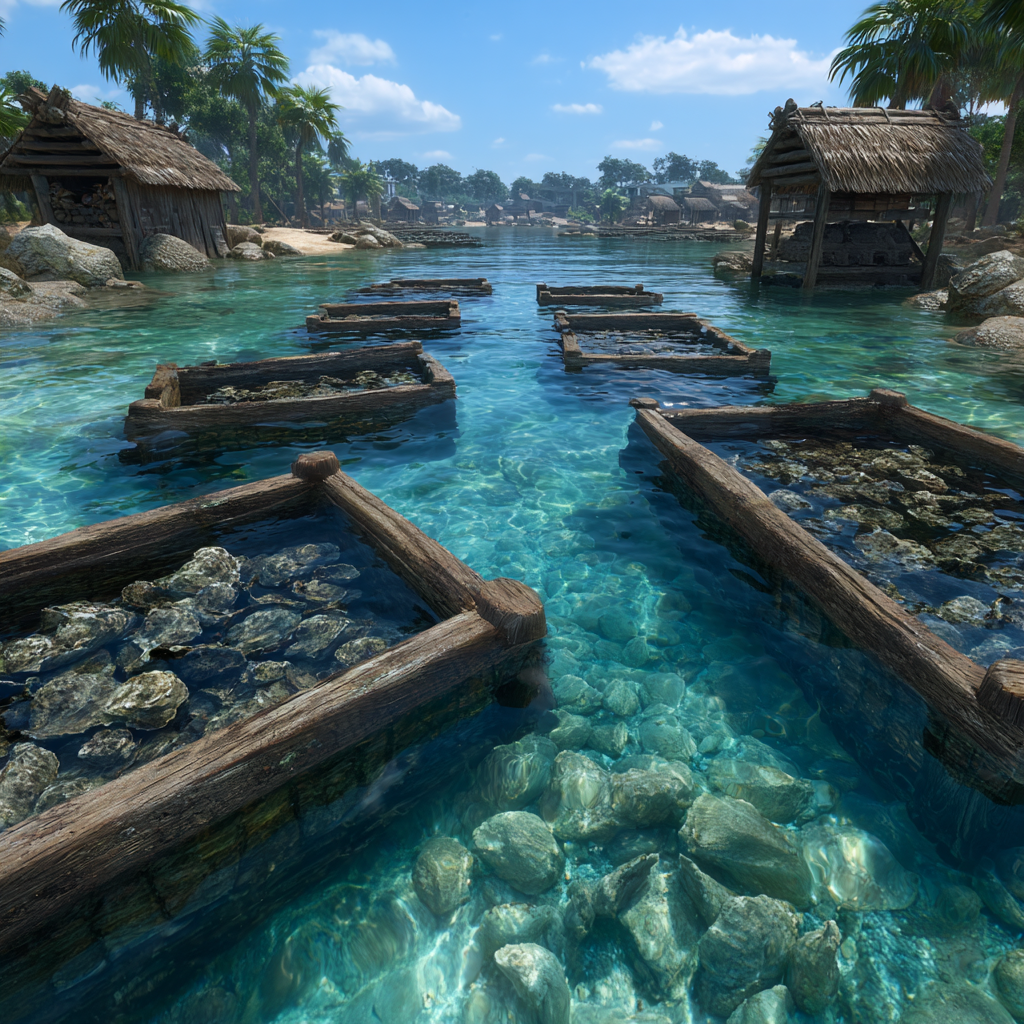
The cultivation surface consists of carefully arranged collections of old oyster shells, rocks with rough surfaces, and specially prepared wooden slats, all materials that provide excellent attachment points for oyster larvae during their settling phase. The Vaitafe learned through experimentation that oysters prefer certain textures and will selectively settle on optimal surfaces when given choices, so the beds incorporate a mixture of substrate types to maximize settlement success. Vertical mesh panels made from woven harakeke fiber create compartments within each bed, organizing the space and preventing overcrowding that would stunt oyster growth. These panels also provide additional settlement surface while allowing water to flow freely through the beds, bringing the microscopic food particles that oysters filter from the water. The entire structure is designed to be partially disassembled for maintenance, with sections that can be lifted to the surface for inspection, cleaning, and harvest without disturbing adjacent growing areas.
Oyster cultivation begins with the collection of larvae during spawning season, a brief period when mature oysters in the wild Pearl Fields release millions of microscopic young into the water. Farmers position special collection panels covered with a thin layer of lime in the water near known spawning areas, creating attractive settlement surfaces that larvae seek out instinctively. After several days, these panels are carefully transported to the cultivation beds where the tiny attached oysters will grow to maturity. The Vaitafe have also developed techniques for encouraging spawning in captive breeding stock, allowing them to extend the natural spawning season and increase the number of larvae available for cultivation. Young oysters, called spat, are monitored closely during their first months when they are most vulnerable to predators, disease, and environmental stress. Workers regularly clean the beds of accumulated silt, remove competing organisms like barnacles and mussels, and thin overcrowded sections by carefully detaching excess oysters and relocating them to less dense areas.
As the oysters mature, they require less intensive care but continued monitoring to ensure optimal conditions. Workers visit each bed during low tide periods, wading through the channels with baskets and tools to inspect the growing bivalves. They check for signs of disease, remove predatory snails and starfish that prey on oysters, and assess growth rates to determine when individual specimens have reached harvestable size. The Vaitafe have learned to recognize the subtle differences between oysters likely to contain pearls and those focused entirely on meat production, allowing them to selectively harvest for different purposes. Oysters destined for the table are typically harvested at around three inches across, when their meat is tender and flavorful. Specimens showing the irregular shell growth patterns that sometimes indicate pearl formation are left to mature longer, as pearls require years to develop properly even in Goodberry's accelerated environment. A small shed on a nearby Spine Bar serves as a processing station where harvested oysters are sorted, cleaned, and prepared for delivery to the settlement's kitchens or for shucking to check for pearls.
The Oyster Beds have proven remarkably successful in Goodberry's accelerated time environment. Oysters that would normally require three to five years to reach market size mature in less than a year, with the fastest-growing specimens ready for harvest in as little as eight months. This rapid growth allows the settlement to maintain a continuous harvest cycle, with beds at different stages of maturity ensuring a steady supply of oysters throughout the year. The beds also serve an important ecological function, as oysters are natural water filters that help maintain water quality in the tidal channels. Each adult oyster can filter up to fifty gallons of water per day, removing excess algae and organic particles while clarifying the water and supporting the health of the entire tidal ecosystem. The success of the Oyster Beds has validated the Vaitafe approach to aquaculture, demonstrating that the ocean can be cultivated as successfully as any terrestrial field when proper techniques are applied with patience and respect for natural processes.
Benefits
The Oyster Beds produce oyster meat every month, providing valuable protein for the settlement with excess being sold off for 200 gold a month. The beds also improve local water quality through natural filtration. This upgrade generates 2 Prestige.