Description
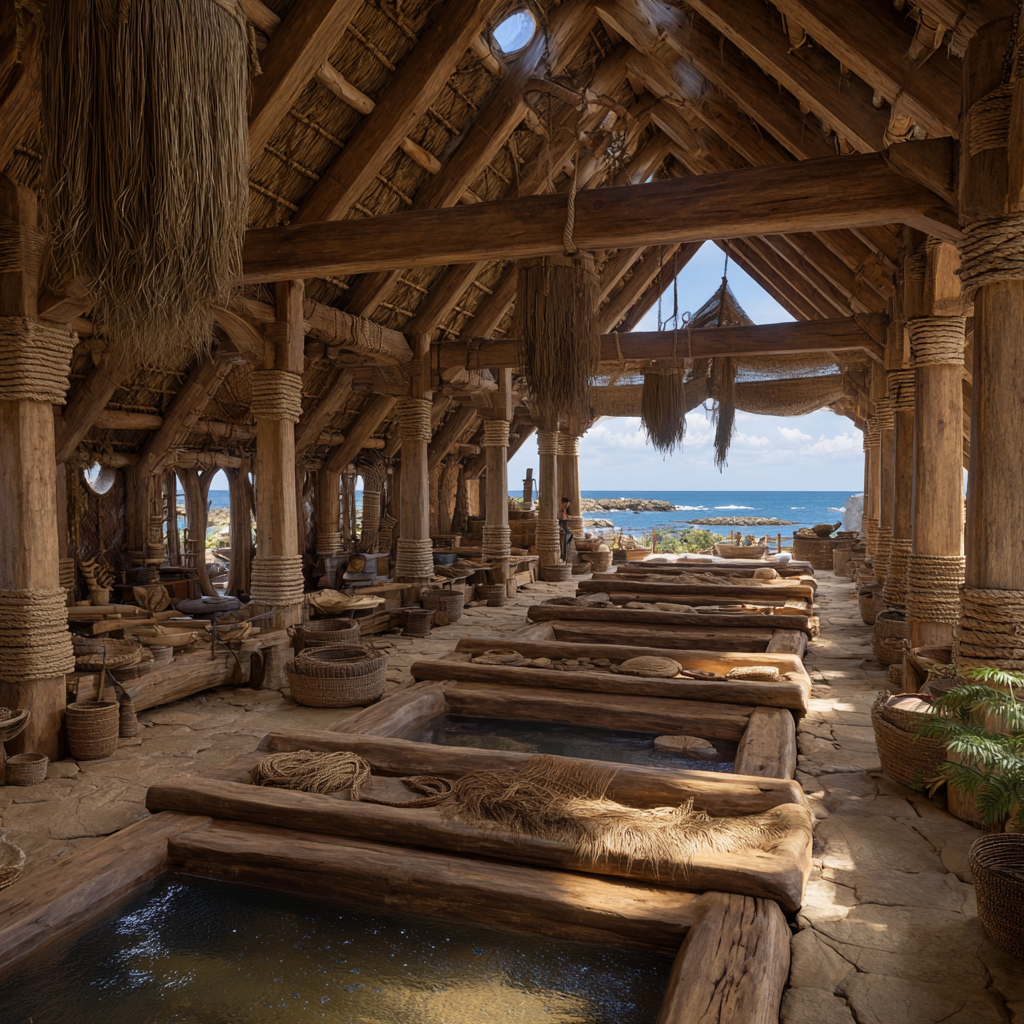
The interior is organized with remarkable efficiency. The back third of the building serves as a processing area where raw materials are prepared for weaving. Bundles of harakeke hang from overhead beams in various stages of preparation, from freshly harvested green stalks to fully processed fiber ready for spinning. Large wooden troughs, carved from single pieces of driftwood, hold soaking fibers being treated with mixtures of seawater and fish oil that increase their strength and resistance to rot. Stone weights and wooden frames allow workers to stretch and dry the processed fibers uniformly, ensuring consistent quality in the finished products. The walls here are lined with baskets containing smaller items: bone needles in various sizes, thin strips of leather for reinforcing stress points, small gourds filled with different grades of cordage, and bundles of dried seaweed that can be woven into nets for specialized purposes.
The front two-thirds of the Guild serves as the actual weaving area, where the magic of transforming simple fibers into life-sustaining tools takes place. Massive wooden frames, some standing upright and others laid horizontally on sturdy trestles, hold nets in various stages of completion. The weavers work with practiced precision, their fingers moving in complex patterns passed down through generations as they tie the intricate knots that give nets their strength and flexibility. Different frame sizes accommodate everything from small hand nets for catching baitfish in tidal pools to massive seine nets that require three people to carry when completed. Smaller projects like fishing lines, rope for securing boats, and decorative fiber work share space on low benches that line the walls. The floor is kept meticulously clean despite the constant work, as any debris that finds its way into a net during construction could create a weak point that fails at a critical moment.
Natural light floods the workspace through the open walls and numerous gaps in the woven panels, essential for the detail-oriented work of net making. On particularly bright days, woven screens can be positioned to provide shade without blocking airflow, and during evening work sessions, carefully placed oil lamps provide focused illumination. The master net maker's station occupies a place of honor at the front center of the workspace, where they can oversee all operations while working on the most complex projects themselves. Their area includes a collection of specialized tools including curved needles of carved bone, precisely measured gauge sticks that ensure uniform mesh size, and a well-worn wooden mallet used to tighten knots and test the strength of completed sections.
Adjacent to the main building is an open-air drying yard where completed nets are stretched, inspected, and receive their final treatments. Tall posts driven deep into the Spine Bar support horizontal lines from which nets hang like enormous spiderwebs, swaying gently in the breeze. This area also serves as a testing ground where nets can be loaded with rocks to verify their strength before being put into service. A small covered annexe provides storage for completed nets awaiting distribution, protected from the elements but accessible for quick retrieval when fishing crews need to replace damaged equipment. The Vaitafe have learned through hard experience that the quality of their nets often means the difference between a successful harvest and empty hands, making this Guild not merely a workshop but a cornerstone of the settlement's economy.
Benefits
The Net Maker's Guild produces high-quality fishing nets, lines, and cordage essential for the settlement's fishing operations. The Guild generates more than enough fishing nets for the settlement, itself. It also generates additional nets that are sold on various markets, bringing in 150 gold a month. Additionally, all fishing operations conducted by the settlement gain a +2 bonus to their productivity due to superior equipment. This upgrade generates 2 Prestige.