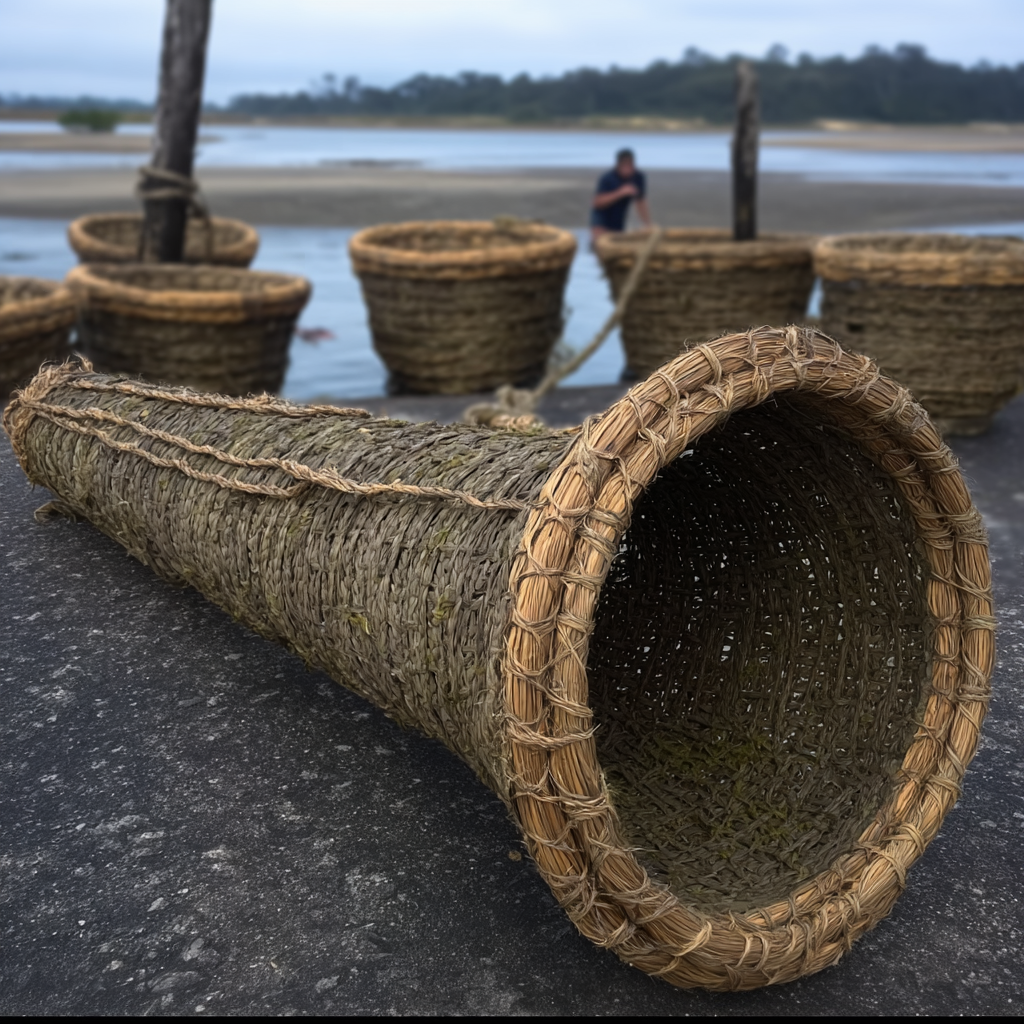
Description
The genius of the eel trap design lies in its entrance mechanism, which takes advantage of eels' instinctive behavior patterns. The wide mouth of each trap features an inward-pointing funnel woven from particularly fine harakeke strands, creating a passage that eels can easily swim through when following the scent of bait but find nearly impossible to navigate in reverse due to their elongated body shape and the way their swimming motion works. Once inside the main chamber, eels encounter a second, smaller internal funnel that leads to the narrow holding section at the trap's end. This double-funnel system ensures that even the most determined eel cannot escape, as both barriers work against their natural movement patterns. The holding section features slightly wider spacing between slats to allow water flow while remaining far too narrow for eels to slip through, and a removable wooden plug at the very end allows harvesters to extract captured eels without dismantling the entire trap structure.
Trap placement follows a precise methodology developed through careful observation of eel behavior in the Tidal Expanse. Eels prefer to travel along channel edges where water is slightly deeper and where they can take advantage of shadowy areas created by overhanging vegetation or rocky outcroppings. Traps are positioned with their mouths facing into the current during incoming tides, as eels tend to swim against water flow while hunting. Each trap is anchored to the channel bottom using a combination of rope lashing and stone weights, with the entire unit angled slightly upward so the entrance sits just above the substrate where eels naturally swim. Marker poles driven into the sand near each trap location allow harvesters to locate them quickly during the brief windows when low tide provides easy access. The traps are baited with fish heads, entrails, and other aromatic materials that eels find irresistible, contained in small mesh bags tied inside the holding section where they can disperse scent through the water but remain secure even if the trap tumbles during rough conditions.
Harvesting follows a regular schedule coordinated with the tidal cycle and eel behavior patterns. Teams visit the traps during early morning low tides, arriving just after the nocturnal feeding period when eels have been most active. Workers wade through the channels carrying baskets and fresh bait, approaching each trap with practiced efficiency. They first check the marker pole to ensure the trap hasn't shifted position, then carefully lift the trap partially from the water to assess its contents without allowing any eels to escape. The wooden plug is removed, and eels are coaxed into collection baskets using gentle prodding, as live eels command premium prices compared to dead specimens. Once emptied, traps receive fresh bait, are inspected for damage, and are repositioned if necessary. Damaged traps are replaced with spares kept in a storage shed on a nearby Spine Bar, a facility that also houses trap-making materials and serves as a workspace where skilled weavers construct replacement traps during periods when weather prevents fishing operations. The regular maintenance schedule ensures the trap fleet remains at peak effectiveness, with old or severely damaged units being carefully dismantled so their materials can be recycled into new construction.
The eels captured through this system have become one of the settlement's most valuable marine resources. Fresh eel meat is prized for its rich flavor and tender texture when grilled or stewed, but the true value lies in smoked eel, which develops an incomparable depth of flavor during the preservation process and can be stored for months without spoiling. The fatty nature of eel flesh makes it ideal for smoking, as it remains moist and develops a beautiful mahogany color while absorbing aromatic wood smoke. In Goodberry's accelerated environment, eel populations mature remarkably quickly, reaching harvestable size in one-fifth the normal time and reproducing at rates that sustain continuous harvesting without threatening population levels. The Vaitafe have developed a traditional preparation method where eels are first filleted and scored in decorative patterns, then hung in dedicated smoking huts where they cure over low fires fueled by driftwood and aromatic herbs. These smoked eels have become signature trade goods, sought after by merchants who appreciate both their exceptional flavor and their durability during transport. The success of the Eel Traps has added another dimension to the settlement's fishing economy, proving once again that understanding and working with natural behaviors produces far better results than fighting against them.
Benefits
The Eel Traps doznes of pounds of fresh eel every week. The majority of this eel is used by the locals for food, but selling the excess yields the settlement 100 gold every month. The traps provide valuable resources for both settlement consumption and trade. This upgrade generates 2 Prestige.