Description
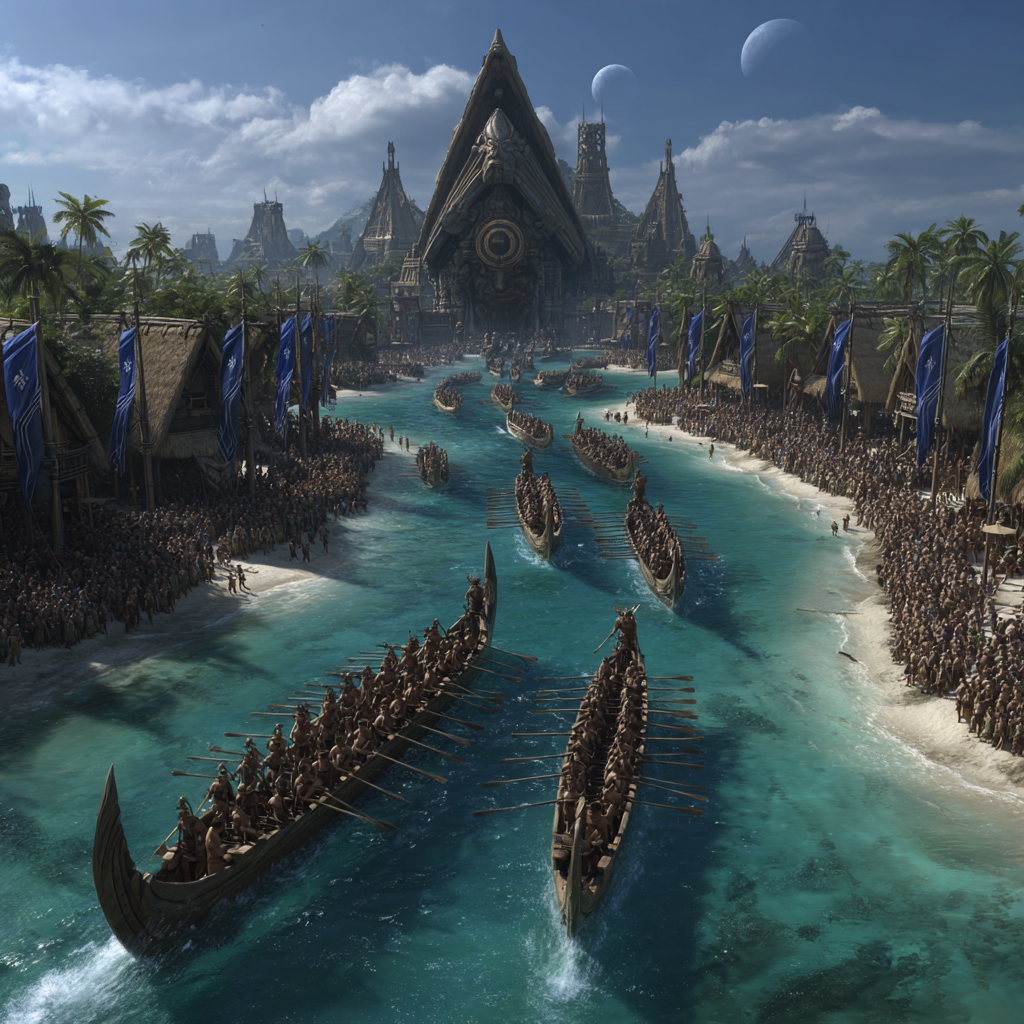
The starting area occupies a wide section of channel where up to eight outrigger canoes can line up side by side without risk of collision. A raised platform constructed from lashed ironwood beams serves as the judge's station, positioned to overlook the entire starting line. From this platform, officials use a massive drum made from hollowed driftwood and covered with tightly stretched sea turtle hide to signal the beginning of each race. The thunderous boom carries across the water for miles, announcing to the entire settlement that a competition is underway. Stone anchors keep the starting platform stable against the constant push and pull of tidal currents, while rope railings provide safety for officials who must lean out to verify fair starts and resolve disputes.
The course itself takes full advantage of the natural topography of the tidal channels, incorporating straightaways where raw speed determines the victor as well as tight turns around sandbar points that test steering skill and crew coordination. The middle section features a challenging stretch where racers must navigate between two submerged reef formations visible only as darker patches in the crystalline water. Experienced paddlers know to read the subtle changes in wave patterns to find the deepest channel through this obstacle, while novices often scrape their outriggers on the coral and lose precious seconds. The final approach to the finish line runs with the prevailing current during incoming tide, allowing crews to achieve breathtaking speeds as they sprint for the carved wooden gateway that marks the end of the course.
Adjacent to the starting area stands a large canoe house built on one of the most stable Spine Bars, its walls constructed from woven palm fronds and its roof thatched with dried cordgrass. Inside this shelter, racing canoes rest on carved wooden cradles that keep the hulls off the ground and protect the delicate outriggers from damage. The building can accommodate twenty canoes ranging from single-person craft to massive six-person racing vessels. Paddles hang on wall racks organized by weight and length, each one carved from a single piece of hardwood and polished smooth by countless hours of use. A workspace at the rear of the structure provides tools and materials for repairs, including coconut fiber cordage, shark oil for waterproofing, and sharp shell scrapers for maintaining hull smoothness.
Race days transform the course into the social heart of the settlement. Spectators gather along both Spine Bars flanking the channel, their cheers echoing across the water as crews power past in flashes of spray and synchronized motion. Betting on race outcomes forms a lively tradition, with wagers placed on everything from outright winners to which crew will execute the cleanest turn around the reef markers. Young children learn paddling fundamentals in smaller training canoes, their instructors teaching the ancient techniques that have been passed down through generations of Vaitafe seafarers. The course serves not merely as entertainment but as vital preparation for the real challenges of life on the tidal expanse, where the ability to paddle swiftly and navigate treacherous channels can mean the difference between reaching safety and being swept away by a rogue current. Champions of the racing course earn respect throughout the settlement and often find themselves recruited for important voyages or dangerous rescue missions where their proven skills can save lives.
Benefits
Characters who train regularly on the Canoe Racing Course gain a +2 competence bonus to Profession (sailor) checks related to small watercraft operation. The training program produces skilled paddlers who can serve as couriers, fishermen, or naval scouts. This upgrade generates 3 Prestige.