Description
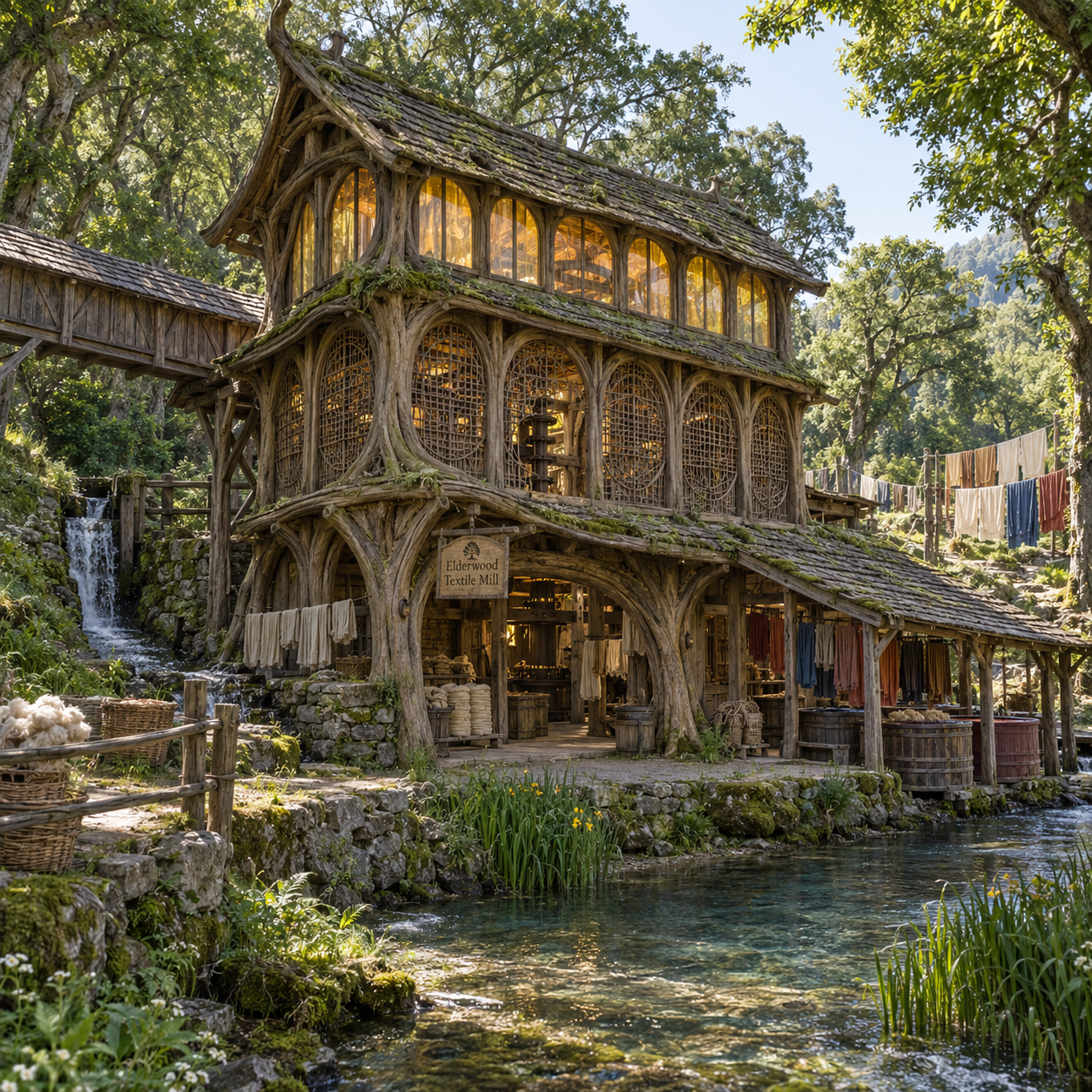
The Textile Mill grew up around the Water Mill's power the way a vine grows up a trellis. A second, gentler drive-shaft of seasoned ash was grafted off the mill's original wheel, running downstream through a covered timber gallery to a longhouse whose three floors were shaped, rather than built, from the same stand of living trees that framed its neighbor. The whole structure still smells faintly of river water underneath the newer scents of lanolin and dye, and the tenders here speak of the building as an extension of the mill upstream, not a separate work altogether.
The ground floor houses the mill's gearwork, wooden teeth pegged and shaped by hand, transferring the borrowed current up through a central shaft that runs the height of the longhouse. This level also serves as receiving and sorting, where raw fleece from the grove's flocks, bundles of flax and nettle fiber, and, when the season allows, raw silk floss carried up from the moth-glades are weighed and sorted by the tenders before being sent upward.
The second floor is given over to spinning. Rows of spinning wheels, some turned by hand and others geared to draw power from the shared drive-shaft, sit beneath tall gaps cut into the living wall and screened with woven lattice, letting in enough light for the spinners to watch their thread without exposing the room to weather. The floor's live-wood joists were grown wide and level specifically to keep the wheels steady, a detail the grove's carpenter-druids are visibly proud of.
Above the spinners, the top floor holds the looms, a mix of power looms driven by the drive-shaft for plain cloth and hand looms reserved for patterned or premium weaves. Clerestory gaps cut high in the walls, glazed with thin sheets of amber resin rather than glass, flood the floor with steady light for detail work. A separate lean-to attached to the longhouse's downstream side holds the dye works, its vats fed by runoff diverted well clear of the mill's return channel so dyestuffs never touch the Crystal Streams themselves, with a drying yard strung between the trees just beyond.
A small office near the entrance, walled in smooth heartwood shelving, handles orders and record-keeping, while a design loft above it keeps pattern books and sample weaves for clients to browse. The mill's tenders sell most of their cloth onward through Silmarithil's own traders, though a fair portion travels downriver to Goodberry, where Elderwood cloth has begun to earn a reputation for its unusually soft hand and faint, water-fresh scent.
Benefits
The facility employs 45 workers and generates 450 gold per month in textile goods sold onward through Silmarithil's traders and downriver to Goodberry. This impressive operation generates 4 Prestige for the settlement.