Description
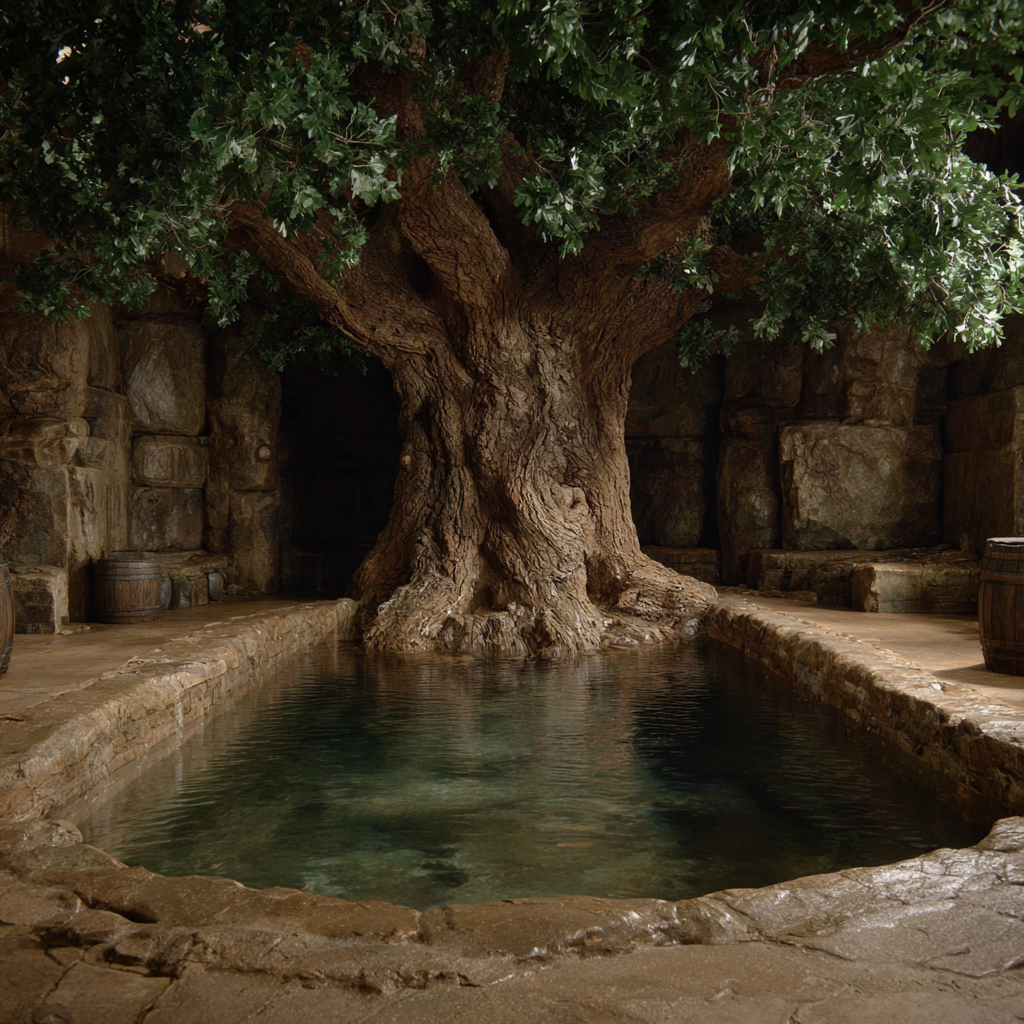
The Rain Catchment Canopy transforms the natural tree cover of the Elderwood Grove into an active water collection system, with Goodberry's magic coaxing certain trees to grow leaves of extraordinary size and specialized shape. Throughout the settlement, particularly in areas of high foot traffic and near important structures, select maples and oaks develop leaves that grow to three feet across, their surfaces waxy and slightly concave to channel water efficiently. These enhanced leaves appear perfectly natural, simply larger and more purposeful versions of their normal counterparts, and they retain their seasonal colors and cycles. During autumn, when these giant leaves would normally fall, they instead fold inward along their stems, becoming compact and remaining attached until spring when they unfurl again to full size. This magical adaptation ensures the collection system operates year-round, though it works most efficiently during the rainy seasons of late winter and early autumn.
The collection network begins at the enhanced leaves themselves, each one positioned and angled by the tree's growth to direct water toward specific collection points. As rain falls on the massive leaf surfaces, it sheets toward the center of each leaf where a pronounced channel formed by the leaf's primary vein carries the water to the stem. From there, the water flows down to carefully shaped branch junctions where Goodberry has encouraged the wood to form smooth, seamless gutters. These living channels spiral down the trunk surfaces, their pathways following the natural grain of the bark but deepened and smoothed to carry substantial water flow. The channels are slightly recessed into the bark itself, making them nearly invisible when dry but clearly functional when rain begins to fall and water starts cascading down their lengths in silvery streams. Where multiple channels converge at larger trunk junctions, the combined flow creates impressive waterfalls that pour into strategically placed collector basins.
The cisterns that receive this collected rainwater are underground chambers formed by Goodberry from the living root systems of the collection trees. Each cistern occupies a space beneath a major collection tree, the roots having been carefully grown and shaped to create watertight chambers approximately eight feet across and six feet deep. The interior surfaces are lined with a dense weave of fine roots that have been sealed with natural resins produced by the trees themselves, creating surfaces that are completely waterproof while remaining alive and able to resist rot or degradation. Access to each cistern is provided by a root-lined shaft with smooth interior surfaces and built-in handholds formed from stubby side roots, allowing descent for maintenance or emergency water drawing. At the bottom of each shaft, the cistern chamber remains in perpetual darkness, the cool temperature and absence of light preserving water quality for extended periods. Each cistern can hold roughly three hundred gallons, and with a dozen such chambers distributed throughout the settlement, the total storage capacity exceeds three thousand gallons of reserve water.
The cisterns connect to the surface through living pumps and distribution points. At ground level near each collection tree, a raised platform of woven roots provides a drawing station where buckets can be filled. The pumping mechanism itself is remarkably clever, using a long hollow branch that extends down into the cistern below. By moving a plunger made from a fitted piece of wood wrapped in leather up and down within this hollow branch, water is drawn up from the cistern and flows out through a spout into waiting containers. The mechanism is simple, reliable, and can be operated by anyone strong enough to work the plunger. For larger water needs, some cisterns feature supplementary channels that can be opened to allow gravity-fed flow to lower-elevation areas, providing water for gardens or larger washing operations without the need for constant pumping. Overflow systems ensure that excess water during heavy rains is directed away from the cisterns through underground root channels that feed back into the Crystal Streams, preventing flooding while ensuring no captured water goes to waste.
The entire system requires regular maintenance to function optimally. Staff inspect the enhanced leaves for damage or disease, clear debris from the channels after storms, and monitor cistern water levels and quality. During dry seasons, the cisterns provide crucial backup water when the streams run lower, and during wet seasons they capture the abundance for use during drier months. The system proves particularly valuable during the settlement's fire season, providing immediate access to substantial water reserves for fighting any blazes that might threaten the wooden structures. Citizens come to appreciate the gentle sound of water flowing down the collection channels during rainstorms, a musical backdrop that reminds them of the grove's ingenuity in working with nature rather than against it. Children delight in watching the water cascade down the trunk channels during heavy rains, and the collection trees become landmarks within the settlement, their practical purpose elevated to something approaching civic pride.
Benefits
The Rain Catchment Canopy provides over 3,000 gallons of stored rainwater in underground cisterns distributed throughout the settlement. This reserve water supply reduces the settlement's dependence on streams during dry periods and provides immediate access to water for fighting fires. During drought conditions, the cistern reserves can sustain the settlement's essential water needs for up to 6 months. This upgrade generates 4 Prestige, reflecting the settlement's sophisticated approach to water management and long-term planning.