Description
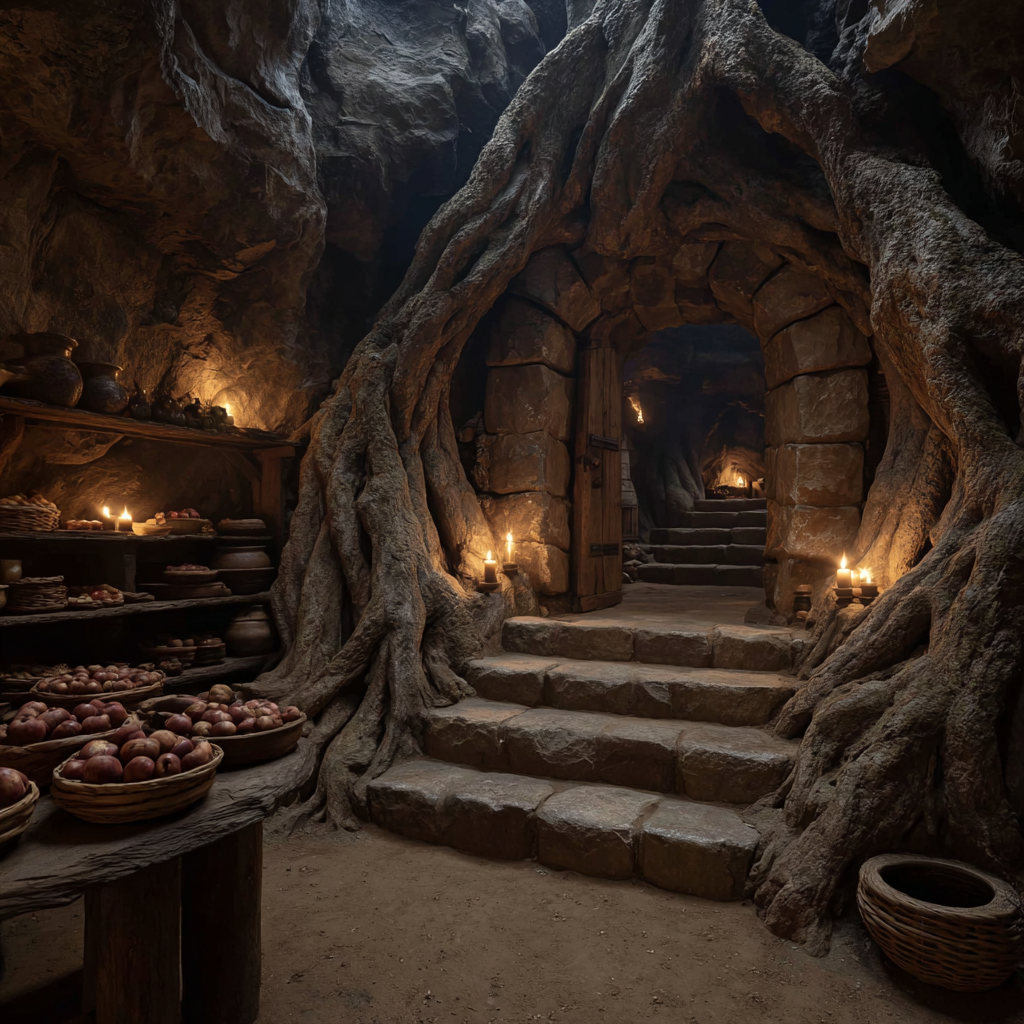
The Preservation Cellar is accessed through a sloped entry passage located at the base of a gentle hill in Autumn's Edge, positioned where three massive oak trees have grown so close together that their root systems intertwine into a natural foundation. The entrance is marked by a heavy wooden door set at a forty-five-degree angle, allowing it to open upward like a traditional root cellar while preventing rain and snow from flowing directly into the passage. The door is constructed from thick planks of dense hardwood, its exterior covered with overlapping cedar shakes that shed water efficiently and its interior lined with insulating bark and moss. Heavy iron hinges allow the door to swing smoothly despite its considerable weight, and a sturdy latch keeps it secured against wind and wildlife. Stone steps lead downward from the entrance, each one carefully shaped and positioned to prevent water accumulation, with their surfaces roughened to provide secure footing even when frost forms during the deepest winter cold.
The passage descends fifteen feet into the earth before opening into the main storage chamber, a roughly circular space thirty feet in diameter with a ceiling that rises to eight feet at its center. The walls are not simply carved earth but are instead formed by the massive intertwined roots of the oaks above, which Goodberry's magic encouraged to grow in specific patterns during the cellar's creation. These living roots form a natural framework that holds the earth walls stable while actively regulating moisture levels, drawing excess humidity away during damp periods and releasing moisture when the air becomes too dry. Between the major roots, smaller rootlets cascade down the walls like wooden curtains, creating natural texture and adding to the organic beauty of the space. The floor is hard-packed earth covered with a thick layer of clean sand, which absorbs any excess moisture and can be easily replaced when it becomes saturated or soiled. Drainage channels carved into the floor's perimeter direct any water seepage toward a sump in the lowest corner, where it slowly percolates into the deeper earth rather than pooling in the storage areas.
Within the chamber, storage has been organized into distinct zones optimized for different types of produce. Along one wall, wooden bins stand in neat rows, each one constructed from unfinished pine with slatted sides that allow air circulation. These bins hold root vegetables like carrots, beets, turnips, and parsnips, each variety separated to prevent flavor transfer and make inventory easier. The vegetables are layered with clean sand or sawdust between them, which maintains optimal moisture while preventing direct contact that could spread rot from one item to another. Another section features wooden racks rising from floor to ceiling, their shelves lined with straw and holding apples arranged in single layers so none touch their neighbors. Different apple varieties occupy different shelves, as some store longer than others and separating them allows the cellar keeper to use shorter-storing varieties first. Winter squash and pumpkins rest on specially designed cradles that keep them elevated off the floor and turned regularly to prevent flat spots from developing during their months of storage. Clay crocks filled with root vegetables preserved in sand line another wall, their lids sealed with wax to maintain internal humidity while protecting contents from pests.
The environmental conditions within the Preservation Cellar are remarkably stable, maintained by the combination of earth insulation, living root regulation, and careful ventilation management. The temperature remains between 32 and 40 degrees Fahrenheit throughout the year, cool enough to slow ripening and prevent sprouting but warm enough that produce never freezes. Humidity hovers around 90 percent, ideal for keeping vegetables crisp and preventing the shriveling that occurs in drier storage. Ventilation is provided by two wooden pipes that extend from the ceiling up through the earth to emerge at ground level several feet apart. These pipes are capped with covers that keep out rain and animals while allowing air exchange. During autumn when produce is still releasing field heat, both vents remain fully open to carry away excess warmth. As winter deepens and temperatures drop, the vents can be partially closed to maintain optimal temperature. The air in the cellar smells of earth and stored produce, a clean, wholesome scent that speaks of abundance and careful stewardship. Small oil lamps provide light when workers need to retrieve items, though they are never left burning unattended, as the flame could consume the oxygen needed to keep the produce fresh.
The work cycle of the Preservation Cellar begins in late summer and early autumn, when the first root vegetables reach maturity and apples begin their harvest. Produce arrives fresh from the gardens and orchards, inspected carefully for any damage or disease before being accepted into storage. Only perfect specimens are stored, as even one rotting vegetable can spread contamination to everything around it. The cellar keeper arranges everything methodically, keeping detailed records of what was stored, when it arrived, and where it was placed within the chamber. Throughout winter, regular inspections occur at least twice weekly, with the keeper examining stored produce for any signs of spoilage, removing questionable items immediately, and rotating stock to ensure the oldest items are used first. Residents visit during designated hours to retrieve vegetables for their meals, always taking from the sections the keeper indicates to maintain proper rotation. By late winter, as stored produce begins to dwindle, the remaining items become increasingly precious. The final apples of the season, wrinkled but still sweet, are treasured treats. The last carrots and beets, brought up from the sand where they have stayed crisp and fresh through months of storage, are celebrated as proof that the settlement can feed itself even in the depths of winter when the frozen earth yields nothing. Come spring, as fresh growth returns to the gardens, the cellar is emptied completely, cleaned thoroughly, and allowed to dry before the cycle begins again with the next harvest season.
Benefits
The Preservation Cellar extends the storage life of root vegetables and apples. Produce that would typically last one month remains fresh for six months, providing crucial nutrition through winter. This upgrade generates 2 Prestige, as a well-stocked root cellar demonstrates both agricultural success and wise resource management.