Description
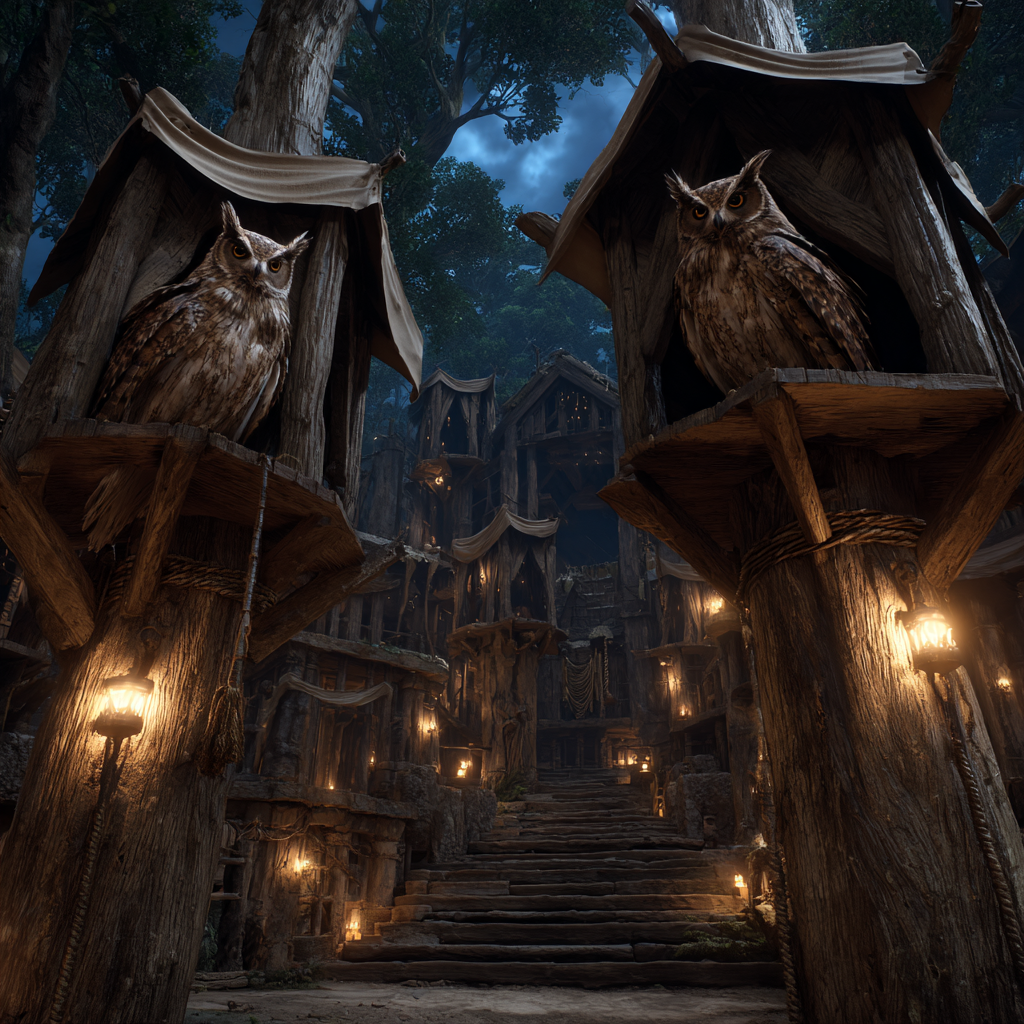
The Owlery Branches occupy the highest reaches of several ancient oaks in the Ancient Heart, where massive limbs branch out to create natural platforms sixty to eighty feet above the forest floor. Rather than constructing artificial buildings, the handlers have enhanced existing tree architecture with carefully placed roosting boxes, perching bars, and sheltered alcoves that blend seamlessly with the natural structure. Each roosting box is crafted from weathered wood and hung securely from thick branches, with multiple entrance holes sized for different owl species and interior spaces lined with soft bark and moss. The boxes face various directions to accommodate each bird's preference for sun exposure and wind protection. Rope ladders and wooden platforms spiral around the tree trunks, allowing handlers to access the roosts for feeding, health checks, and message retrieval without disturbing the birds unnecessarily. A central platform built where several major branches converge serves as the handlers' station, complete with a weatherproof storage chest for supplies, a message sorting table, and a small brazier for warmth during cold night watches. Canvas tarps can be unfurled to provide shelter during storms, but most nights the station remains open to the sky, allowing handlers to work under stars and moon alongside their nocturnal partners. The entire facility feels less like a constructed building and more like a city built into the trees themselves, existing in harmony with the forest's upper realm.
The dimensional acceleration flowing through the grove transforms owl development and training into remarkably efficient processes. Owlets hatched in the branches reach full size and flight capability within six weeks rather than the typical four to six months, their feathers developing rapidly and their hunting instincts manifesting early. Training that would normally require a full year to establish reliable message delivery and route memorization condenses into just two and a half months of intensive work. Young owls learn flight paths, recognize destinations, and understand the importance of message capsules with startling speed, as if the compressed timeframe somehow enhances their cognitive development rather than rushing it. Adult owls brought to the facility adapt to their messenger roles in weeks instead of months, forming bonds with handlers and learning routes that might otherwise take seasons to establish. This accelerated timeline means the settlement can maintain a fully functional message network and watch rotation far more quickly than would be possible outside the grove's boundaries. The owls themselves seem to thrive under these conditions, their plumage lustrous, their eyes bright and alert, their flights powerful and sure through the darkened forest.
The owlery houses a diverse population selected for specific capabilities and characteristics. Barn owls with their heart-shaped faces and silent flight form the primary messenger corps, capable of carrying small packages and scrolls over distances up to fifty miles with remarkable reliability. Their pale plumage makes them visible to receivers watching for incoming messages even on dark nights. Great horned owls serve as both messengers for heavier packages and as watch sentinels, their powerful builds allowing them to carry larger loads while their fierce nature makes them effective at driving away potential threats spotted during patrol. Screech owls, smaller and more agile, handle short-range deliveries within the grove and to nearby locations, darting through dense canopy with precision. Barred owls add their distinctive calls to the night chorus while serving dual roles as messengers and pest controllers, hunting rodents during their watch patrols. Long-eared owls, with their distinctive tufts and exceptional hearing, excel at sentinel duty, detecting disturbances in the forest that might go unnoticed by other watchers. Each bird is individually assessed for temperament and ability, with some excelling at navigation, others at speed, and still others at the patience required for long watches. The handlers maintain detailed records of each owl's capabilities, preferred routes, and personality quirks, ensuring messages are assigned to appropriate birds and watch schedules accommodate individual needs.
The training philosophy emphasizes partnership and trust rather than domination, treating the owls as intelligent collaborators in important work rather than mere tools for message delivery. Young owls are imprinted on handlers through consistent feeding and gentle interaction, forming social bonds that make them willing to return after flights rather than simply escaping into the wild. Training progresses through carefully designed stages: first, short flights between nearby perches for food rewards; then, progressively longer flights to recognized landmarks; finally, complete routes to specific destinations where the bird learns to seek out designated receivers. Messages are carried in lightweight leather capsules attached to leg bands, designed to be comfortable and aerodynamic while protecting their contents from weather. The owls learn to associate these capsules with positive experiences, understanding that delivery results in treats, praise, and comfortable rest. For watch duty, owls are trained to recognize unusual sounds, movements, or scents and to return immediately to handlers with alert calls that signal potential problems. This training never employs punishment or negative reinforcement, only patient repetition and positive rewards that build genuine enthusiasm for the work rather than fearful compliance.
Beyond practical communication and security functions, the Owlery Branches become a source of nocturnal wonder and community connection. The soft hooting of owls echoing through the night provides comfort to residents, a reminder that watchful guardians patrol the darkness while they sleep. Children grow up knowing the different calls of various owl species, learning to distinguish the barn owl's raspy screech from the great horned owl's deep hoots. Receiving a message by owl creates a sense of importance and connection, the dramatic arrival of a silent bird out of darkness lending weight to even routine communications. The handlers often work night shifts, becoming familiar figures moving through the canopy by lantern light, and their dedication to maintaining the message network in all weather earns deep respect. Young residents sometimes apprentice as night handlers, learning to move through the dark forest, read owl behavior, and manage the complex logistics of coordinating multiple birds across various routes and schedules. The facility includes a small education area on the main platform where visitors can observe (from a respectful distance) the owls roosting during daylight hours, their eyes closed in peaceful sleep, their feathers fluffed against the day's warmth, patient and still until darkness returns and calls them back to wing.
Benefits
The Owlery Branches maintains a stable population of 25 trained owls providing reliable message delivery within 50 miles at rates far faster than ground messengers (messages can be delivered overnight rather than requiring 2-3 days of travel). The service generates 150 gold per month from paid message deliveries to and from nearby settlements. This upgrade generates 6 Prestige, reflecting the settlement's sophisticated communication network and the impressive sight of trained owls serving as nighttime guardians.