Description
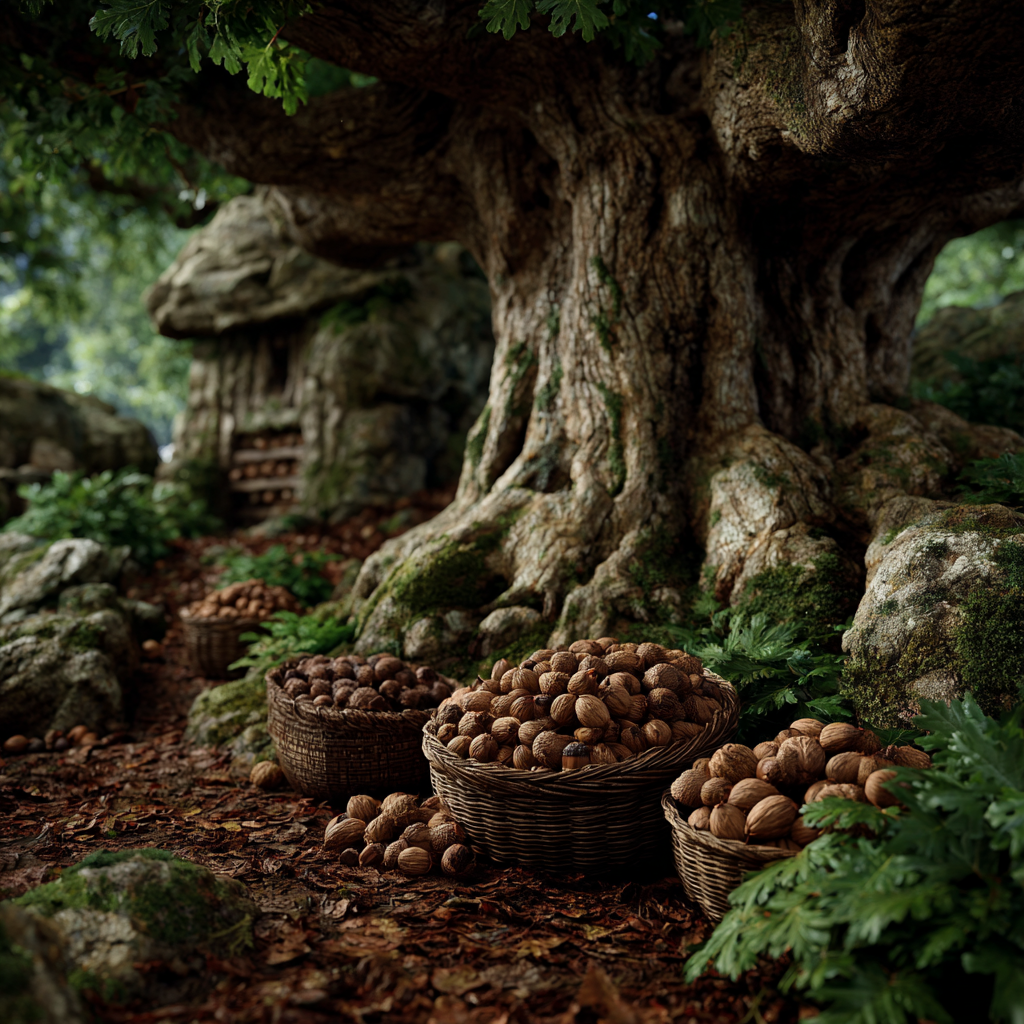
The first Nut Orchards consist of carefully selected hazelnut and black walnut trees positioned to work with the natural landscape rather than against it. Rather than clear-cutting areas to plant uniform rows, these initial orchards fill in gaps in the canopy and establish productive trees in locations where they can thrive without displacing the ancient growth. Black walnut trees with their compound leaves and deeply furrowed bark occupy the richer soils near the Crystal Streams, their roots releasing compounds that shape the plant community around them into complementary partnerships. Hazelnut shrubs form productive understory thickets in the transition zones, their catkins dancing in spring breezes and their clusters of nuts ripening in papery husks each fall.
The dimensional magic of the grove begins to affect these foundational trees in remarkable ways. These typically slow-growing species reach productive maturity in just three to four years rather than the usual seven to ten. Once mature, the trees produce enhanced yields during the fall harvest season, with each tree offering multiple harvests over the autumn months rather than a single crop. The dimensional properties seem to concentrate the trees' energy into nut production while maintaining their health and vigor, creating a sustainable system that doesn't deplete the soil or exhaust the trees themselves.
The orchards are designed with wildlife partnership as a core principle from the beginning. While the Orchard Keeper marks and tends specific harvest areas, portions of the groves are left as wildlife zones where squirrels, deer, jays, and other forest creatures can gather nuts without interference. This deliberate sharing ensures that the forest's animal population thrives, storing nuts throughout the woodland and inadvertently planting the next generation of trees. The practice creates a harmonious relationship between cultivation and wilderness, where the settlement's needs and nature's abundance coexist rather than compete.
Harvest time brings a satisfying rhythm to the autumn months. The Orchard Keeper uses long poles with padded hooks to gently shake branches or knock down high nuts without climbing, gathering the fallen treasures into woven baskets. The distinctive thunk of falling walnuts and the lighter patter of hazelnuts create an autumn soundtrack, accompanied by the rustle of leaves and the occasional scolding call of a squirrel asserting territorial claims. Fresh black walnuts with their green husks require processing to reveal the hard shells within, while hazelnuts in their papery coverings are easier to harvest and prepare, making them popular for immediate consumption.
Benefits
The Nut Orchards I produce hazelnuts and black walnuts that generate 300 gold per month in revenue during the autumn harvest season. The foundational groves establish the framework for expanded nut production. These orchards generate 3 Prestige.