Description
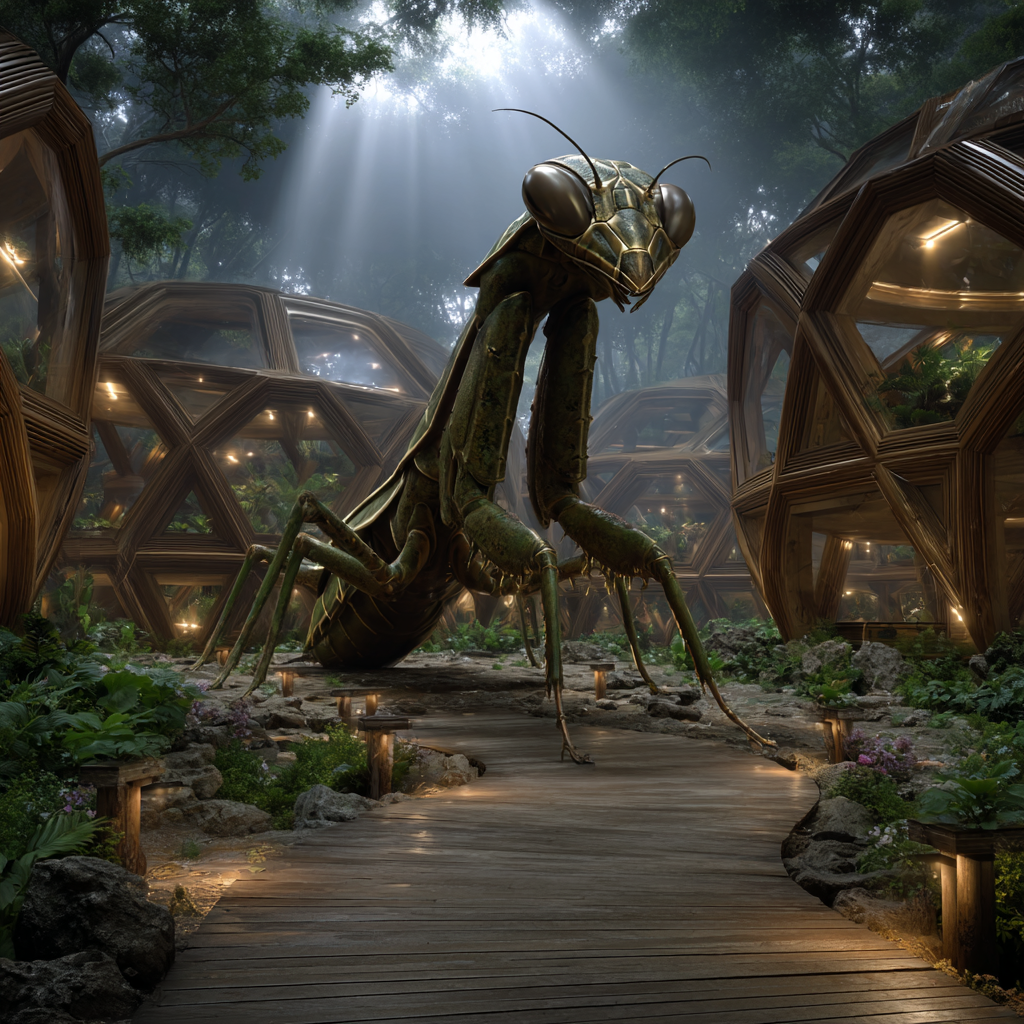
The Insectarium Hollow occupies a natural depression in the forest floor approximately two hundred feet across and thirty feet deep, its walls formed by the exposed roots of ancient trees that ring the hollow like living buttresses. Goodberry has transformed this depression into a multi-level research complex by constructing a series of interconnected domed structures made from living wood and specially grown transparent amber panels that allow natural light to filter through while maintaining precise environmental controls. The largest dome, positioned at the hollow's center, rises forty feet high and contains dozens of individual enclosures ranging from tiny boxes suitable for studying solitary beetles to vast chambers where entire ant colonies can establish themselves under controlled conditions. Smaller satellite domes branch off from the central structure, each one dedicated to a specific category of insects: one for pollinators like bees and butterflies, another for predatory species like mantises and dragonflies, a third for decomposers like beetles and millipedes, and a fourth serving as the breeding research laboratory where the facility's most ambitious work takes place. The entire complex is connected by covered walkways suspended on wooden platforms, allowing researchers to move between domes without disturbing the subjects or being exposed to weather.
Inside each dome, Goodberry has created microcosms that replicate specific forest environments with painstaking accuracy. The pollinator dome features hundreds of flowering plants arranged by blooming season, ensuring year-round food sources while allowing researchers to observe pollination behaviors and measure efficiency. The predatory dome contains carefully balanced ecosystems where hunting insects can pursue appropriate prey species, the populations managed to prevent extinction while allowing natural behaviors to manifest. The decomposer dome is filled with fallen logs in various stages of decay, leaf litter, and compost heaps where insects can be observed breaking down organic matter and returning nutrients to the soil. Each enclosure features its own climate controls, allowing researchers to simulate different seasons, test temperature preferences, and understand how various species respond to environmental changes. Observation platforms with mounted magnifying lenses allow close study without disturbance, and a comprehensive system of notebooks, charts, and preserved specimens documents every discovery made within these walls. The knowledge accumulated here represents the most complete understanding of forest insect ecology anywhere in Xeres, with detailed life cycle information, feeding preferences, social structures, and ecological roles recorded for hundreds of species.
The breeding research laboratory houses the facility's crowning achievement and most closely guarded work: the selective breeding program that has produced the Elderwood Striders, a domesticated variety of giant mantis developed over years of careful genetic selection and magical enhancement. The program began when researchers discovered that certain mantis species exposed to the concentrated natural magic of the grove occasionally produced offspring larger than normal. By carefully selecting these larger individuals for breeding, providing them with abundant food and optimal growing conditions, and applying gentle growth enchantments during key developmental stages, the researchers succeeded in creating a stable lineage of mantises that grow to extraordinary size while retaining remarkable intelligence and, crucially, a calm and trainable temperament. Adult Elderwood Striders stand approximately eight feet tall at the shoulder when in their natural hunting posture, with bodies stretching twelve feet long and forelegs that can extend another six feet beyond that. Despite their formidable appearance, these creatures have been bred for docility and responsiveness to commands, their natural hunting instincts carefully suppressed through generations of selection that favored individuals showing curiosity and gentleness toward humanoid handlers rather than aggression or prey drive.
The Striders possess remarkable characteristics that make them ideal mounts for forest environments. Their six legs provide exceptional stability on uneven terrain, allowing them to navigate steep slopes, fallen logs, and dense underbrush that would challenge conventional mounts like horses. Their bodies are covered in a lightweight exoskeleton that provides natural armor protection, colored in patterns of green and brown that blend seamlessly with forest surroundings, making mounted riders significantly harder to detect. Perhaps most impressive, their ability to rotate their triangular heads nearly 180 degrees gives riders unprecedented situational awareness, and their compound eyes can detect movement at remarkable distances. The Striders can carry up to 400 pounds with ease, moving at speeds comparable to a fast horse when traveling through forest terrain while maintaining almost complete silence, their specialized leg joints designed to step carefully rather than crash through undergrowth. They require relatively little food for their size, subsisting primarily on a diet of small animals, large insects, and supplementary vegetation, and they live for approximately 15 to 20 years when properly cared for. The breeding program maintains a careful balance, producing approximately four to six young Striders per year that can be trained as mounts while keeping several breeding pairs in reserve and ensuring genetic diversity through occasional introduction of enhanced wild stock.
Beyond the Strider program, the Insectarium serves numerous other valuable functions for the settlement. It produces healthy populations of pollinating insects that are released into the settlement's gardens and orchards, dramatically improving crop yields. It breeds beneficial predatory insects that help control pest populations naturally without need for harmful pesticides. It serves as an educational facility where citizens can learn about the crucial ecological roles insects play, fostering appreciation and reducing unnecessary killing of beneficial species. The research conducted here has applications in agriculture, medicine, and even military tactics, as understanding insect behavior and capabilities opens doors to innovations in numerous fields. The facility employs a dedicated staff of naturalists, handlers, and researchers who work in shifts to maintain the various ecosystems, monitor breeding programs, and care for the Striders from hatching through training. Visitors are welcome during designated hours, walking the observation platforms to witness the intricate beauty of insect life magnified and made accessible, often leaving with newfound respect for creatures they previously considered mere pests or overlooked entirely. The Insectarium stands as proof that even the smallest forms of life deserve study, respect, and protection, and that patient observation and careful breeding can transform wild creatures into willing partners in civilization's growth.
Benefits
The Insectarium Hollow maintains a stable population of 2d4+2 trained Elderwood Striders available as mounts for settlement use. These giant mantises have the following statistics: Large magical beast, AC 16, Speed 50 ft., Str 18, Dex 15, Con 16, Int 4, Wis 14, Cha 10. They can carry 400 pounds, grant their rider a +2 bonus to Stealth checks in forest terrain due to their natural camouflage and silent movement, and their 180-degree head rotation grants the rider a +2 bonus to Perception checks to avoid being surprised. The Striders can make natural attacks (two claws +8, 1d6+4 each) if necessary but are trained to avoid combat when carrying riders. The facility generates 8 Prestige, reflecting the settlement's remarkable achievement in domesticating and breeding a entirely new category of mount and its sophisticated approach to understanding and working with nature's smallest creatures.