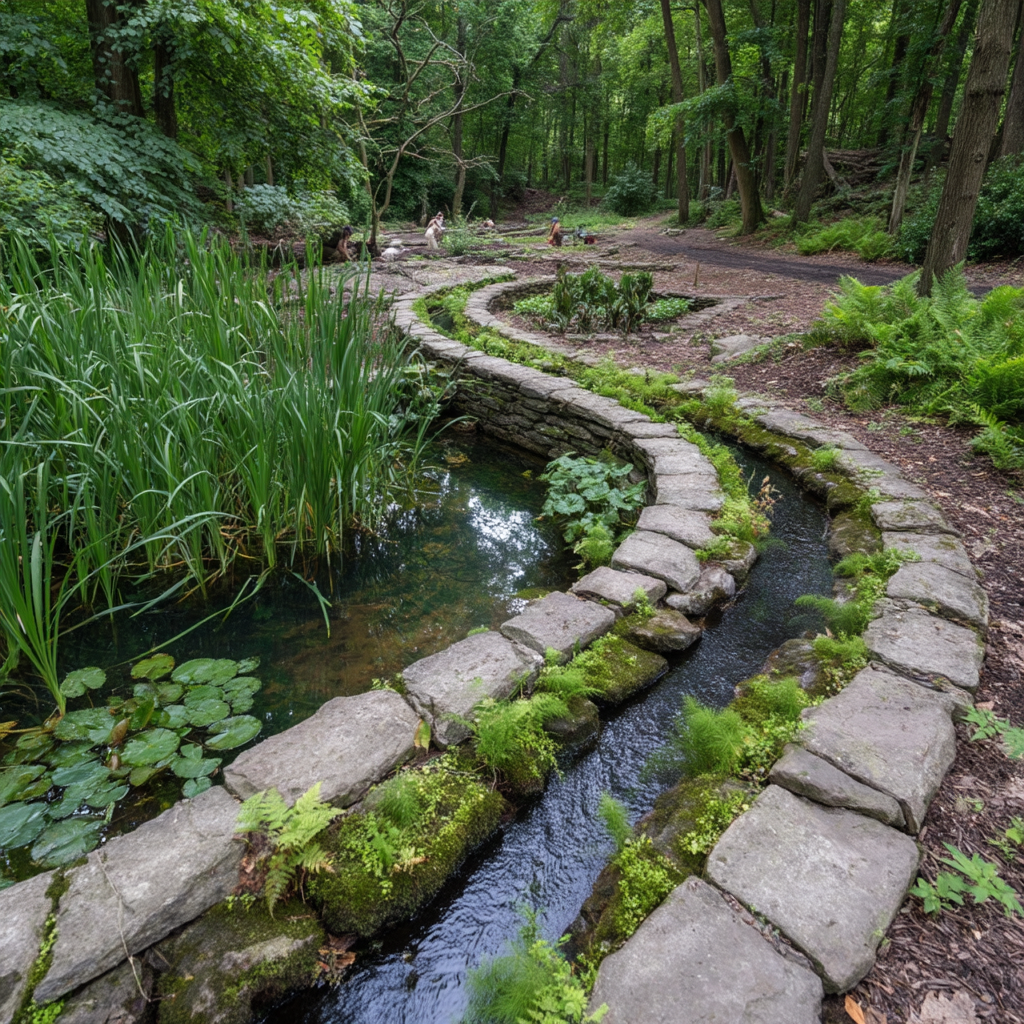
Description
The druids who founded Elderwood Grove understood a fundamental truth: waste is simply matter in the wrong place. Everything the forest produces eventually returns to the forest, broken down by fungi, consumed by insects, processed by bacteria, and reclaimed by the soil. The Forest Flow System does not fight against these natural cycles, it works with them, directing human waste into channels where the forest can reclaim it efficiently and safely.
The system begins with a network of carefully engineered channels following the natural contours of the land. Unlike Goodberry's brick sewers, these waterways are lined with carefully selected stones and deliberately planted with water-loving plants, reeds, sedges, and specific varieties of iris known for their filtering properties. Gray water from washing and food preparation flows into these channels from collection points near dwellings and workshops, carried gently downslope by gravity and the subtle grade built into the channel design. The water moves slowly enough that sediment settles and plant roots can extract nutrients, but fast enough to prevent stagnation.
The channels converge at a series of filtration ponds located in a secluded hollow well away from dwellings and water sources. These ponds operate on a three-stage principle. The first pond allows heavy particles to settle while emergent plants extract dissolved nutrients. Water flows through a carefully maintained bed of gravel and sand into the second pond, where floating plants further cleanse the water. The third pond, the cleanest, hosts fish and frogs, living indicators that the water has been restored to a state the forest can accept. From there, water percolates into the ground or continues into the Crystal Streams, fully integrated back into the watershed.
Solid waste follows a different path. Composting groves occupy three separate locations on the settlement's downwind edges, each grove managing a different stage of decomposition. Fresh material is collected in covered pits lined with clay and layered with carbon-rich materials, dried leaves, wood chips, and shredded bark. The druid tenders who oversee the system know precisely how much green material balances how much brown, how often to turn the piles, and when to shift material from active decomposition to the curing groves. The process takes months, but the result is clean, odorless compost that enriches the settlement's gardens and mushroom plots without spreading disease or attracting vermin.
The tenders are the quiet experts of the system. They walk their rounds checking water flow in the channels, clearing blockages of fallen leaves or debris, ensuring the filtration plants remain healthy and well-distributed. They manage the composting groves with the precision of master craftspeople, tracking temperatures, adjusting moisture levels, and rotating materials through the system. They work early, before the settlement fully wakes, and late, after most have retired to their homes. Their knowledge is passed through apprenticeship, each tender training their replacement over the course of years until the rhythms of the system become instinct.
Overseeing the entire operation is the Grove Keeper, a druid of at least moderate experience who reports directly to Duke Hotaru. The Grove Keeper maintains maps showing every channel, every filtration pond, every composting grove. They schedule inspections, coordinate with healers when contamination concerns arise, and ensure the system adapts as the settlement grows. They also serve as the settlement's primary expert on soil health and nutrient cycles, advising farmers and gardeners on amending their plots with the finished compost.
Benefits
The Forest Flow System dramatically improves public health throughout Elderwood Grove. All residents and visitors within the settlement gain a +2 resistance bonus to saving throws against disease and poison originating from contaminated food, water, or unsanitary conditions. This bonus stacks with the +1 resistance bonus provided by the Living Well, for a combined total of +3 against such effects while within the settlement.
The system suppresses the threat of disease outbreaks. In any situation where the GM would normally roll to determine whether a settlement-wide illness event occurs due to waste accumulation or water contamination, that roll is made with a +8 bonus to the DC required to trigger the outbreak. Events powerful enough to overcome this threshold are treated as exceptional magical or supernatural in origin, not the result of ordinary conditions.
The composting operation produces high-quality soil amendment distributed to the settlement's agricultural areas. This resource is permanent, self-sustaining, and cannot be depleted. Additionally, the filtration ponds create habitat for medicinal plants and useful creatures, providing herbalists with a reliable source of water-loving specimens. This upgrade generates 5 Prestige.