Description
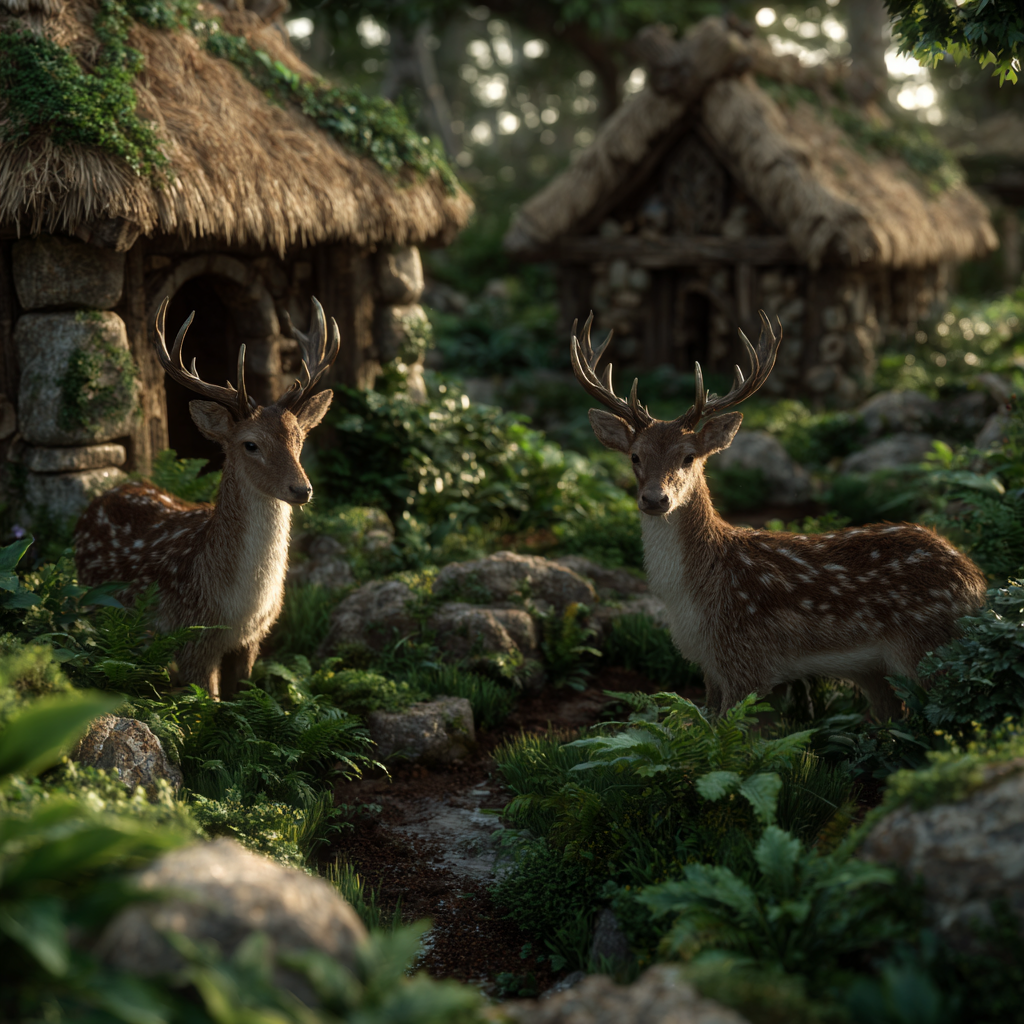
The Deer Paddock occupies a rolling meadow at the border between Autumn's Edge and the Whispering Paths, where natural clearings provide abundant grazing while nearby forest offers shelter and browse. The enclosure is defined by a living fence of densely planted hawthorn, dogwood, and other thorny shrubs that have been shaped through patient pruning and gentle magic into an impenetrable barrier eight feet tall. This green wall appears entirely natural from outside, blending seamlessly with the surrounding forest, yet creates an effective boundary that keeps the deer contained without the harsh appearance of wooden posts or metal fencing. Gates woven from flexible willow branches allow handlers to enter and exit while maintaining the organic aesthetic. Within this spacious enclosure of nearly ten acres, the landscape varies naturally between open meadow, scattered copses of young trees, rocky outcroppings that provide minerals through salt licks, and a clear stream that winds through the space providing fresh water year-round. Simple three-sided shelters built from stacked logs and thatched with reeds offer protection during harsh weather, positioned at the meadow's edge where deer naturally seek cover. The entire paddock is designed to feel like a protected section of wild forest rather than a farm, allowing the deer to express natural behaviors while remaining accessible for management and care.
The dimensional acceleration of the Elderwood Grove transforms deer husbandry from a multi-year endeavor into a remarkably efficient operation. Fawns born in the paddock reach full adult size within three months rather than the typical year and a half, growing strong and healthy through compressed development cycles that don't sacrifice bone density or muscle quality. Does enter their breeding cycle more frequently, producing fawns twice per year rather than annually, though handlers carefully manage breeding to prevent overpopulation and maintain genetic diversity. The accelerated timeline means a breeding program can establish stable population numbers within a single season rather than requiring years of patient growth. Antlers on bucks grow and shed at five times the normal rate, with full racks developing in weeks and the valuable velvet stage compressed into just days. This rapid cycle provides regular harvests of shed antlers for crafting without requiring the animals to be harmed. The deer's accelerated metabolism also means they process feed efficiently, converting browse and supplemental fodder into body mass at rates that would seem impossible in normal time. Despite this compressed existence, the animals show no signs of stress or premature aging, apparently experiencing their accelerated lives as naturally paced from their own perspective.
The paddock maintains multiple varieties of deer selected for different qualities and purposes. White-tailed deer form the primary population, valued for their adaptability, mild temperament, and high-quality venison that remains tender even from mature animals. A smaller population of larger mule deer provides more substantial carcasses when needed for major gatherings or extended food preservation. Fallow deer, with their distinctive spotted coats and palmate antlers, add genetic diversity and produce particularly fine leather prized by craftspeople. A few red deer, the largest variety, serve primarily as breeding stock to introduce size and vigor into the herd genetics. The handlers maintain careful records of lineages, rotating breeding pairs to prevent inbreeding while selecting for desirable traits like calm temperament, efficient feed conversion, and healthy confirmation. Young deer are gentled from birth through regular handling, becoming accustomed to human presence without losing their essential deer nature. This semi-domestication makes them easier to manage for health checks, hoof care, and the eventual selection of animals for culling, while allowing them to live in social groups that mirror wild herds with established hierarchies and natural behaviors.
The ethical considerations surrounding the Deer Paddock weigh heavily on the settlement's collective conscience, particularly given the philosophical tensions between necessity and reverence for life. The facility operates under the same sacred framework that governs all animal management in the grove, treating the deer as honored participants in the cycle of life rather than mere livestock. Before any culling, handlers perform rituals of gratitude and apology, acknowledging the weight of taking life even when necessary. Animals selected for harvest are those who have lived full, healthy lives in conditions far superior to wild existence, protected from predators, disease, and starvation. The actual culling is performed with absolute efficiency by the settlement's most skilled hunters, ensuring instant death without suffering or fear. Every part of each animal is used with reverence: meat feeds the community, hides become clothing and leather goods, bones craft tools and fertilizer, sinew provides cordage, antlers create implements and art, and organs feed the settlement's working dogs. Nothing is wasted, nothing is taken lightly. Young residents learning animal husbandry spend time in the paddock not just learning practical skills but absorbing the gravity of participating in death as part of sustaining life, understanding that eating meat requires accepting responsibility for the ending of consciousness, and that this responsibility demands utmost respect and gratitude.
Beyond its role in food production, the Deer Paddock serves as a bridge between domestication and wilderness, a place where residents can safely observe and interact with animals that retain much of their wild character. Children visit under supervision to hand-feed gentle does, learning patience and respect for animal boundaries. Artists come to sketch the deer in their natural grace, capturing the elegant lines and alert postures that make them such compelling subjects. Rangers and druids study herd dynamics and behavior patterns, gaining insights that inform their understanding of wild populations beyond the grove's borders. The sight of deer grazing peacefully in the morning mist, backlit by rising sun filtering through autumn leaves, becomes an iconic image of the settlement's harmony with nature. Shed antlers are collected and distributed to craftspeople who transform them into knife handles, tool implements, ceremonial objects, and decorative carvings. The paddock's stream, flowing through the enclosure before continuing into the broader forest, is said to carry the blessing of the deer with it, enriching the waters downstream. In the evening, when the deer gather at the meadow's center to bed down for the night, their soft calls and the sight of spotted fawns nestled against their mothers provide a profound sense of peace, a reminder that even in the management of life and death, there can be beauty, dignity, and grace.
Benefits
The Deer Paddock supports a healthy herd of 30–40 deer, providing a steady, sustainable source of protein for the settlement. Through carefully managed culling, it produces venison valued at 800 gold per month while maintaining herd health. The paddock also yields valuable byproducts, including hides and shed antlers worth 200 gold per month, along with sinew, bones, and organs used for crafting and other needs. Its ethical and sustainable management earns the settlement 5 Prestige.