Description
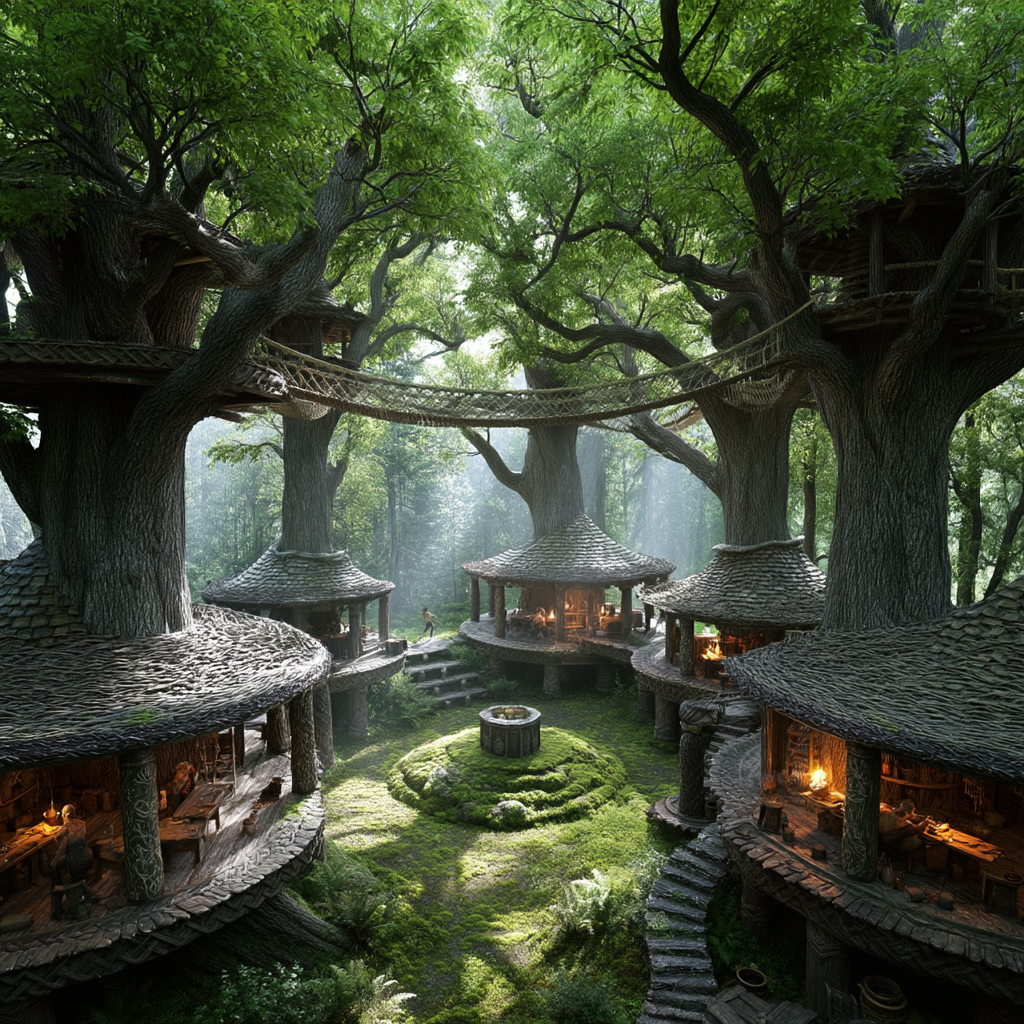
The Crafter's Circle is not a single building but rather a harmonious collection of structures woven seamlessly into a grove of seven massive oak trees. These ancient sentinels form a natural ring roughly two hundred feet across, their interlocking canopies creating a living roof that filters sunlight into dappled patterns across the forest floor. The trees themselves are unharmed, no nails pierce their bark, no saws bite their wood. Instead, the craftspeople of Elderwood Grove have learned to work with the trees' natural growth, guiding branches through patient pruning and gentle persuasion to create the framework their structures need.
At ground level, the space between the oaks is divided into seven workshop pavilions, each oriented to face the center of the circle. These open-air structures feature roofs of woven thatch supported by carved wooden pillars, with walls that can be opened completely during fair weather or enclosed with woven reed panels when wind or rain demands shelter. Each pavilion is dedicated to a particular craft tradition, woodcarving, barkweaving, herbalism, stonework, pottery, bowcraft, and leatherworking, though the assignments rotate seasonally to prevent any single guild from claiming permanent ownership of the best-positioned space.
The central clearing serves as the Circle's communal heart. Here, a flat expanse of moss-covered stone provides seating for gatherings of up to one hundred craftspeople. When the full Circle convenes, masters sit in the inner ring, journeymen in the middle, and apprentices along the outer edge, a physical representation of skill and experience that reinforces the traditional hierarchy without spoken word. A low altar of stacked river stones marks the exact center, where offerings of first fruits, perfect specimens of craftsmanship, or simple flowers are left to honor the forest that provides the materials for their work.
Above the ground-level workshops, the oak branches support a network of elevated platforms connected by rope bridges and wooden walkways. These canopy spaces serve multiple purposes: private meeting rooms where guild masters can discuss sensitive matters, quiet studies for preserving written knowledge of craft techniques, and secure storage for valuable tools and rare materials. One platform, built into the highest branches of the largest oak, functions as the Master's Platform, a ceremonial space where journeymen undergo their final examinations before advancement, witnessed only by the forest and their examining masters.
Each workshop pavilion is equipped according to its craft's needs. The woodcarving space features sturdy workbenches with built-in vises, racks of chisels and planes organized by size, and a collection of seasoned wood samples representing every tree species in the forest. The herbalist's pavilion includes drying racks suspended from the rafters, stone mortars and pestles of varying sizes, and clay storage jars labeled in the flowing script of the forest folk. The bowcraft pavilion maintains a selection of cured staves, sinew for strings, and finishing oils, while the stonework pavilion displays examples of carved meditation stones and architectural elements.
Between the workshop pavilions, smaller ancillary structures provide support services. A communal tool repair station ensures that chisels stay sharp and saw teeth remain true. A materials exchange allows craftspeople to trade surplus materials, excess bark for needed sinew, spare clay for additional herbs. A small library built into a hollow at the base of one oak houses bark scrolls and bound volumes recording guild histories, apprenticeship curricula, and masterwork specifications.
The Circle includes a demonstration area where master craftspeople can display their techniques to groups of learners. This space features good sightlines from multiple angles and allows for hands-on participation, encouraging the oral tradition of knowledge transfer that forest folk prefer over written instruction. Seasonal festivals bring the entire settlement to witness demonstrations of particularly impressive craftsmanship or the unveiling of collaborative masterworks.
Security within the Circle relies more on community awareness than physical barriers. The open design makes theft difficult, as any suspicious activity is visible to multiple workshops simultaneously. Valuable items are stored in the elevated platforms, accessible only by those willing to navigate the canopy walkways, a feat requiring both skill and familiarity with the forest's vertical geography. A rotating watch of senior apprentices ensures someone is always present during the night hours, though theft is rare in a community where reputation matters more than wealth.
Benefits
The Crafter's Circle generates 200 gold per month from guild membership contributions, material sales, and commissioned masterworks. Craftspeople working within the Circle's workshops gain a +2 circumstance bonus on their primary Craft checks, as the quality of tools, abundance of materials, and presence of peer expertise elevates the standard of work. The Circle's reputation attracts skilled artisans seeking to learn forest craft traditions, increasing the likelihood that specialized services or custom work can be commissioned within the settlement. This monument to sustainable craftsmanship generates 7 Prestige for Elderwood Grove.