Description
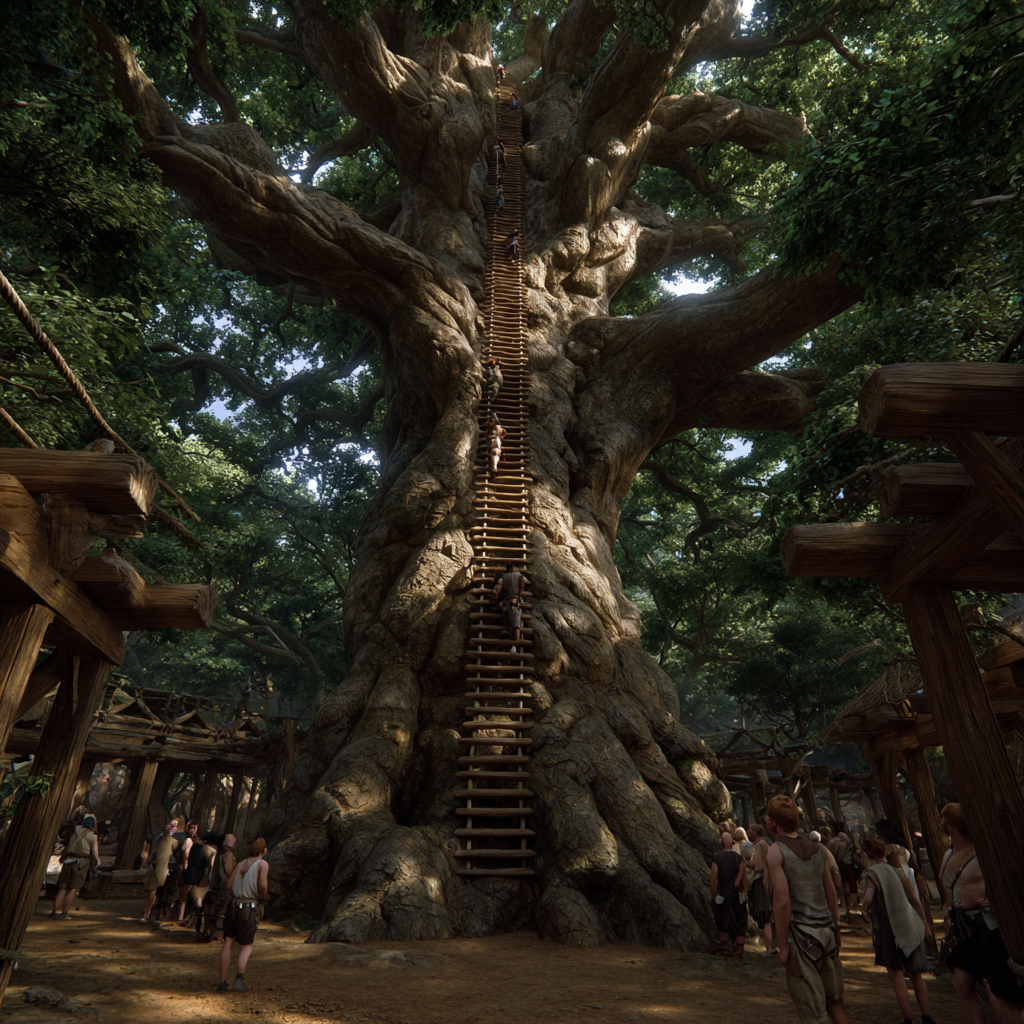
The Climbing Tree is an ancient oak that stands ninety feet tall near the Forest Floor Commons, selected for its exceptional characteristics that make it ideal for instruction. The tree features unusually regular branch spacing that creates natural ladder-like progression up its trunk, with sturdy limbs emerging at convenient intervals from ten feet off the ground all the way to the crown. The bark texture provides excellent grip without being rough enough to scrape skin badly, and the trunk diameter remains substantial throughout its height, never narrowing to the point where climbers might feel unstable. Druids worked with the tree over several months, encouraging specific branch development and pruning away any dead or weak limbs that might pose hazards. The dimensional magic of the grove accelerated this shaping process while strengthening the tree's overall structure, making it virtually impossible to damage through heavy use. The result is a living climbing wall that offers dozens of different routes to the top, each presenting unique challenges and requiring different techniques to navigate successfully.
The tree's surface has been carefully marked with a color-coding system that guides climbers toward routes appropriate to their skill level. Beginner routes marked with green paint on branch bases follow the easiest paths, with closely spaced handholds and footholds that allow even nervous first-timers to ascend safely while building confidence. Intermediate routes marked in blue require longer reaches between holds and incorporate some overhanging sections that demand stronger grip and basic technique. Advanced routes marked in red challenge experienced climbers with difficult sequences, requiring them to use less obvious holds, plan their movements several steps ahead, and employ sophisticated techniques like heel hooks and dynamic movements. Expert routes marked in black test even master climbers, featuring sections that seem nearly impossible until the correct sequence of tiny holds and precise weight shifts reveals itself. Instructors can direct students to routes matching their current abilities while providing clear progression paths toward more challenging climbs.
Safety infrastructure surrounds the tree at multiple levels, ensuring that even failed attempts result in nothing more serious than bruised pride. The ground beneath features a deep cushion of wood chips mixed with soft pine needles, extending twenty feet out in all directions and providing excellent impact absorption for lower falls. Heavy hemp rope netting hangs between the tree and four surrounding support poles at the fifteen-foot level, creating a catching platform that prevents dangerous falls from the lower third of the tree. Above that height, climbing ropes secured to massive branches and threaded through permanent anchor points allow instructors to belay students, controlling their descent if they slip or lose nerve. Leather climbing harnesses in various sizes hang from pegs on a nearby equipment tree, available for anyone who wants the security of being roped during their ascent. A warning bell suspended from a lower branch can be rung to alert ground-level instructors if someone above needs assistance or feels panicked and unable to proceed.
Instruction follows a carefully structured curriculum developed by the settlement's most experienced rangers and tree-dwelling residents. Beginners start by learning proper three-point contact technique, where at least three limbs maintain secure holds at all times, creating stable triangles of support. They practice reading the tree, identifying which branches will bear weight and which are too thin or positioned awkwardly. Balance exercises teach them to trust their feet rather than relying entirely on arm strength, which leads to exhaustion. As students progress, they learn more advanced techniques like stemming between two branches, using knee locks to rest during long climbs, and the all-important skill of controlled descent, which proves more challenging than ascending. Classes typically run for an hour and limit themselves to six students per instructor, ensuring everyone receives individual attention and immediate correction of dangerous habits before they become ingrained.
Beyond formal instruction, the Climbing Tree serves as a community gathering point where climbers of all levels come to practice, challenge themselves, and socialize. Early mornings see serious practitioners working on difficult routes, their faces set in concentration as they work through challenging sequences. Midday brings children and their parents, the youngsters scrambling up green routes with natural fearlessness while adults follow more cautiously. Evenings feature friendly competitions where climbers race to see who can reach specific branches fastest, or who can ascend using the fewest handholds. The tree becomes a source of community pride as residents track their progress from tentative beginners who can barely manage the first branch to confident climbers who can reach the crown and look out over the entire grove. For many, the day they first touch the highest branch marks a rite of passage, proving they have mastered an essential skill and earned their place among the canopy dwellers.
Benefits
The Climbing Tree provides essential training that transforms ground-dwelling settlers into confident canopy navigators. The facility generates no direct income but provides immeasurable value through skill development and safety. Any character who trains at the Climbing Tree for at least 2 hours per week gains a +2 bonus to all Climb checks within Elderwood Grove as they learn the specific techniques needed for tree navigation. This upgrade generates 3 Prestige.