Description
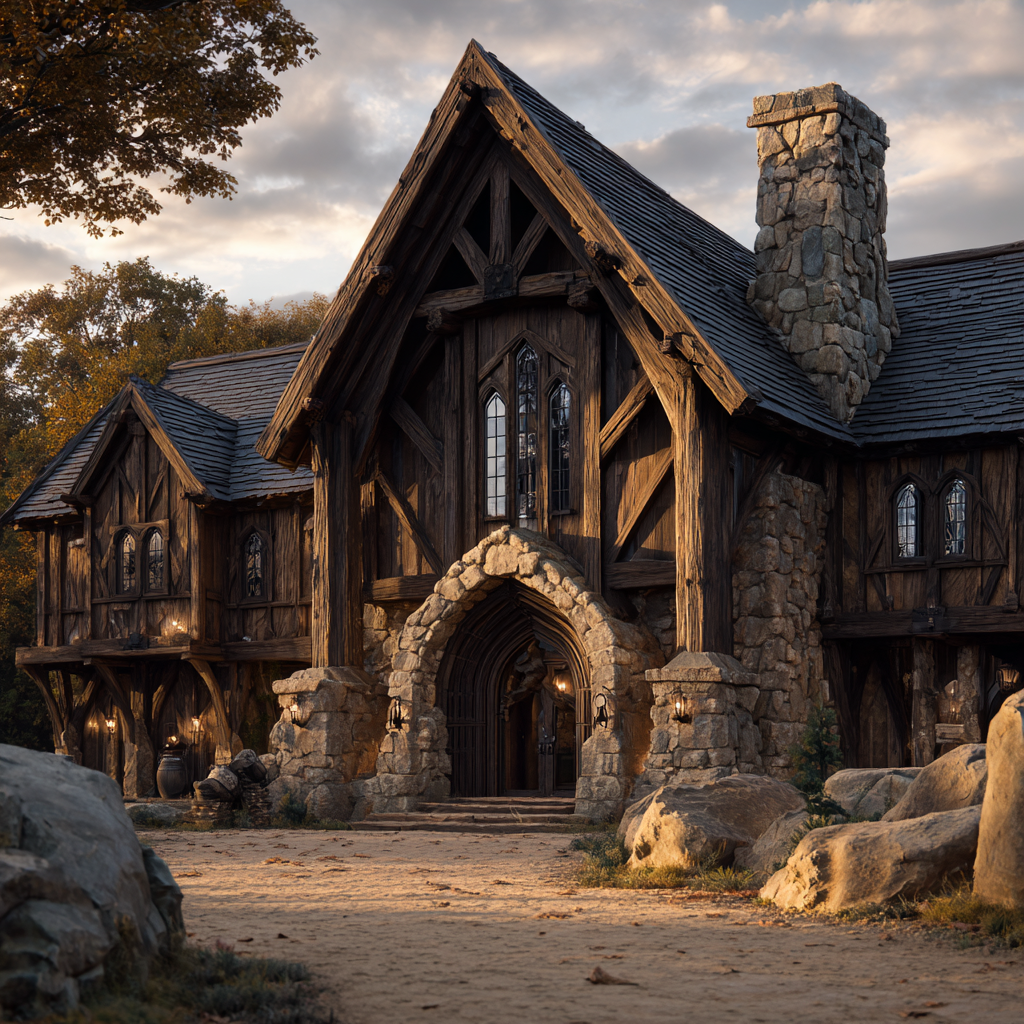
The Beastmaster Lodge occupies a central location within the Elderwood Grove, positioned strategically between the various animal facilities it coordinates and supports. The main structure is a handsome two-story building constructed from massive timber beams and fitted stones, its architecture blending rustic strength with careful craftsmanship. The lower floor houses a great hall that serves as meeting space, dining area, and communal gathering point for handlers from all the settlement's animal facilities. One wall is dominated by a massive stone fireplace whose warmth makes the space welcoming even during winter's deepest cold, while the opposite wall features floor-to-ceiling shelves holding an extensive library of texts on animal husbandry, training techniques, veterinary medicine, and natural history. Hand-drawn anatomical charts, behavioral observation notes, and breeding records cover much of the remaining wall space, creating a visual encyclopedia of the settlement's collected knowledge about working with animals. Long wooden tables fill the center of the hall, their surfaces scarred by years of use, surrounded by benches where handlers gather for meals, planning sessions, and the informal knowledge-sharing that happens when experienced practitioners swap stories and techniques. The upper floor contains private quarters for the resident beastmasters, master trainers who have dedicated their lives to understanding animal behavior and teaching others the arts of partnership. Each room is modest but comfortable, with a bed, writing desk, storage chest, and large windows overlooking different sections of the grove, allowing the masters to observe animal facilities even during their private hours.
Surrounding the main lodge, a complex of specialized training grounds and support facilities creates a comprehensive campus for animal education. A large outdoor arena with raked sand footing provides space for training exercises with horses, wolves, and other ground-based animals, its perimeter lined with seating where students can observe demonstration sessions. A smaller enclosed courtyard with high walls serves as a controlled environment for introducing animals to novel stimuli, urban sounds, and other challenges they might encounter beyond the grove's borders. A series of obstacle courses of varying difficulty test and develop agility, courage, and problem-solving abilities in different species, from simple pole-weaving exercises for young foxes to complex climbing structures for training raptors to navigate challenging terrain. A medical building houses examination tables, surgical equipment, and stores of veterinary supplies, staffed by healers who specialize in animal medicine and teach students to recognize and treat common ailments and injuries. Several smaller workshop buildings contain specialized equipment for different training disciplines: perches and flight chambers for raptor work, grooming stations for equine care, and quiet rooms designed for the patient socialization of nervous or traumatized animals. An outdoor amphitheater carved into a natural hillside provides seating for formal lectures and demonstrations, its excellent acoustics allowing instructors to address large groups without shouting. Throughout the complex, carefully maintained trails connect the various facilities, their surfaces suitable for leading animals between areas while providing exercise and exposure to changing environments.
The dimensional acceleration of the Elderwood Grove transforms the Beastmaster Lodge from a simple training facility into an institution of remarkable efficiency and depth. Apprentices who would normally require five to ten years to master animal handling skills can complete comprehensive training in just one to two years, absorbing techniques, developing instincts, and accumulating practical experience at five times the normal rate. This compression allows for intensive, immersive education where students work with animals daily, observing behaviors, practicing techniques, and receiving immediate feedback from master trainers who can identify and correct mistakes before they become ingrained habits. The accelerated learning doesn't sacrifice depth for speed but rather allows students to experience more situations, work with more individual animals, and accumulate the practical wisdom that normally comes only with decades of patient work. Master beastmasters find they can take on more apprentices without diluting the quality of instruction, as the compressed timelines mean cohorts graduate and new students arrive in rapid succession. The lodge's library grows quickly, with handlers documenting observations and developing new techniques at a pace that would be impossible outside the grove. Most remarkably, animals trained at facilities coordinated by the lodge seem to benefit from the accumulated expertise, as handlers share successful techniques across disciplines, creating a culture of continuous improvement where breakthroughs in raptor training inform approaches to equine work, and insights about fox behavior enhance wolf handling methods.
The philosophy taught at the Beastmaster Lodge forms the ethical and practical foundation for all animal work in the settlement. The core principle, repeated in every lesson and demonstrated in every action, holds that animals are partners to be respected rather than tools to be exploited. Students learn that effective training begins with understanding an animal's natural behavior, instincts, and needs, then shaping human requests to work with these inherent qualities rather than against them. Force and punishment are revealed as the tools of ignorance, producing fearful compliance rather than genuine cooperation, while patience, consistency, and positive reinforcement build trust that creates willing partners. The curriculum emphasizes reading animal body language, recognizing subtle signals of stress, discomfort, fear, or confusion, and adjusting approaches to keep animals below threshold levels where learning can occur. Students study not just training techniques but animal cognition, learning about the different ways various species think, remember, and problem-solve. The ethical dimensions of keeping, breeding, and working with animals receive extensive attention, with frank discussions about the responsibilities humans accept when they bring animals into partnership, the moral weight of managing life and death, and the sacred duty to ensure that animals in human care live better lives than they would in the wild. Graduates of the lodge's programs emerge not just as skilled handlers but as thoughtful practitioners who understand their work carries spiritual and ethical dimensions that transcend mere utility.
Beyond training, the Beastmaster Lodge serves as a vital coordination hub that ensures the settlement's various animal facilities operate in harmony rather than isolation. Regular meetings bring together handlers from the mewsery, wolfden, paddock, owlery, rookery, and stables to share observations, coordinate schedules, and address common challenges. The lodge maintains centralized records of all animals in the settlement's care, tracking lineages, health histories, training progress, and placement with residents. When problems arise, whether behavioral issues, disease outbreaks, or facility maintenance needs, the lodge's resources and expertise can be mobilized quickly to provide solutions. The medical staff treat animals from all facilities, ensuring consistent quality care and building comprehensive knowledge about species-specific health needs. The library serves as a repository where handlers document successful techniques, failed experiments, and accumulated wisdom, creating an institutional memory that prevents knowledge from being lost when individual practitioners retire or pass away. The lodge also manages the careful process of matching animals with potential handlers or purchasers, ensuring that partnerships are appropriate, that animals go to situations where they'll thrive, and that the settlement's reputation for producing well-trained, healthy animals remains sterling. Research initiatives explore new training methods, study animal cognition, and develop improved approaches to nutrition, health care, and facility design. Visiting experts from other settlements present lectures and demonstrations, while the lodge's own masters occasionally travel to share their knowledge, building networks of collaboration that advance animal husbandry practices far beyond the Elderwood Grove's borders. In these many ways, the lodge transforms scattered animal facilities into a coordinated system, elevates individual handler skills into collective expertise, and ensures that the settlement's approach to animal partnership remains both effective and ethical across all species and applications.
Benefits
The Beastmaster Lodge allows all Handle Animal checks made by residents of the settlement receive a +1 competence bonus permanently while within city borders. The lodge's coordination of animal facilities increases overall efficiency, generating an economic benefit of 200 gold per month through improved breeding programs, reduced animal losses, and optimized placement of trained animals. The medical facilities reduce animal mortality and enable faster recovery from injuries across all facilities. The lodge can train specialized handlers in rare skills such as exotic creature management, magical beast comprehension, or advanced veterinary techniques (requiring 6-8 months of study). Graduates of the advanced program gain the ability to use Wild Empathy as a druid of half their character level, even if they don't possess that class feature normally. The presence of the lodge attracts talented handlers and beast experts to the settlement, occasionally bringing rare animals or unique training knowledge. This upgrade generates 9 Prestige, reflecting the settlement's reputation as a center of excellence for ethical and effective animal partnership.